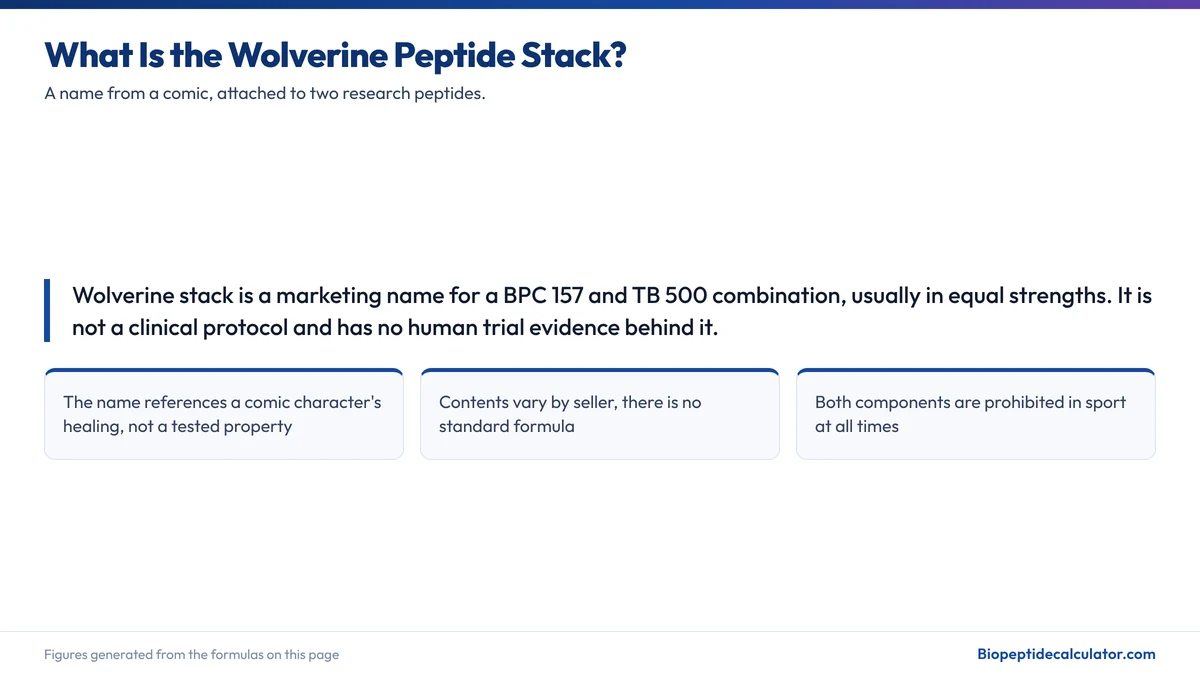
- The name references a comic character’s healing, not a tested property
- Contents vary by seller, there is no standard formula
- Both components are prohibited in sport at all times
The name tells you what the product is reaching for. It tells you nothing about whether it gets there.
What the name refers to
A combination of BPC 157 and TB 500, sold together and marketed for recovery and tissue repair.
That is the whole definition. There is no governing body that defines it, no standard ratio, and no protocol it derives from.
Where the name came from
From the comic book character with an accelerated healing ability.
Worth sitting with for a second. The name is an aspiration borrowed from fiction, applied to two compounds that have never been tested in a human trial. That is not a reason to dismiss the compounds, and it is a reason to treat the name as the marketing it is.
What is usually in it
Some sellers add a third compound and keep the name. There is no formula to deviate from, so check what is actually in the vial rather than assuming.
Compounds that turn up in vials sold under this name include GHK-Cu, thymosin alpha-1 and KPV. None of that is standardized, which is the practical point. Two products with the same name on the label can contain different things in different ratios, so the name on the box is not a specification.
The evidence position
No published human clinical trial has tested BPC 157 and TB 500 together. Neither compound has published human trials individually, so a combination has no human evidence of any kind behind it.
Nothing in humans. Not for the combination, and not for either component on its own.
What exists instead is preclinical work on each compound separately, largely in rodents, plus a large volume of user reports. User reports are self-selected, have no comparison group and no denominator, and recovery from a soft tissue injury happens over weeks anyway, which makes attribution close to impossible from the inside.
How it is sold
Two formats, and the difference matters more than the name does.
Dosing math for the usual pairing
For a blend listing 5 mg of each, reconstituted with 3 mL, every draw delivers both in equal amounts.
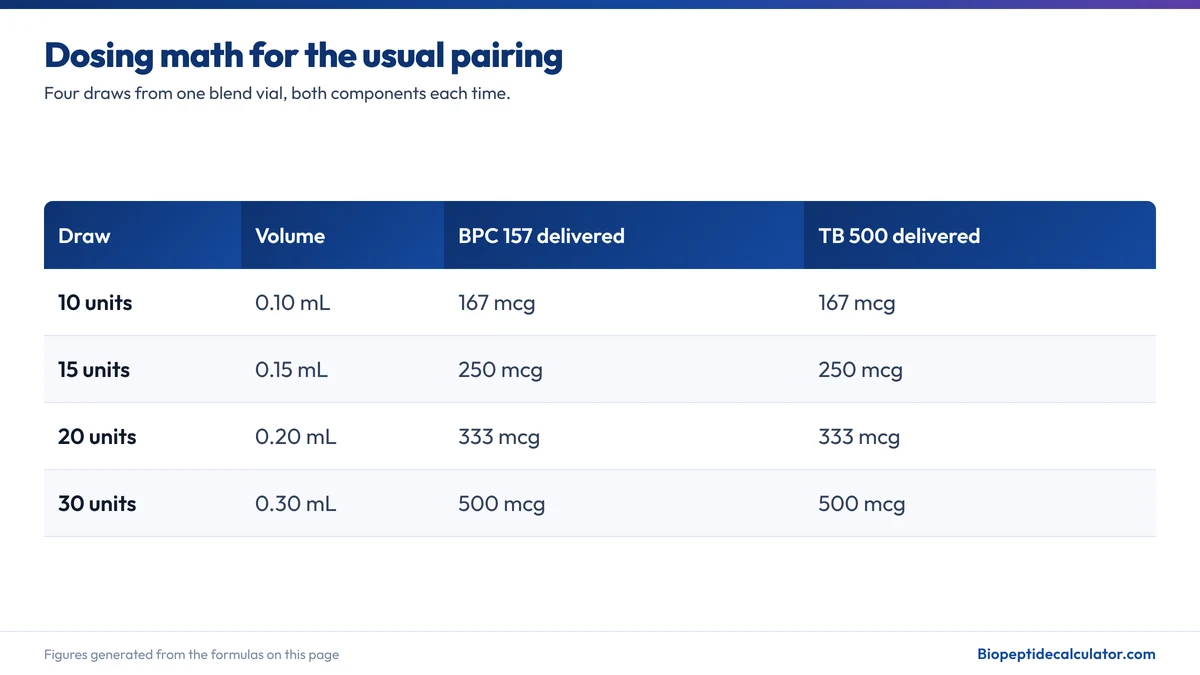
Run your own vial through the peptide reconstitution calculator, because the strengths and the water volume both change every number above.
One point worth drawing out of that table. Because both components share the same water, you cannot change one dose without changing the other. Doubling your BPC 157 doubles your TB 500, whether or not that is what you intended. A blend decides that for you at the point of manufacture.
How it differs from running the two separately
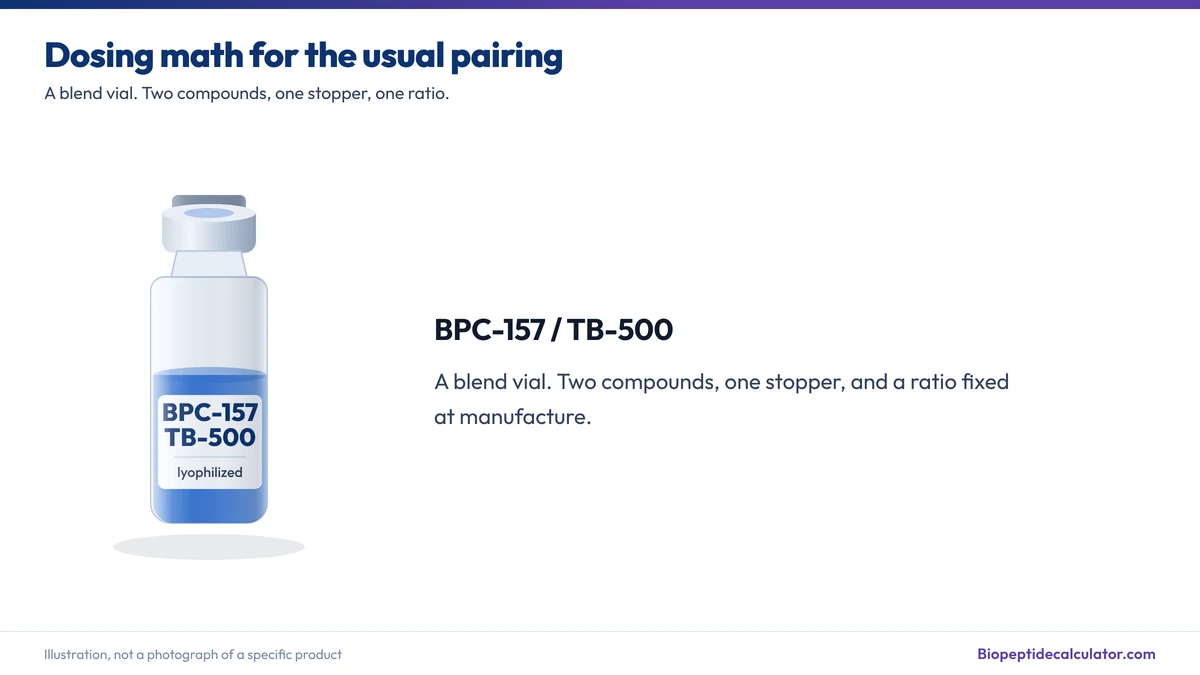
Same compounds. Different amount of control.
Anti-doping and regulatory status
Both compounds are named on the World Anti-Doping Agency 2026 Prohibited List, and both are prohibited at all times rather than in competition only. They sit in different sections: BPC 157 is named under S0, non-approved substances, while TB 500 is named under S2.3, growth factors and growth factor modulators, as Thymosin-beta4 and its derivatives e.g. TB-500.
On the regulatory side, both components were removed from FDA Category 2 in April 2026 and both are named in the October 2026 draft HHS enforcement discretion policy. None of these 2026 actions approved any peptide. Enforcement discretion is a statement about what a regulator intends to prioritize, not a finding that a substance is safe or effective.
Frequently asked questions
What is the Wolverine peptide stack?
Wolverine stack is an informal marketing name for a combination of BPC 157 and TB 500, sold on the basis of accelerated tissue repair. It is not a clinical protocol and the name has no official standing.
What peptides are in the Wolverine stack?
BPC 157 and TB 500, usually in equal strengths. Some sellers add other compounds, so the contents vary by vendor rather than following a standard formula.
Does the Wolverine stack work?
No published human clinical trial has tested it. Neither component has published human trials individually either, so there is no human evidence for the combination.
Why is it called the Wolverine stack?
It is a reference to the comic book character known for rapid healing. The name is marketing, chosen for what it implies about recovery speed rather than describing any tested property.
Is the Wolverine stack legal?
Neither component is an approved drug. Both were removed from FDA Category 2 in April 2026 and named in a draft HHS enforcement discretion policy in October 2026, neither of which is approval. Both are prohibited in sport at all times.
Run your own vial and dose through the peptide calculator.
Sources & Scientific References
The science on this page traces to the peer-reviewed and reference sources below. We link only to research and reference material.
Peer-Reviewed Research
- Jozwiak M, et al. Multifunctionality and Possible Medical Application of the BPC 157 Peptide: Literature and Patent Review. Pharmaceuticals, 2025;18:185 (PMC). – the current review of what BPC 157 research does and does not show
Reference & Regulatory
- World Anti-Doping Agency: The 2026 Prohibited List, in force January 1 to December 31, 2026. – the official list, which names BPC 157 under S0 and TB 500 under S2.3
- Federal Register: Enforcement Discretion Policy Regarding 503A Compounding Using Certain Peptide Bulk Drug Substances. HHS, 91 FR, October 30, 2026. Docket HHS-OASH-2026-0496. – the official notice of the draft enforcement discretion policy, which states that compounded drugs are not FDA-approved
More at Bio Peptide Calculator
- BPC 157 and TB 500 together – the evidence and the dosing math in full
- What is BPC 157 peptide – the first component on its own
- Peptide reconstitution calculator – work out units for a blend vial