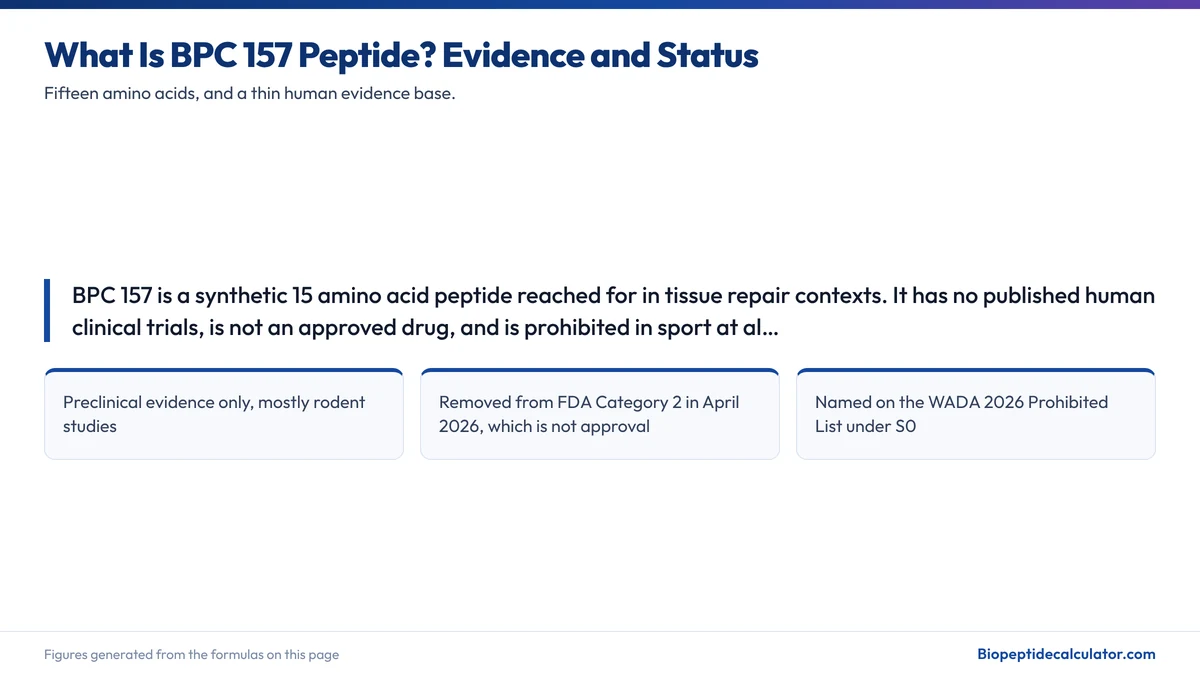
- Preclinical evidence only, mostly rodent studies
- Removed from FDA Category 2 in April 2026, which is not approval
- Named on the WADA 2026 Prohibited List under S0
Few compounds have this gap between how confidently it is discussed and how little human evidence sits behind it. Both halves of that are worth stating plainly.
What BPC 157 is
BPC 157 is a synthetic 15 amino acid peptide, described as a partial sequence of a protein found in human gastric juice. The name stands for body protection compound.
BPC 157 is not an approved drug anywhere, and is not a dietary supplement ingredient.
Where the name comes from
Body protection compound, candidate 157.
The naming is a research code rather than a description of proven function. A compound called body protection compound has not thereby been shown to protect anything, in the same way that a drug code number carries no claim.
What the research actually consists of
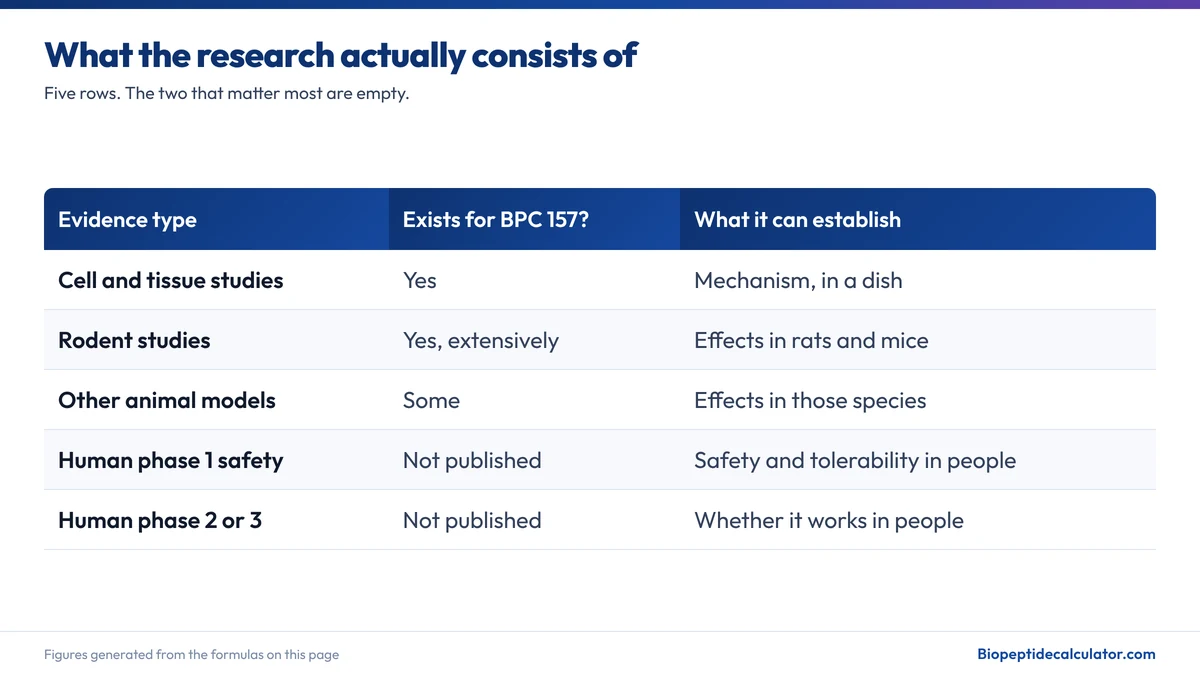
BPC 157 has not been through published human clinical trials. The evidence base is preclinical, overwhelmingly rodent studies.
What it is claimed to do
Claims cluster around tendon and ligament repair, muscle injury, gut healing and inflammatory bowel conditions, and protection against gastric damage.
Those claims trace back to the preclinical literature, where effects have been reported in animal models across several tissue types. The honest translation is that something interesting happens in rats, and nobody has published what happens in people.
Oral, injected and the absorption question
Most peptides cannot be taken orally because digestion destroys them. BPC 157 is sold in oral form on the argument that a peptide derived from gastric juice should tolerate the gut.
Plausible. Unproven.
Regulatory status after 2026
BPC 157 sat at the center of the 2026 regulatory changes, and the reporting around it has been poor in both directions.
On April 15, 2026 the FDA announced its intent to remove twelve peptide bulk drug substances from Category 2 of the 503A bulks list review, among them BPC 157, TB 500, Epitalon, KPV, MOTS-c, Semax and Melanotan II.
At the Pharmacy Compounding Advisory Committee meeting held on July 23 and 24, 2026, the committee voted to recommend six of seven peptides for the 503A bulks list. BPC 157 passed 8 votes to 6 with one abstention.
On October 30, 2026 the Department of Health and Human Services published a notice of availability for a draft enforcement discretion policy covering 503A compounding with six peptide bulk drug substances: BPC 157, Epitalon, KPV, MOTS-c, Semax and TB 500. The comment period, under docket HHS-OASH-2026-0496, closed on November 13, 2026.
The Federal Register notice states plainly that compounded drugs are not FDA-approved, which means FDA does not review their safety, effectiveness, or quality before they are marketed.
Anti-doping status
Both compounds are named on the World Anti-Doping Agency 2026 Prohibited List, and both are prohibited at all times rather than in competition only. They sit in different sections: BPC 157 is named under S0, non-approved substances, while TB 500 is named under S2.3, growth factors and growth factor modulators, as Thymosin-beta4 and its derivatives e.g. TB-500.
Prohibited at all times means there is no permitted out of competition window. For a tested athlete this is straightforward and there is no ambiguity about it.
Reconstitution math for a BPC 157 vial
BPC 157 vials are commonly 5 mg or 10 mg, and protocols are usually written in micrograms, which is where the arithmetic errors come from.
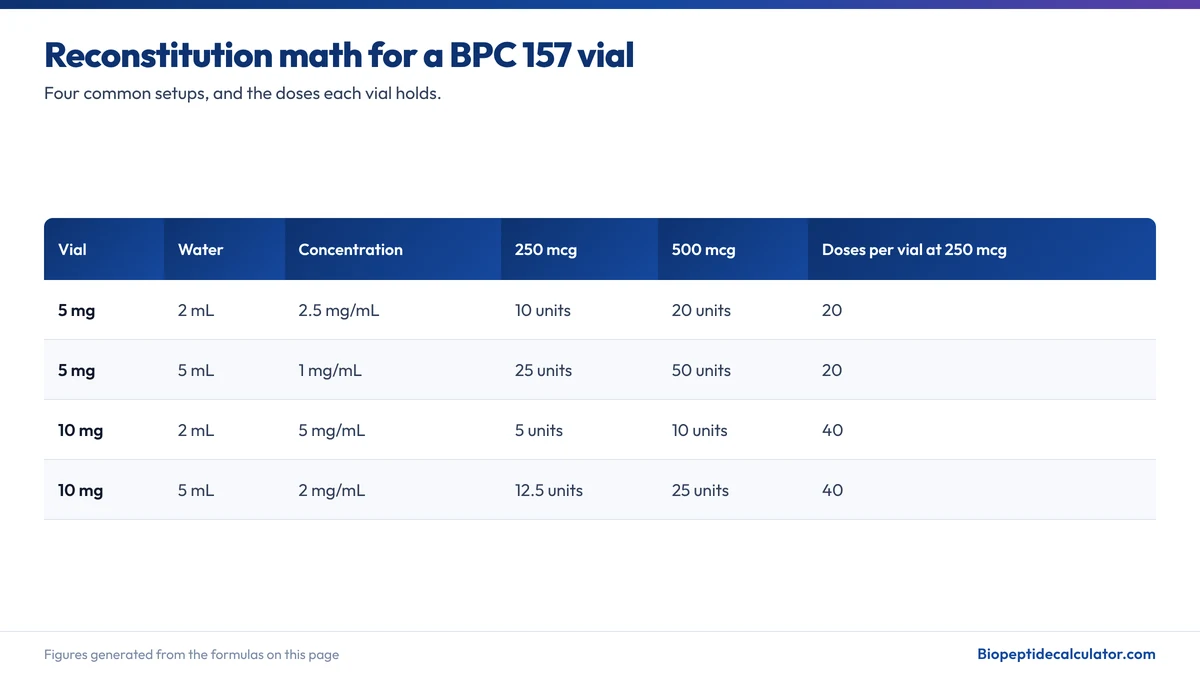
Notice the right-hand column does not change with water volume. Doses per vial equals vial strength divided by dose size, and the volume of water added does not change that number.
Frequently asked questions
What is BPC 157 peptide?
BPC 157 is a synthetic 15 amino acid peptide described as a partial sequence of a protein found in human gastric juice. The name stands for body protection compound. It is not an approved drug anywhere and has no published human clinical trials.
Does BPC 157 have human clinical trials?
No. BPC 157 has not been through published human clinical trials. Its evidence base is preclinical and overwhelmingly consists of rodent studies.
Is BPC 157 legal in 2026?
It is not approved. In April 2026 it was removed from FDA Category 2, in July 2026 an advisory committee recommended it for the 503A bulks list by 8 votes to 6, and in October 2026 it was named in a draft HHS enforcement discretion policy. None of those is approval, and it was not on the bulks list as of November 2026.
Is BPC 157 banned in sport?
Yes. BPC 157 is named on the World Anti-Doping Agency 2026 Prohibited List under S0, non-approved substances, and is prohibited at all times rather than in competition only.
What is BPC 157 used for?
It is reached for mainly in the context of tendon, ligament, muscle and gut healing. Those uses come from preclinical research and user reports, not from human trials.
Is oral BPC 157 effective?
Oral forms are sold on the basis that the compound derives from gastric juice and might therefore survive the gut. Whether a meaningful amount reaches circulation in humans has not been established in published human studies.
Run your own vial and dose through the peptide calculator.
Sources & Scientific References
The science on this page traces to the peer-reviewed and reference sources below. We link only to research and reference material.
Peer-Reviewed Research
- Jozwiak M, et al. Multifunctionality and Possible Medical Application of the BPC 157 Peptide: Literature and Patent Review. Pharmaceuticals, 2025;18:185 (PMC). – the current review of what BPC 157 research does and does not show
- Sikiric P, et al. Reply on BPC 157 therapy, angiogenesis and nitric oxide. Pharmaceuticals (PMC). – the exchange between research groups on mechanism
Reference & Regulatory
- Federal Register: Enforcement Discretion Policy Regarding 503A Compounding Using Certain Peptide Bulk Drug Substances. HHS, 91 FR, October 30, 2026. Docket HHS-OASH-2026-0496. – the official notice of the draft enforcement discretion policy, which states that compounded drugs are not FDA-approved
- McDermott Will & Schulte: PCAC backs majority of peptides in two-day public meeting, July 2026. – the recorded vote counts from the July 23 to 24, 2026 advisory committee meeting
- World Anti-Doping Agency: The 2026 Prohibited List, in force January 1 to December 31, 2026. – the official list, which names BPC 157 under S0 and TB 500 under S2.3
More at Bio Peptide Calculator
- FDA status of research peptides – what the 2026 actions actually did
- Peptide reconstitution calculator – run your own vial through it
- BPC 157 and TB 500 together – the combination, and what evidence exists for it