
This ipamorelin dosage chart shows the common research dosing for ipamorelin on its own and the cjc-1295 ipamorelin dosage when the two are stacked, with exact syringe units for each vial size. Ipamorelin is a research peptide, not FDA-approved; the figures below reflect community-reported protocols, not medical guidance.
Educational information only. Ipamorelin and CJC-1295 are sold as research chemicals and are not FDA-approved for human use. Nothing here is medical advice or a dosing recommendation. Doses shown are community-reported research protocols, not clinically validated regimens.
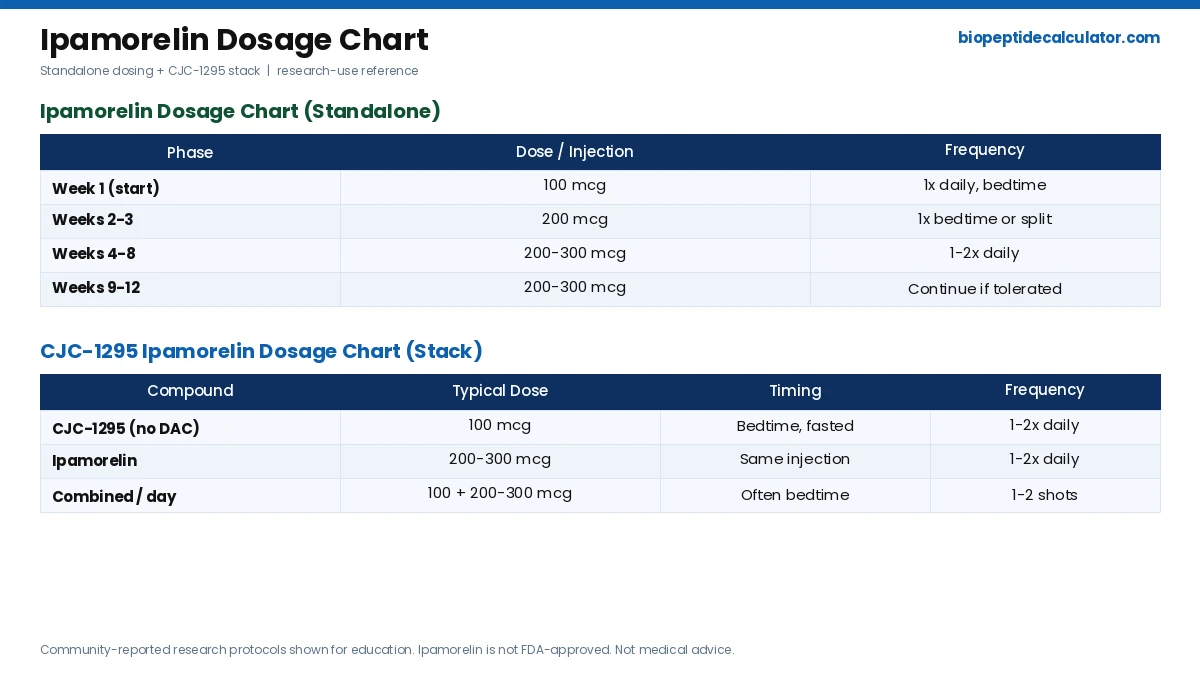
Ipamorelin Dosage Chart (Standalone)
This ipamorelin dosage chart summarizes the dosing structure most often cited in research-community protocols. Ipamorelin is dosed in micrograms (mcg), injected subcutaneously, and most protocols build gradually from a low starting dose. There is no FDA-approved ipamorelin dose, so this is a comparison reference only.
| Phase | Timing | Dose Per Injection | Frequency |
|---|---|---|---|
| Starting | Week 1 | 100 mcg | 1x daily, bedtime, fasted |
| Titration | Weeks 2–3 | 200 mcg | 1x bedtime, or split AM + PM |
| Standard | Weeks 4–8 | 200–300 mcg | 1–2x daily |
| Extended | Weeks 9–12 | 200–300 mcg | Continue if tolerated |
| Off-cycle | 4 weeks | 0 mcg | Rest before next cycle |
Most protocols cap a single injection around 300 mcg, because GH release flattens beyond that point. Timing is usually on an empty stomach (food blunts the GH pulse), and bedtime is the most common single dose. This schedule is community-derived and not from clinical trials.
CJC-1295 Ipamorelin Dosage Chart (Stack)
Ipamorelin is most often stacked with CJC-1295 because the two hit different receptors — ipamorelin the ghrelin receptor, CJC-1295 the GHRH receptor — producing a bigger, cleaner growth-hormone pulse together than either alone. This cjc-1295 ipamorelin dosage chart shows the most commonly cited stack protocol. The cjc-1295 ipamorelin dosage per day is typically a single combined bedtime injection.
| Compound | Typical Dose | Timing | Frequency |
|---|---|---|---|
| CJC-1295 (no DAC) | 100 mcg | Bedtime, fasted | 1–2x daily |
| Ipamorelin | 200–300 mcg | Same injection | 1–2x daily |
| Combined per day | 100 mcg + 200–300 mcg | Often bedtime | 1–2 combined shots |
For cjc-1295 ipamorelin bodybuilding dosage, community protocols sometimes run the higher end (300 mcg ipamorelin, 100 mcg CJC-1295, twice daily) during an 8–12 week cycle, always with an off-period afterward. The two are commonly drawn into one syringe and injected together. These are unverified community protocols, not medical advice.
Ipamorelin Units by Vial Size (Reconstitution Chart)
Ipamorelin ships as a freeze-dried powder that you reconstitute with bacteriostatic water. The vial size and the water you add set the concentration, which determines the units to draw on a U-100 insulin syringe. This chart shows the units for a 200 mcg dose at common setups. For any other combination, use the ipamorelin dosage calculator.
| Vial Size | BAC Water | Concentration | 100 mcg | 200 mcg | 300 mcg |
|---|---|---|---|---|---|
| 2 mg | 1.0 mL | 2,000 mcg/mL | 5 units | 10 units | 15 units |
| 5 mg | 2.0 mL | 2,500 mcg/mL | 4 units | 8 units | 12 units |
| 10 mg | 3.0 mL | 3,333 mcg/mL | 3 units | 6 units | 9 units |
Units are for a U-100 insulin syringe (100 units = 1 mL); round to the nearest whole unit. A 30-unit (0.3 mL) syringe is easiest for these small draws. The same dose is a different number of units at each concentration, so always match your own vial.
Ipamorelin Dosage Per Day
There is no FDA-approved daily ipamorelin dose. The ipamorelin dosage per day in community protocols depends on the amount per injection and how many injections are used. Because ipamorelin has a short half-life of about two hours, each injection produces one clean growth-hormone pulse and then fades, which is why some protocols split the daily total into more than one shot.
| Per Injection | Frequency | Daily Total |
|---|---|---|
| 100 mcg | Once daily | 100 mcg/day |
| 100 mcg | Twice daily | 200 mcg/day |
| 200 mcg | Once daily | 200 mcg/day |
| 300 mcg | Twice daily | 600 mcg/day |
These are arithmetic examples from schedules discussed above, not dosing recommendations. Higher daily totals raise side-effect risk without necessarily raising the GH response, since the per-pulse effect flattens above ~300 mcg.
Disclaimer: No human trial has validated these schedules for growth-hormone optimization, body composition, or anti-aging. They are community-reported and not medical advice.
Ipamorelin Benefits and How It Works
Ipamorelin signals the pituitary gland to release the body’s own growth hormone in short, natural pulses. It binds the GHS-R1a receptor — the same receptor the hunger hormone ghrelin uses — and triggers a GH pulse that peaks around 30 to 40 minutes after injection. Most of that GH is then converted by the liver into IGF-1, the downstream signal behind tissue repair, fat metabolism, and muscle protein building.
What makes ipamorelin stand out among growth-hormone-releasing peptides is its selectivity. In the foundational research (Raun et al., 1998), ipamorelin raised GH without raising cortisol, ACTH, or prolactin, even at doses far above what is needed for a GH pulse. Its cousins GHRP-2 and GHRP-6 do raise those stress hormones. That clean profile is why ipamorelin is often the first-choice GHRP in research protocols. The benefits people research it for — better recovery, sleep quality, body composition, and skin — all flow from that pulsed GH and IGF-1 rise, though it is important to note these outcomes come from community reports, not controlled human trials.
Ipamorelin vs Tesamorelin vs Sermorelin
These three are often compared, but there is a key difference: ipamorelin works on the ghrelin (GHS-R1a) receptor, while tesamorelin and sermorelin are GHRH analogs that work on the GHRH receptor. That is precisely why ipamorelin is stacked with a GHRH analog rather than swapped for one. The table compares all three across the factors that matter.
| Ipamorelin | Tesamorelin | Sermorelin | |
|---|---|---|---|
| What it is | GHRP / ghrelin-receptor agonist (GHS-R1a) | GHRH analog (full 44-aa), FDA-approved (Egrifta) | GHRH analog (29-aa), closest to natural GHRH |
| Used for | GH pulse for recovery, sleep, body composition (research) | HIV-associated visceral fat (approved); GH research | GH support, anti-aging research; once a diagnostic |
| Typical dose | 100–300 mcg per shot, 1–3x/day | 2 mg once daily (approved) | 100–300 mcg once daily (often bedtime) |
| Half-life | ~2 hours | ~30–40 minutes | ~10–15 minutes |
| Advantages | Very selective; no cortisol/prolactin rise; stacks with GHRH analogs | Only FDA-approved GHRH analog; strong Phase 3 visceral-fat data | Most physiologically natural; long clinical history; compounding access with Rx |
| Side effects | Mild: headache, water retention, tingling, injection-site reactions | Injection-site reactions, joint pain, edema, possible glucose effects | Injection-site reactions, flushing, headache |
| Approx. cost/month | ~$40–80 (research) | $1,000+ (brand Egrifta); less compounded | ~$50–150 (compounded with Rx) |
| FDA status | Not approved | Approved (Egrifta) | Formerly approved (Geref, discontinued); compounded |
Costs are rough market estimates and vary widely. The biggest practical divide is evidence and legality: tesamorelin has real FDA approval and Phase 3 data, sermorelin has a long clinical pedigree and compounding access with a prescription, while ipamorelin remains a research compound. All are banned in sport.
Ipamorelin Side Effects and Safety
Ipamorelin’s side-effect profile is considered cleaner than most growth-hormone-releasing peptides, largely because it does not raise cortisol or prolactin. Most reported effects are mild and short-lived, but they still occur, especially at higher doses or early in a cycle.
Commonly reported (mild): a brief headache, light water retention or bloating, a mild increase in appetite, and tingling in the hands or feet, mostly at the start of a cycle. Injection-site redness or a small bump can also occur; rotating sites and using sterile technique reduces this.
With higher doses or longer use: mild joint stiffness, temporary fatigue, and carpal-tunnel-style symptoms linked to GH-related fluid retention. Because ipamorelin raises GH and IGF-1, there is a theoretical concern about promoting the growth of existing cancers, which is why anyone with active or recent cancer is advised to avoid it.
Who should avoid it: people with active or recent cancer, uncontrolled diabetes, severe heart disease, sleep apnea (which GH can worsen), and anyone pregnant, breastfeeding, or still growing. Competitive athletes should note that ipamorelin is banned by WADA. Because quality varies on the research market, a recent third-party Certificate of Analysis matters.
Disclaimer: This is not a complete list of risks. Ipamorelin has not been studied for long-term safety in the uses people pursue today. Only a qualified clinician can assess whether any risk applies to you.
Ipamorelin Cycling: On and Off Periods
Ipamorelin is generally cycled rather than run continuously. Community protocols most often describe 8 to 12 weeks on, followed by about 4 weeks off, with some clinician-guided protocols extending the on-period toward 16 weeks. The stated rationale for the off-period is to keep the pituitary and GH receptors responsive and avoid blunting the pulse over time. It is worth being honest that no clinical trial has validated these specific cycle lengths or shown that an off-period preserves responsiveness — this is accepted community practice, not proven science. If you stack with CJC-1295, the cycle is typically run and rested together.
What Do Users Say About Ipamorelin?
Read this as community sentiment, not evidence. The themes below summarize what recurs across peptide communities such as Reddit’s r/Peptides and bodybuilding forums. These are unverified personal reports from anonymous users, not clinical findings, and they often contradict each other. They are included so you understand the real-world conversation, not as anything to act on.
The “clean” profile is the most praised feature. The single most consistent thing users say about ipamorelin is that it feels clean compared with other GHRPs — little to no hunger spike, no obvious cortisol or “wired” feeling. People who tried GHRP-6 and switched almost always mention that ipamorelin lacks the intense hunger, and they treat that tolerability as its main selling point.
Deeper sleep is the most reported effect. Bedtime dosing and improved sleep quality come up again and again. Many users describe falling into deeper sleep and waking more rested within the first week or two, and this is often the effect they say convinces them it is “working,” even before any body-composition change. Skeptics counter that sleep improvements can be placebo or from simply having a consistent bedtime routine.
Most experienced users insist on the CJC-1295 stack. A strong consensus in the community is that ipamorelin alone is underwhelming and that pairing it with CJC-1295 (or another GHRH analog) is what makes the protocol worthwhile. The common framing is “a GHRP needs a GHRH partner to get a real pulse.” Solo-ipamorelin disappointment posts are usually met with “add CJC.”
The fasting window is the top practical tip. Veterans repeatedly stress dosing on an empty stomach — roughly two hours after eating and 20–30 minutes before the next meal — because insulin from food blunts the GH pulse. Newer users who report “no results” are often told their food timing, not their dose, is the problem.
Expectations get managed down. Experienced posters routinely push back on beginners expecting dramatic muscle gain, framing ipamorelin as a subtle recovery, sleep, and well-being tool rather than a mass builder. The recurring message is that it supports a good training and nutrition base rather than replacing it, and that anyone chasing steroid-like results will be disappointed.
Product quality is a constant worry. Because ipamorelin is sold on the research-chemical market, a major recurring theme is doubt about whether a vial is real, correctly dosed, and uncontaminated. Community veterans obsess over third-party testing and reconstitution accuracy, and many argue a large share of “it didn’t do anything” reports are really under-dosed or degraded product rather than a failure of the peptide itself.
For the live conversation, the most active hub is Reddit’s r/Peptides community, and broader performance discussion appears on the r/PEDs community. Reading recent threads there gives a more current, unfiltered picture than any single summary — including this one.
Disclaimer: Community reports are anecdotal, unverifiable, and often influenced by other compounds users are taking at the same time. They are not a substitute for medical evidence or professional guidance.
Need exact syringe units for your vial? The ipamorelin dosage calculator converts any vial size, bacteriostatic water volume, and target dose into precise units. Browse all tools in the calculator library and dosage charts.
Ipamorelin Dosage FAQ
What does ipamorelin do for you?
Ipamorelin signals your pituitary gland to release your own growth hormone in short, natural pulses, which then converts to IGF-1. People research it for better recovery, deeper sleep, improved body composition, and skin quality. Unlike direct growth hormone injections, it works with your body’s own pulsed release and normal feedback controls, and unlike other GHRPs it does this without raising cortisol or prolactin.
What are the risks of taking ipamorelin?
The most common risks are mild: headache, water retention, tingling, and injection-site reactions. More significant concerns include GH-related fluid retention (carpal tunnel symptoms), possible effects on blood sugar, and a theoretical risk of promoting existing cancer growth because it raises GH and IGF-1. It is not FDA-approved, long-term safety in current uses is unstudied, and research-market product quality varies. People with cancer, diabetes, heart disease, or sleep apnea are advised to avoid it.
Does ipamorelin increase testosterone?
No, not directly. Ipamorelin works on the growth-hormone axis, not the testosterone axis. It raises GH and IGF-1, but it does not meaningfully raise testosterone. They are separate hormone pathways, so ipamorelin should not be expected to act as a testosterone booster.
Is it okay to take ipamorelin every day?
Community protocols commonly use ipamorelin daily (often once at bedtime) throughout an 8–12 week cycle, followed by a rest period. Daily use during a cycle is the norm in these protocols, but it is not medically validated, and the off-period is considered important for keeping the GH response effective. Whether daily use is appropriate for a given person is a decision for a clinician, since ipamorelin is not approved for human use.
Does ipamorelin grow muscle?
Ipamorelin raises growth hormone and IGF-1, which are involved in muscle protein synthesis, so in theory it can support muscle growth and recovery. In practice, the effect is modest and works best alongside proper training and nutrition, not as a standalone muscle builder. Importantly, no controlled human trial has demonstrated meaningful muscle gain from ipamorelin; the muscle-related benefits come from community reports and the known role of GH/IGF-1, not proven outcomes.
Can I take ipamorelin with testosterone?
Some community protocols combine ipamorelin with testosterone because they act on different pathways — GH versus androgen — and the goals can be complementary. However, combining unapproved research chemicals with hormones multiplies the unknowns and the risks, and both affect the body in ways that need monitoring (blood sugar, blood counts, and more). This should only be considered under the guidance of a qualified clinician, never self-directed.
How quickly does ipamorelin work?
A single dose produces a growth-hormone pulse that peaks around 30 to 40 minutes after injection and fades within a few hours. Noticeable subjective effects, such as improved sleep, are sometimes reported within the first week or two of bedtime dosing. Body-composition or recovery changes that people report tend to emerge over several weeks, though these are anecdotal rather than trial-proven.
Does ipamorelin make you look younger?
Some users report improvements in skin quality and a more youthful appearance, attributed to raised GH and IGF-1 supporting collagen and tissue repair. These are subjective, anecdotal reports, not results from controlled anti-aging trials. Any effect on appearance is gradual and modest, and there is no clinical evidence establishing ipamorelin as an anti-aging treatment.
How long can I stay on ipamorelin?
Community protocols typically run 8 to 12 weeks on, with some extending to 16 weeks under guidance, followed by about 4 weeks off. Continuous, indefinite use is generally discouraged in these protocols because of concern that the GH response fades over time without a break. There is no clinically established maximum duration, since ipamorelin is not an approved medication with a defined treatment course.
Will I lose fat on ipamorelin?
Raising growth hormone can support fat metabolism, and some users report gradual fat loss, particularly with consistent dosing alongside diet and exercise. However, ipamorelin is not a dedicated fat-loss drug, and any effect is modest compared with dedicated weight-loss medications. The fat-loss reports are anecdotal; no controlled trial has demonstrated significant fat loss from ipamorelin in humans.
Do I need to cycle off of ipamorelin?
Community protocols strongly favor cycling off — usually about 4 weeks off after 8 to 12 weeks on. The stated reason is to keep the pituitary responsive and prevent the GH pulse from weakening with continuous use. While this off-period is standard practice, it is based on community experience and GH-axis reasoning rather than validated clinical data.
What happens when I stop taking ipamorelin?
When you stop, the extra GH pulses end and your growth hormone and IGF-1 return to your natural baseline over a short period, since ipamorelin has a short half-life and clears quickly. Any benefits people attribute to it (sleep, recovery, body-composition changes) gradually fade unless maintained by other means. There is no known withdrawal syndrome; it simply stops boosting GH release.
How is the CJC-1295 ipamorelin stack dosed per day?
A frequently cited stack uses 100 mcg CJC-1295 (no DAC) plus 200–300 mcg ipamorelin, drawn into one syringe and injected together, usually at bedtime, once or twice daily. The two hit different receptors (GHRH and ghrelin), so combined they produce a larger GH pulse than either alone. This is the most common growth-hormone stack in community protocols, but it is unverified and not medical advice.
Ipamorelin Dosage Chart
What is the cjc-1295 ipamorelin bodybuilding dosage?
In bodybuilding-focused community protocols, the stack often runs at the higher end — around 300 mcg ipamorelin with 100 mcg CJC-1295, once or twice daily during an 8–12 week cycle, timed post-workout and/or at bedtime on an empty stomach. These are anecdotal protocols, not validated or approved dosing, and both compounds are banned in tested sport.
Why is ipamorelin stacked with CJC-1295 instead of used alone?
Because they work on two different receptors that control GH release. Ipamorelin activates the ghrelin (GHS-R1a) receptor, while CJC-1295 activates the GHRH receptor. Pressing both at once produces a stronger, more complete growth-hormone pulse than either alone, which is why the combination is the most popular GH-releasing stack. Ipamorelin can be used alone, but many protocols consider the stack more effective.
Tesamorelin vs sermorelin: what is the difference?
Both are GHRH analogs that stimulate GH release, but they differ in size, evidence, and status. Tesamorelin is a full 44-amino-acid analog, FDA-approved as Egrifta for HIV-associated visceral fat, with Phase 3 trial data. Sermorelin is a shorter 29-amino-acid analog, closest to natural GHRH, with a very short half-life and a long clinical history (it was previously FDA-approved and is now available through compounding pharmacies). Tesamorelin has the stronger fat-loss evidence; sermorelin is the more natural, accessible option through medical channels.
Tesamorelin vs ipamorelin: which is better?
They are not directly comparable because they work differently. Tesamorelin is a GHRH analog with FDA approval and proven visceral-fat reduction; ipamorelin is a ghrelin-receptor GHRP that triggers GH pulses and is not approved. For evidence-backed visceral fat loss, tesamorelin has the data. For a clean, pulsed GH release often used in stacks, ipamorelin is the common choice. Many protocols actually use a GHRH analog and ipamorelin together rather than choosing one.
Ipamorelin vs sermorelin: how do they compare?
Ipamorelin acts on the ghrelin receptor (GHS-R1a); sermorelin acts on the GHRH receptor. Sermorelin is closest to the body’s natural GHRH with a very short half-life, and it is accessible through compounding pharmacies with a prescription. Ipamorelin has a longer (~2 hour) half-life and a very selective profile. They are frequently combined rather than compared, since a GHRH analog like sermorelin plus a GHRP like ipamorelin produces a bigger GH pulse together.
What is ipamorelin’s half-life?
Ipamorelin has a terminal half-life of about two hours in human pharmacokinetic data. The GH pulse it triggers peaks around 30 to 40 minutes after injection and returns to baseline within about two to three hours. This short duration is why some protocols split the daily dose into more than one injection.
Is ipamorelin FDA-approved?
No. Ipamorelin is not FDA-approved for any human use. It reached a Phase II trial for postoperative ileus (a gut-recovery condition), which did not show efficacy, and the program was discontinued. It is sold only as a research chemical, its compounding status has shifted with FDA rulings, and it is banned under WADA anti-doping rules.
Ipamorelin Timeline: What to Expect Week by Week
Because no clinical trial has tracked body-composition or recovery outcomes for ipamorelin, there is no validated timeline for the effects people pursue. What follows combines the known pharmacology with what the research community reports, so treat it as a rough guide rather than a promise.
First injection: a growth-hormone pulse peaks around 30–40 minutes and fades within a few hours. Most people feel nothing at standard doses.
Week 1–2: a mild headache or tingling is possible early on, and some people on a bedtime dose report deeper sleep. This is when the cjc-1295 ipamorelin dosage per day is often kept low while tolerance is assessed.
Weeks 2–4: most early side effects fade as the body adjusts, and any sleep changes tend to stabilize.
Weeks 4–12: this is when community reports of changes in recovery, sleep quality, or skin appear. These reports are variable and not from controlled studies, and most protocols end the cycle around week 8–12 for a rest period.
How to Reconstitute Ipamorelin
Ipamorelin arrives as a lyophilized (freeze-dried) powder that must be mixed with bacteriostatic water before use. Getting this step right is what makes the ipamorelin dosage chart above usable, because the water volume you choose sets your concentration and therefore your units.
The basic steps most protocols follow:
- Let the vial reach room temperature, and swab the rubber stoppers of both the peptide vial and the bacteriostatic water with separate alcohol wipes.
- Draw your chosen water volume (commonly 1 mL for a 2 mg vial, 2 mL for 5 mg, 3 mL for 10 mg) and let it run slowly down the inside glass wall of the vial — do not spray it directly onto the powder.
- Swirl gently to dissolve. Never shake, as agitation can damage the peptide. The solution should turn clear and colorless.
- Label the vial with the concentration and date, then refrigerate.
Once you know your concentration, the ipamorelin dosage calculator converts any target dose into exact units. Discard the solution if it ever becomes cloudy, discolored, or shows particles.
Storing Ipamorelin
Before reconstitution, the freeze-dried powder is stable refrigerated for months and can be frozen for long-term storage. After reconstitution, store the liquid refrigerated at 2–8°C (36–46°F), protected from light, and use it within about 28 days. Avoid repeated freeze-thaw cycles unless you freeze it in single-use portions. Keep the vial upright in the back of the fridge rather than the door, and always use bacteriostatic (not plain sterile) water for multi-dose vials, since its preservative helps shelf life.
Ipamorelin Legal and Regulatory Status
Ipamorelin is not FDA-approved for any human use. Its status under FDA pharmacy-compounding rules has shifted more than once: it was placed on the FDA’s Category 2 (“do not compound”) interim list in 2023, then removed in 2024 after the nomination was withdrawn, and as of 2026 it is not on the approved Category 1 list, meaning it is not eligible for standard 503A compounding. In practice, most ipamorelin in circulation is sold by research-chemical suppliers rather than pharmacies. It is not approved as a medicine in the EU, UK, Canada, or Australia, and it is a prohibited substance under WADA rules both in and out of competition. Anyone subject to drug testing should not use it.
Disclaimer: Regulatory status changes over time and varies by country. This is general information, not legal advice. Verify the current rules in your jurisdiction.
Sources & Research References
The pharmacology and clinical facts on this page trace to the primary sources below. We link only to peer-reviewed research, regulators, and reference sources — never to vendors.
Peer-Reviewed Studies
- Raun K, et al. Ipamorelin, the first selective growth hormone secretagogue. Eur J Endocrinol. 1998. — the foundational study defining ipamorelin’s selectivity (no cortisol or prolactin rise).
- Gobburu JV, et al. Pharmacokinetic-pharmacodynamic modeling of ipamorelin in human volunteers. Pharm Res. 1999. — the human PK study establishing the ~2-hour half-life and ~40-minute GH peak.
- Beck DE, et al. Ghrelin mimetic ipamorelin for postoperative ileus. Int J Colorectal Dis. 2014. — the Phase II trial (117 patients) that did not meet its efficacy endpoint.
- Sigalos JT, et al. Effects of growth hormone secretagogues on body composition and bone. Sex Med Rev. 2018. — a review of the GH-secretagogue class including ipamorelin.
Trial Records & Regulatory
- ClinicalTrials.gov: Ipamorelin in Postoperative Ileus (NCT00672074). — official record of the Phase II bowel-surgery trial.
- World Anti-Doping Agency Prohibited List. — confirms ghrelin mimetics (including ipamorelin) are banned in sport.
Reference & Comparison Compounds
- Wikipedia: Ipamorelin. — background on the molecule (NNC 26-0161), mechanism, and development.
- Wikipedia: Tesamorelin (Egrifta). — the FDA-approved GHRH analog for HIV lipodystrophy.
- Wikipedia: Sermorelin. — the GHRH analog closest to natural GHRH.
- Wikipedia: CJC-1295. — the GHRH analog most often stacked with ipamorelin.
More at Bio Peptide Calculator
- Ipamorelin dosage calculator — convert any dose to exact units.
- Main peptide reconstitution calculator — the all-in-one dosing tool.
- All peptide dosage charts — every compound’s chart in one place.
- Peptide library — guides and information on every compound.
Full disclaimer: This ipamorelin dosage chart is educational only and is not medical advice. Ipamorelin and CJC-1295 are not approved for human use and are sold as research chemicals; buying, possessing, or using them may be restricted where you live, and both are banned in competitive sport. All dosing, cycle, and stacking information reflects community-reported research protocols, not clinically validated regimens or a recommendation to use anything. Always consult a licensed healthcare professional before considering any peptide.