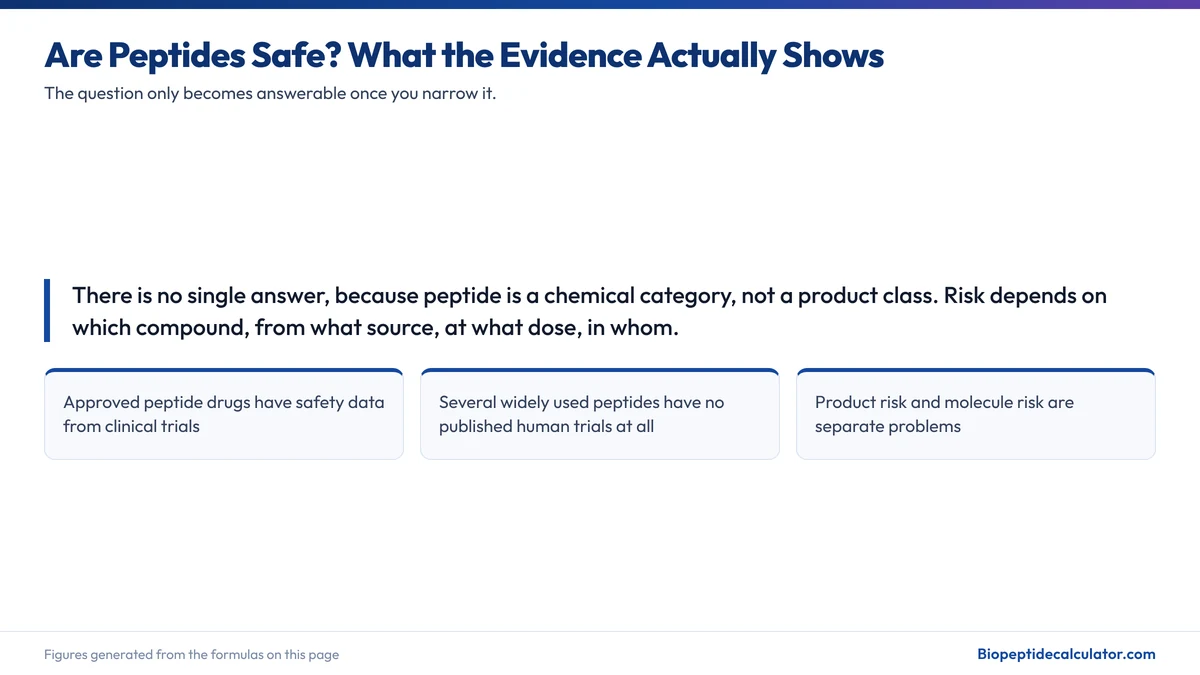
- Approved peptide drugs have safety data from clinical trials
- Several widely used peptides have no published human trials at all
- Product risk and molecule risk are separate problems
Insulin is a peptide. So is a vial of unlabeled powder from an unnamed supplier. Asking whether peptides are safe is like asking whether chemicals are safe.
- Safe is not a property of the word peptide
- Three different risk profiles
- Product risk versus molecule risk
- What an approved peptide drug’s safety data looks like
- What no published human trials actually means
- Risks that apply regardless of compound
- Who should be especially cautious
- How to reduce the risks you can control
Safe is not a property of the word peptide
A peptide is a short chain of amino acids joined by peptide bonds, generally counted as fewer than about 50 residues, above which the chain is normally called a protein. That definition covers insulin, oxytocin, glutathione, semaglutide and every unlabeled vial sold as a research chemical.
Nothing useful can be said about the safety of all of them at once.
Three different risk profiles
The Federal Register notice states plainly that compounded drugs are not FDA-approved, which means FDA does not review their safety, effectiveness, or quality before they are marketed.
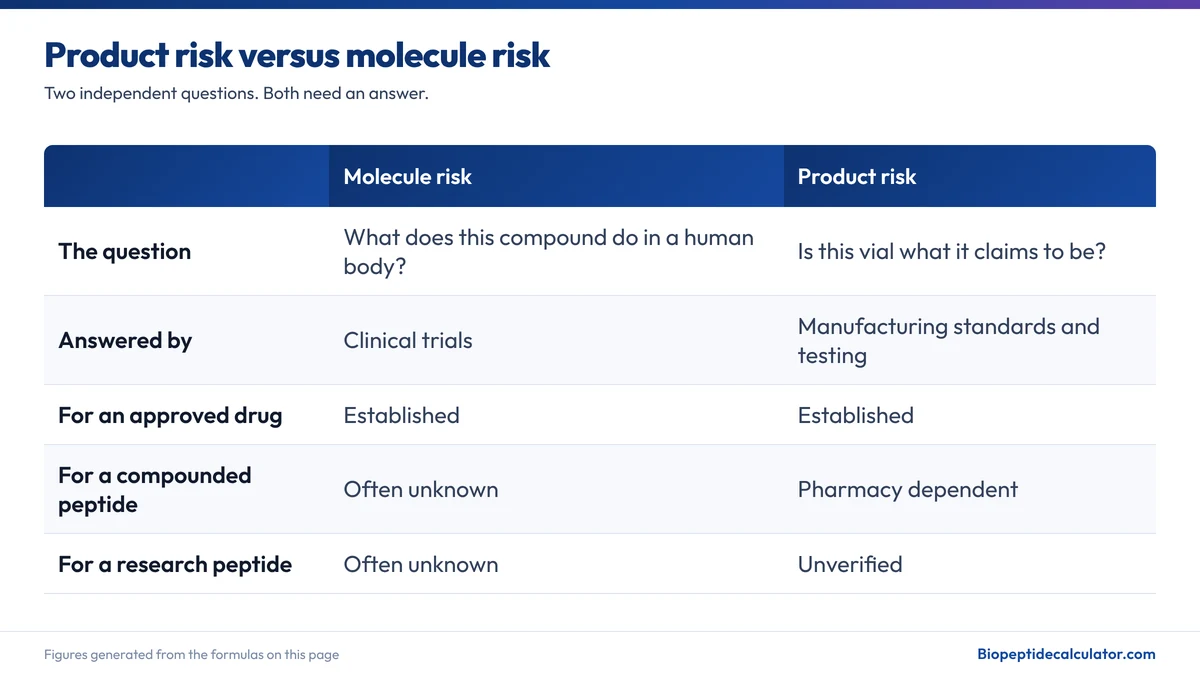
Product risk versus molecule risk
Two distinct questions get collapsed into one, and separating them clarifies a lot.
A perfectly pure vial of a compound nobody has studied in humans is still an unknown. A well-studied molecule in a contaminated vial is still a hazard. Both problems have to be solved, and solving one does not touch the other.
What an approved peptide drug’s safety data looks like
It is worth seeing what real safety data looks like, because it sets a standard that most of this field does not meet.
Retatrutide’s phase 3 trial, TRIUMPH-1, enrolled 2,339 people and reported adverse events by dose against placebo.
What no published human trials actually means
BPC 157 has not been through published human clinical trials. The evidence base is preclinical, overwhelmingly rodent studies.
This is routinely misread in both directions, so both readings are worth naming.
The accurate statement is narrower and less satisfying. Nobody knows.
Risks that apply regardless of compound
Some risks come from the act of injecting rather than from the compound.
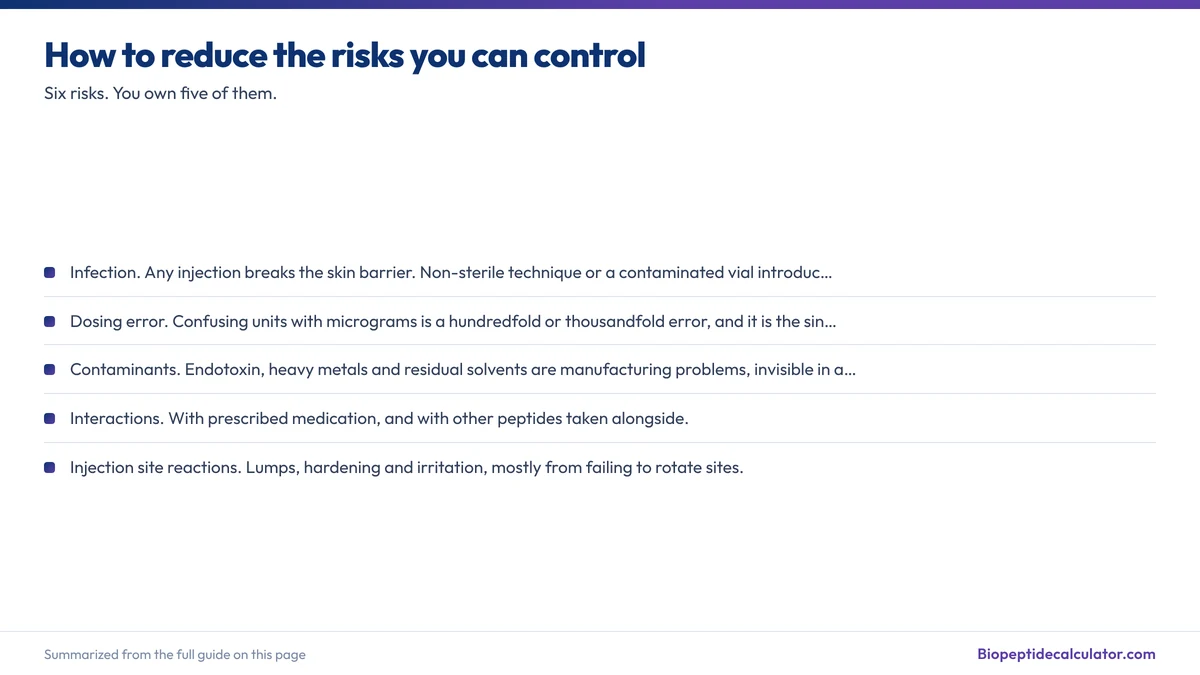
- Infection. Any injection breaks the skin barrier. Non-sterile technique or a contaminated vial introduces organizms directly past it.
- Dosing error. Confusing units with micrograms is a hundredfold or thousandfold error, and it is the single most common mistake in this subject.
- Contaminants. Endotoxin, heavy metals and residual solvents are manufacturing problems, invisible in a clear solution.
- Interactions. With prescribed medication, and with other peptides taken alongside.
- Injection site reactions. Lumps, hardening and irritation, mostly from failing to rotate sites.
The dosing one is solvable with arithmetic, which is what the peptide reconstitution calculator is for. The others are not.
Who should be especially cautious
General caution applies more strongly to some people than others.
None of this is a substitute for asking a clinician who knows your history.
How to reduce the risks you can control
Some risks are fixed by the choice of compound. Others are in your hands.
Frequently asked questions
Are peptides safe?
There is no single answer, because peptide is a chemical category rather than a product class. An approved peptide drug has a safety profile established in clinical trials. An unapproved research peptide of unknown purity has no safety profile at all, and absence of reported harm is not the same as evidence of safety.
What are the side effects of peptides?
They depend entirely on the compound. GLP-1 peptides such as semaglutide and retatrutide cause gastrointestinal effects in a large share of users. Compounds with no human trials have no documented side effect profile, which means unknown rather than none.
Are research peptides safe to inject?
Research peptides are labeled for laboratory use only and are not manufactured, tested or labeled to the standard required for human medicines. There is no requirement that the vial contains what the label claims, at the purity claimed, free of contaminants.
Can peptides cause long-term harm?
For compounds without long-term human studies, this is unknown rather than ruled out. Short-term tolerability in a small number of people says nothing about effects over years, which is one reason the approval process takes as long as it does.
Is it safe to buy peptides online?
The chemistry of a molecule does not change with where it was bought, but everything about the product does: identity, purity, sterility, dose accuracy and contaminants. A certificate of analysis from the seller is better than nothing and is not equivalent to pharmaceutical manufacturing oversight.
Do peptides interact with medications?
Some do. Metabolic peptides in particular affect gastric emptying and glucose handling, which has implications for anyone taking diabetes medication or drugs with narrow therapeutic windows. This is a question for a prescriber, not a forum.
Run your own vial and dose through the peptide calculator.
Sources & Scientific References
The science on this page traces to the peer-reviewed and reference sources below. We link only to research and reference material.
Peer-Reviewed Research
- Jozwiak M, et al. Multifunctionality and Possible Medical Application of the BPC 157 Peptide: Literature and Patent Review. Pharmaceuticals, 2025;18:185 (PMC). – the current review of what BPC 157 research does and does not show
- Jastreboff AM, et al. Triple-Hormone-Receptor Agonist Retatrutide for Obesity: A Phase 2 Trial. N Engl J Med, 2023. – the 48 week phase 2 trial reporting up to 24% mean weight reduction
Reference & Regulatory
- Eli Lilly: Lilly’s triple agonist, retatrutide, delivered powerful weight loss in pivotal Phase 3 obesity trial. May 21, 2026. – the manufacturer’s topline TRIUMPH-1 results, with adverse event rates against placebo
- Federal Register: Enforcement Discretion Policy Regarding 503A Compounding Using Certain Peptide Bulk Drug Substances. HHS, 91 FR, October 30, 2026. Docket HHS-OASH-2026-0496. – the official notice of the draft enforcement discretion policy, which states that compounded drugs are not FDA-approved
- Cleveland Clinic: Wilson Disease. – the copper-metabolism disorder for which GHK-Cu should be avoided
More at Bio Peptide Calculator
- FDA status of research peptides – the regulatory position as of November 2026
- Peptide reconstitution calculator – removing the dosing error from the list
- How to store reconstituted peptides – the degradation risk you can control