- 1 mg = 1000 mcg
- 1 unit = 0.01 mL on a U-100 syringe
- The same dose is a different number of units at every concentration
Most dosing mistakes are not math errors. They are unit errors, which are worse, because a unit error is usually off by a factor of ten or a thousand rather than a little.
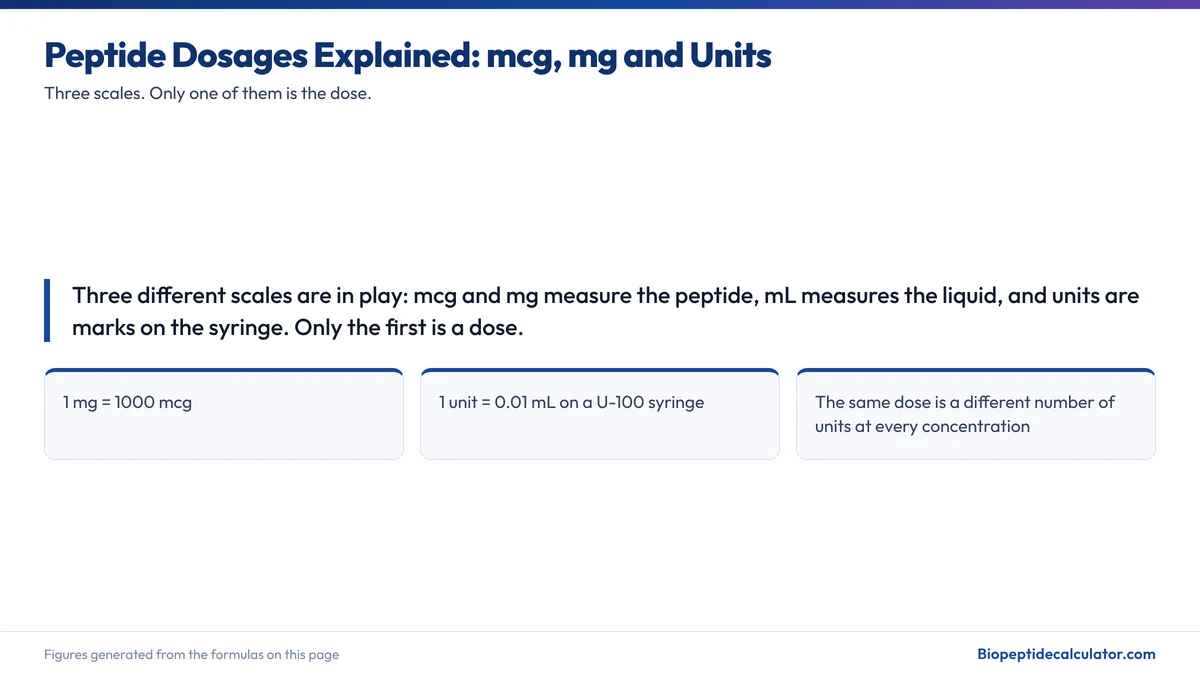
Three scales, one injection
Here is the whole source of confusion, in one table.
Read the right-hand column twice. Mass is a property of the peptide. Volume is a property of what you did to it.
Micrograms and milligrams
1 mg equals 1000 mcg. That is the entire conversion, and it is a decimal shift of three places.
Why protocols are written in mcg
Because the decimals get silly otherwise.
A dose of 0.0001 g is hard to read, hard to say, and easy to mistype. The same dose is 100 mcg. Units of measurement get chosen so the interesting numbers sit between about one and a thousand, and for most research peptides that scale is micrograms.
Units are a volume, not a dose
This is the one that causes real harm, so it is worth being very clear.
A unit is not an amount of peptide.
On a U-100 insulin syringe 100 units equals 1 mL, so each unit is 0.01 mL. A unit is a quantity of liquid, and how much peptide is in that liquid depends entirely on the concentration you created when you reconstituted the vial.
Converting a protocol into a syringe mark
Three steps, and the middle one is the one people skip.
- Write down the dose from your protocol.
In mg or mcg. Convert to mg if it is in mcg, because the formula wants mg.
- Work out your concentration.
Vial strength divided by the water you added. Not the water the internet added.
- Divide and multiply by 100.
Dose divided by concentration gives mL. Times 100 gives units.
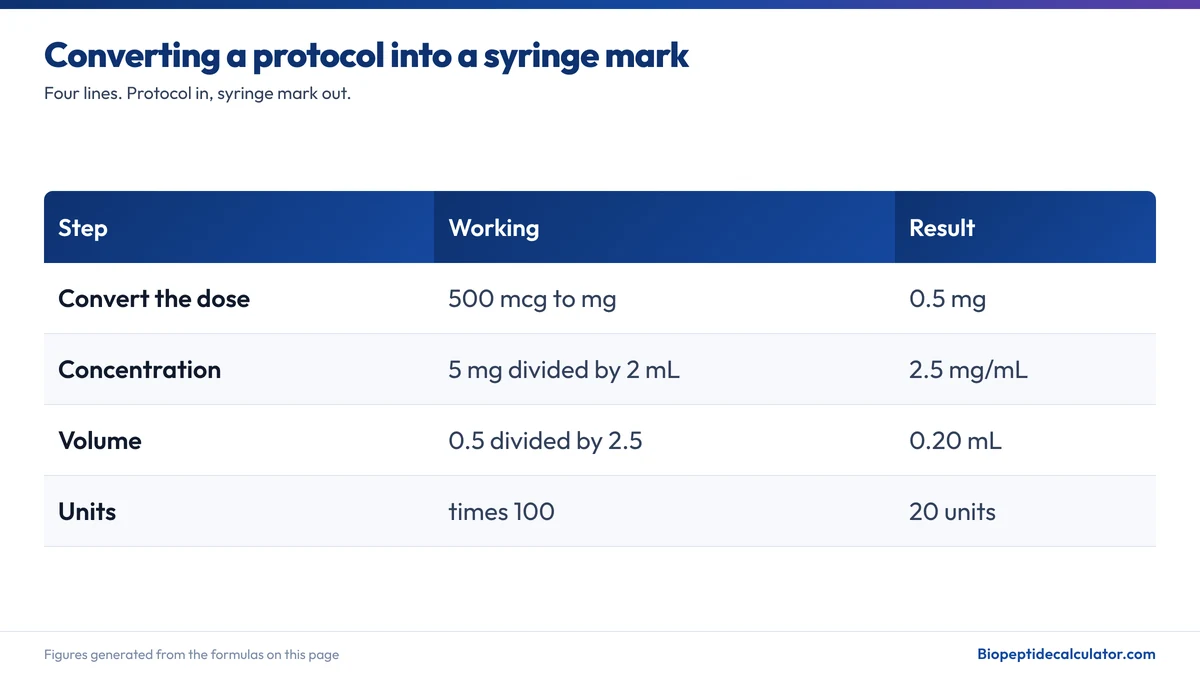
Worked through for a common case: a 5 mg vial, 2 mL of water, and a 500 mcg dose.
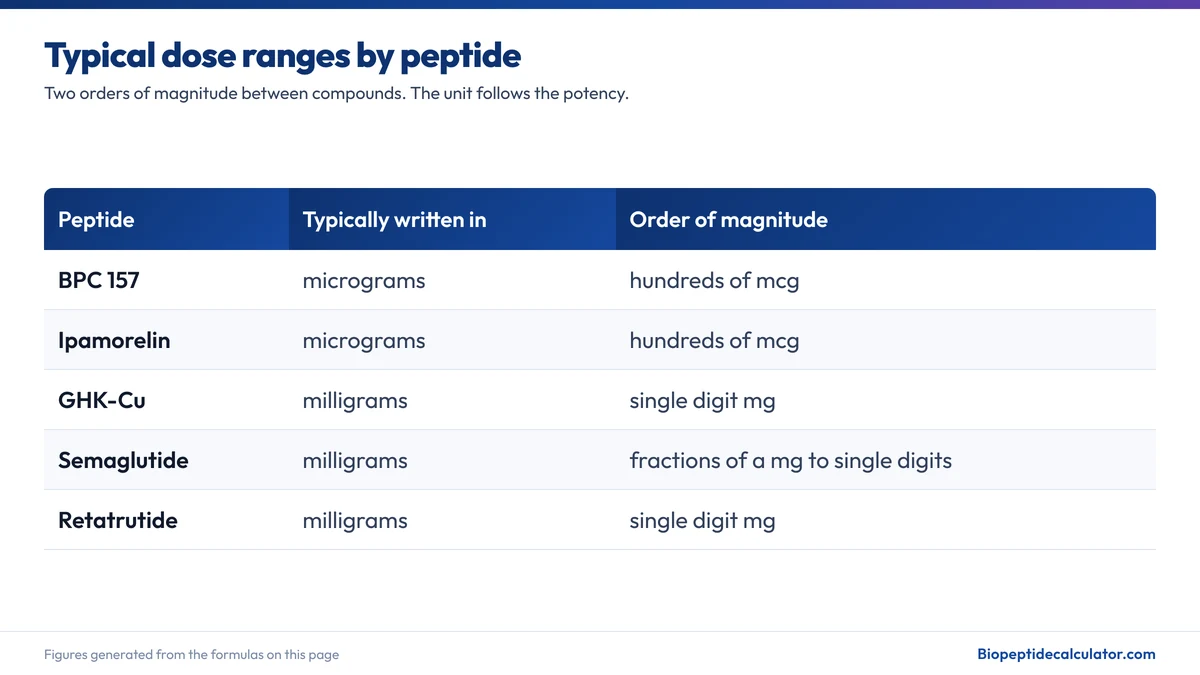
Typical dose ranges by peptide
Dose ranges differ enormously between compounds, which is itself the point. There is no general peptide dose.
Dose per kilogram, and when it matters
Some protocols are written per kilogram of body weight. Most research peptide protocols are not.
When they are, the arithmetic gains one step at the front: multiply the per-kg figure by your weight to get a dose in mg, then carry on exactly as above.
Nothing else changes. The concentration math is identical.
The errors that actually happen
Frequently asked questions
What is the difference between mcg and mg in peptide dosing?
One milligram equals 1000 micrograms. A 250 mcg dose is 0.25 mg, and a 5 mg vial holds twenty of them. Vials are labeled in milligrams while protocols are usually written in micrograms, which is where the confusion starts.
How many units is a 250 mcg peptide dose?
It depends entirely on how much water you added. At 1 mg/mL a 250 mcg dose is 25 units. At 2.5 mg/mL the same dose is 10 units. Units measure volume, so the answer changes with concentration and never with the peptide.
Is a unit the same as a microgram?
No, and treating them as the same is the most common dosing error in this subject. A microgram is a mass of peptide. A unit is 0.01 mL of liquid. They only line up by coincidence at one specific concentration.
How do I know what dose to use?
The dose comes from the protocol you are following, not from the calculator. A calculator converts a dose into a syringe mark. It has no opinion about whether that dose is right.
Why do some peptides dose in mg and others in mcg?
Potency. A peptide active at tens of micrograms is written in micrograms to avoid long strings of decimal places, while a peptide dosed at several milligrams is written in milligrams for the same reason.
Does body weight change the peptide dose?
For some compounds protocols are written per kilogram, in which case yes. For many research peptides the published dosing is a flat amount, and weight is not part of the calculation.
Run your own vial and dose through the peptide calculator.
Sources & Scientific References
The science on this page traces to the peer-reviewed and reference sources below. We link only to research and reference material.
Reference & Regulatory
- PubChem: Copper tripeptide-1. – the chemical database entry for the GHK-Cu complex
More at Bio Peptide Calculator
- Peptide reconstitution calculator – convert a dose into a syringe mark
- Peptide dosage charts – per-compound dosing, one peptide at a time
- How to read an insulin syringe – what the marks on the barrel actually mean