
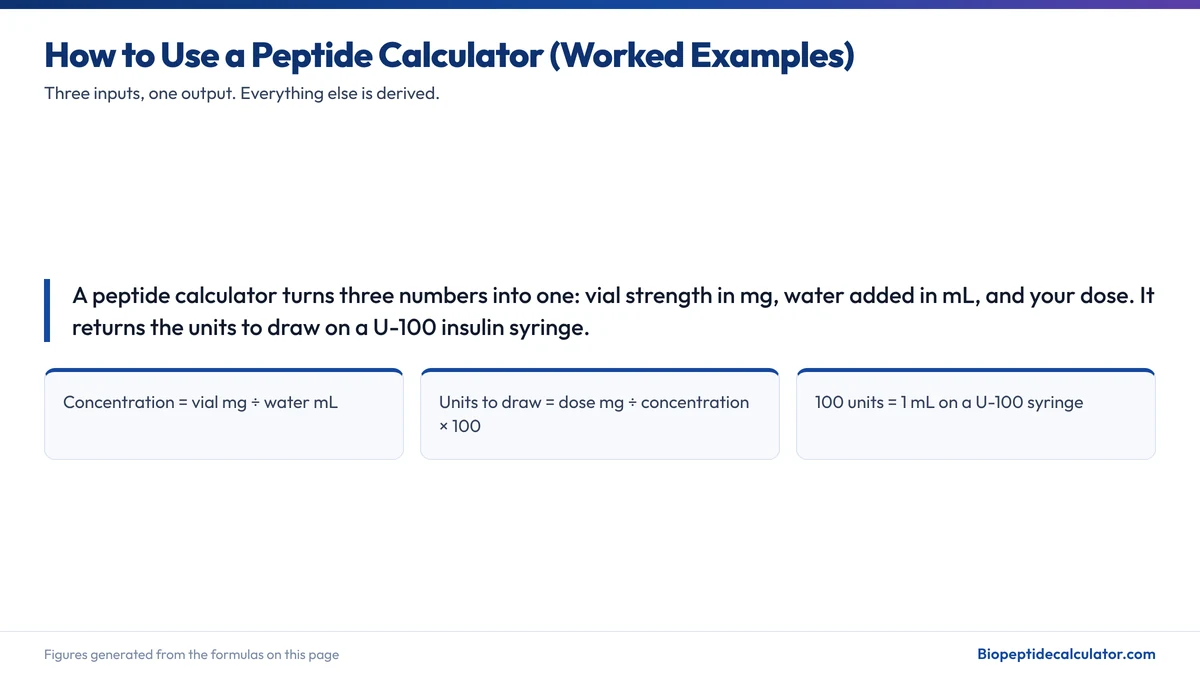
- Concentration = vial mg ÷ water mL
- Units to draw = dose mg ÷ concentration × 100
- 100 units = 1 mL on a U-100 syringe
Reconstitution math is not hard. It is just easy to get wrong at 6am with a vial in one hand. The arithmetic below is what the peptide reconstitution calculator runs, shown step by step so you can check it yourself.
- The three numbers a calculator needs
- Worked example: a 5 mg vial
- Worked example: a 10 mg vial at four volumes
- Reading the answer on your syringe
- Why more water does not mean more doses
- Working backwards from a mark you want
- mg, mcg and units without the confusion
- Mistakes the calculator exists to catch
The three numbers a calculator needs
Every peptide calculator, including ours, needs the same three inputs. Nothing else.
From those three it derives two more: the concentration of the solution, and the volume you need to draw. The second one is the answer.
Worked example: a 5 mg vial
Take a 5 mg vial. You add 2 mL of bacteriostatic water.
Concentration is 5 divided by 2, so 2.5 mg/mL. That single number drives everything that follows.
Read the last column and draw to that mark. That is the whole job.
Worked example: a 10 mg vial at four volumes
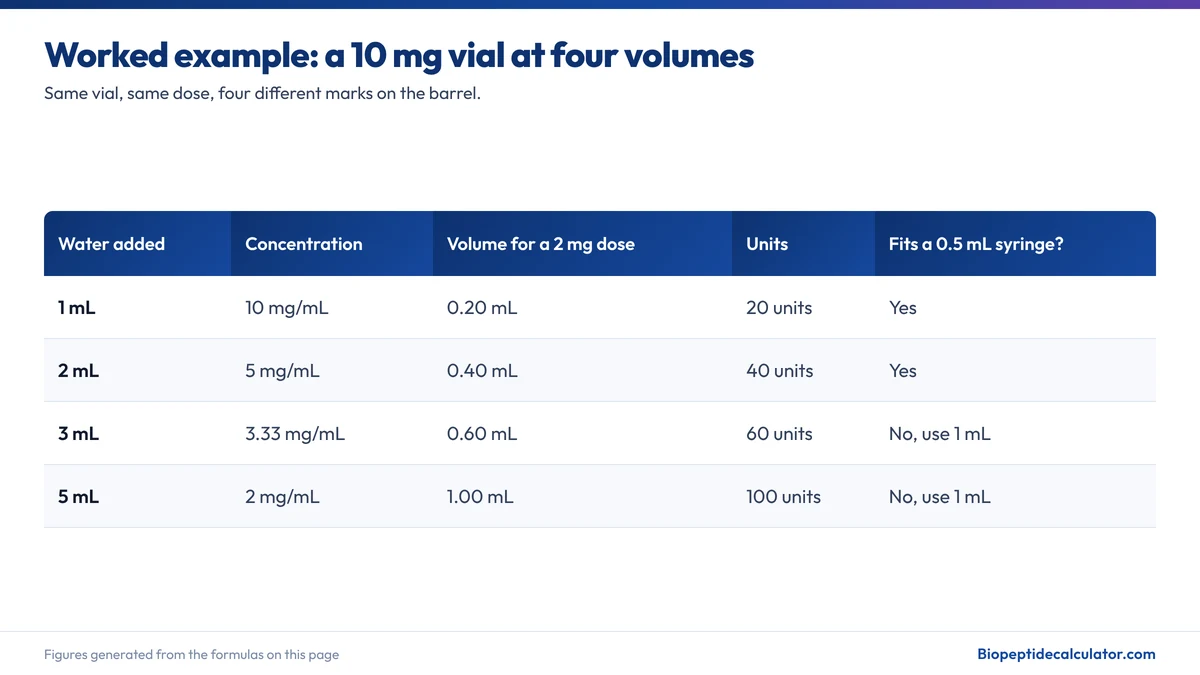
The same vial can give you very different numbers depending on the water. Here is a 10 mg vial at four common volumes, with a 2 mg dose.
Notice what changes and what does not. The concentration changes. The units change. The number of doses in the vial does not.
Reading the answer on your syringe
A U-100 insulin syringe is marked in units, not milliliters. The conversion is fixed and worth memorizing.
On a U-100 insulin syringe 100 units equals 1 mL, so each unit is 0.01 mL.
If your answer comes out above 100 units, it does not fit a 1 mL syringe. Use less water next time, or split the dose. The insulin syringe guide covers reading the barrel itself.
Why more water does not mean more doses
This is the single most common misunderstanding, and it is worth being blunt about.
Water is not peptide.
So what is the water actually for? Readability. More water means a bigger volume per dose, which means a dose that is easier to measure accurately. The trade is that it has to still fit the syringe.
Working backwards from a mark you want
Most people use a calculator forwards. Backwards is often more useful.
Instead of asking what 2 mL gives you, decide what you want a dose to read, then solve for the water.
Round numbers on the barrel mean fewer errors. Twenty units is easier to hit than seventeen and a half.
mg, mcg and units without the confusion
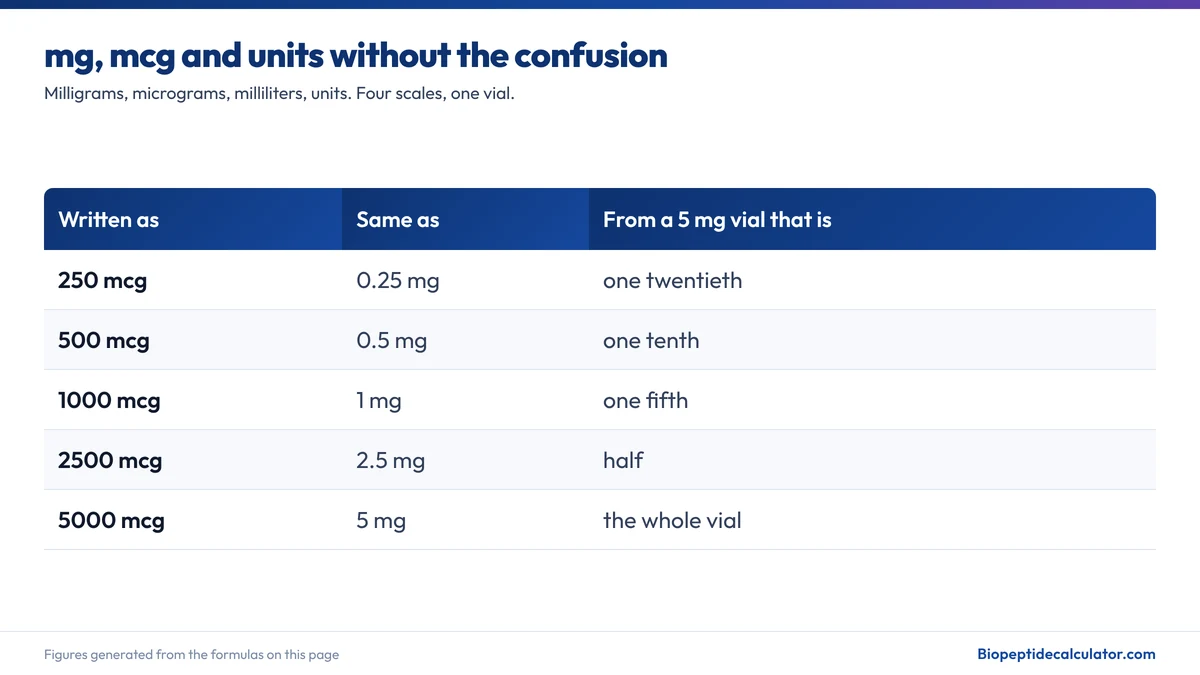
1 mg equals 1000 mcg. That is the whole conversion, and it trips people up because vials are labeled in one unit and protocols are written in the other.
Three units are in play at once: milligrams of peptide, milliliters of liquid, and units on a syringe. Keeping them separate in your head is most of the battle.
Mistakes the calculator exists to catch
A calculator is not there to do hard math. It is there to stop four specific errors.
- Confusing units with milliliters. Drawing to 50 when you needed 0.5 mL is correct. Drawing to 0.5 on a unit scale is a hundredfold error.
- Assuming more water stretches the vial. It does not, as the table above shows.
- Mixing mg and mcg mid-calculation. A thousandfold error, and the most dangerous one on this list.
- Picking a volume that will not fit. If a dose comes out at 140 units it does not fit a 1 mL barrel at all.
Frequently asked questions
How do you use a peptide calculator?
Enter three numbers: the milligrams in the vial, the milliliters of bacteriostatic water you added, and the dose you want. The calculator divides strength by volume to get concentration, then divides your dose by that concentration to get the volume to draw, and multiplies by 100 to turn milliliters into units on a U-100 syringe.
What is the formula a peptide calculator uses?
Units to draw equals dose in mg divided by concentration in mg/mL, times 100. Concentration is vial strength divided by the water you added. A 5 mg vial with 2 mL of water is 2.5 mg/mL, so a 2 mg dose is 0.8 mL, which is 80 units.
Does adding more bacteriostatic water give you more doses?
No. The vial holds a fixed amount of peptide. Adding more water spreads the same peptide through more liquid, so each dose is a larger volume but there are exactly the same number of doses. A 10 mg vial gives five 2 mg doses whether you add 1 mL or 5 mL.
How many units is 1 mL on an insulin syringe?
On a U-100 syringe, 100 units equals 1 mL. So one unit is 0.01 mL, and 50 units is half a milliliter.
What is the difference between mg and mcg in peptide dosing?
One milligram equals 1000 micrograms. Research peptides are often dosed in micrograms while vials are labeled in milligrams, so a 250 mcg dose from a 5 mg vial is 0.25 mg of a 5 mg total, which is one twentieth of the vial.
How much bacteriostatic water should I add to a vial?
Enough that your intended dose lands on a mark you can read, and little enough that one dose fits your syringe. Working backwards is easier: pick the number of units you want a dose to be, and the calculator tells you the water to add.
Run your own vial and dose through the peptide dosage calculator.
Sources & Scientific References
The science on this page traces to the peer-reviewed and reference sources below. We link only to research and reference material.
Reference & Regulatory
- PubChem: Copper tripeptide-1. – the chemical database entry for the GHK-Cu complex
More at Bio Peptide Calculator
- Peptide reconstitution calculator – run any vial and dose through it
- BAC water calculator – solve for the water instead of the dose
- Dosage charts – pre-built charts for common peptides