- Larger doses need less water to stay inside the syringe
- Doses per vial depend only on dose size
- Same reconstitution procedure as any peptide
Ten milligrams is the most common MOTS-c vial, and the doses discussed are large enough that syringe capacity becomes a real constraint.
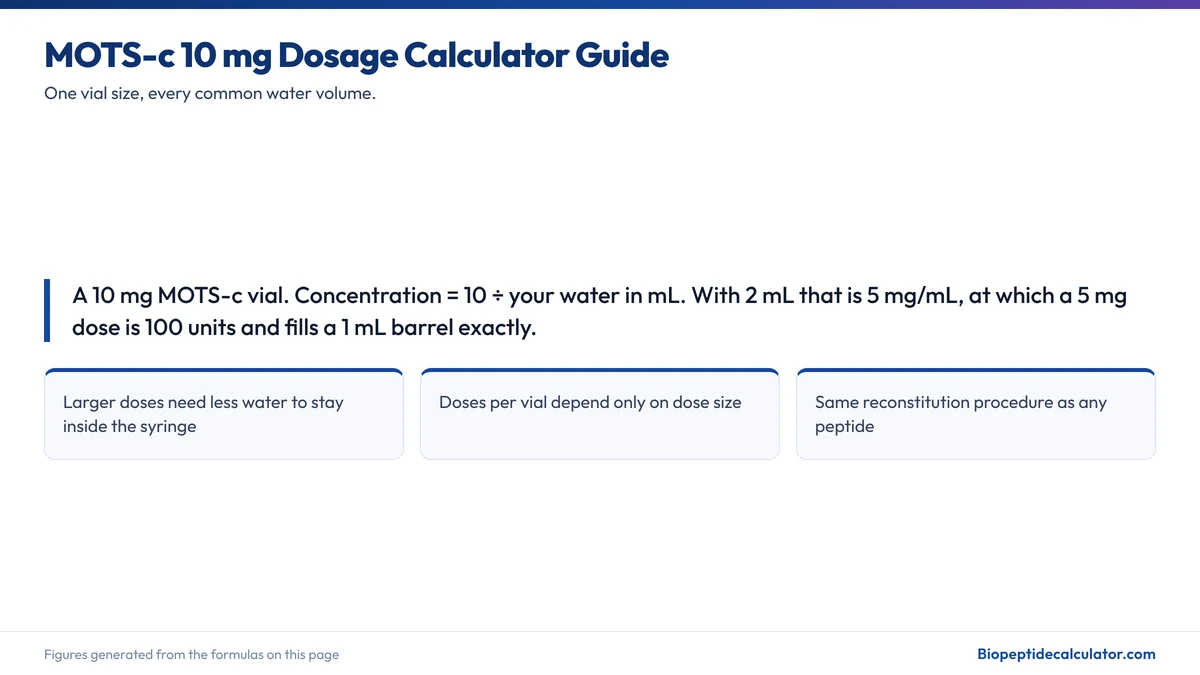
The 10 mg vial
Ten milligrams of lyophilized powder. Concentration equals vial strength divided by the volume of bacteriostatic water added, so a 5 mg vial reconstituted with 2 mL gives 2.5 mg/mL.
Concentration by water volume
Units for common doses
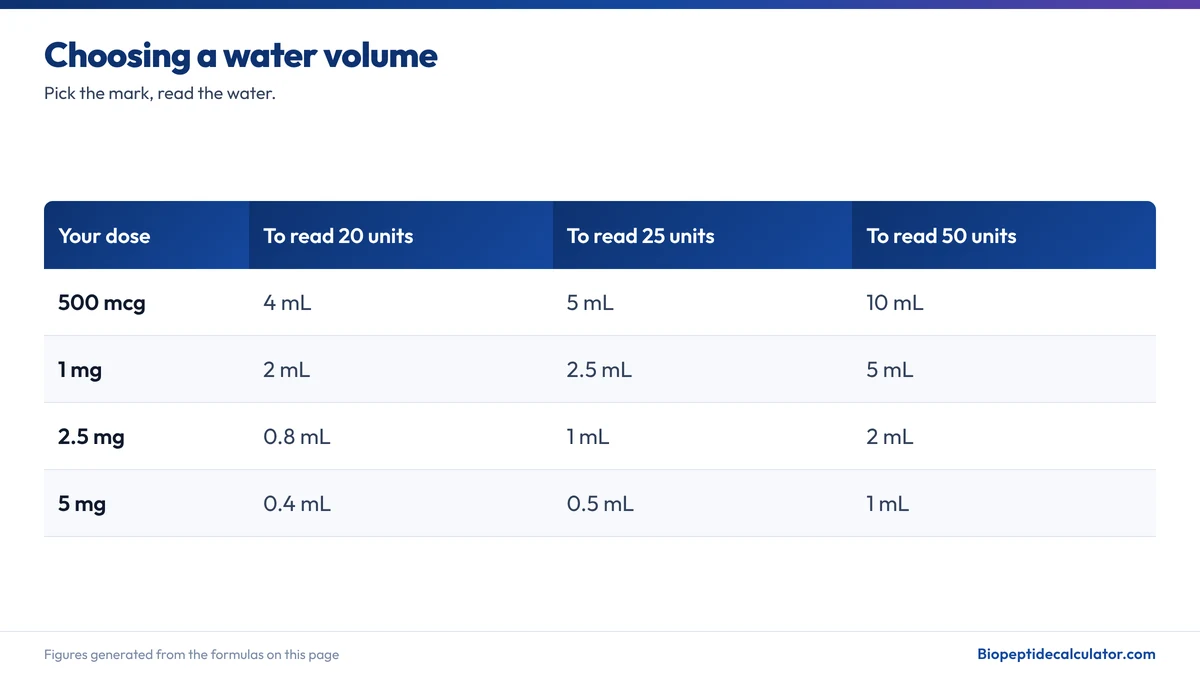
Choosing a water volume
Work backwards from the dose you intend.
Doses per vial
Doses per vial equals vial strength divided by dose size, and the volume of water added does not change that number.
A worked example
A 10 mg vial, 2 mL of water, a 2.5 mg dose.
The last row closes the loop. Four doses of 50 units is the 2 mL you put in.
Frequently asked questions
How do you calculate MOTS-c 10 mg dosing?
Divide 10 mg by the bacteriostatic water you added to get concentration, then divide your dose by that and multiply by 100 for units. With 2 mL the concentration is 5 mg/mL, so a 5 mg dose is 100 units.
How much bacteriostatic water for a 10 mg MOTS-c vial?
Whatever puts your dose on a readable mark and still fits your syringe. With larger doses such as 5 mg, less water keeps the draw inside a 1 mL barrel.
How many units is 5 mg of MOTS-c?
It depends on the water. From a 10 mg vial, 5 mg is 50 units with 1 mL of water, 100 units with 2 mL and 150 units with 3 mL. The last of those does not fit a 1 mL syringe.
How many doses are in a 10 mg MOTS-c vial?
Ten at 1 mg, four at 2.5 mg, two at 5 mg. The number of doses depends only on the dose size, never on how much water you added.
Does MOTS-c need different reconstitution from other peptides?
No. Room temperature, wipe the stopper, water down the inside glass wall, swirl rather than shake. The arithmetic is identical to any other peptide.
Run your own vial and dose through the peptide dosage calculator.
Sources & Scientific References
The science on this page traces to the peer-reviewed and reference sources below. We link only to research and reference material.
Reference & Regulatory
- Federal Register: Enforcement Discretion Policy Regarding 503A Compounding Using Certain Peptide Bulk Drug Substances. HHS, 91 FR, October 30, 2026. Docket HHS-OASH-2026-0496. – the official notice of the draft enforcement discretion policy, which states that compounded drugs are not FDA-approved
More at Bio Peptide Calculator
- What is MOTS-c peptide – the compound itself
- Peptide reconstitution calculator – other vial sizes
- BAC water calculator – solve for the water