
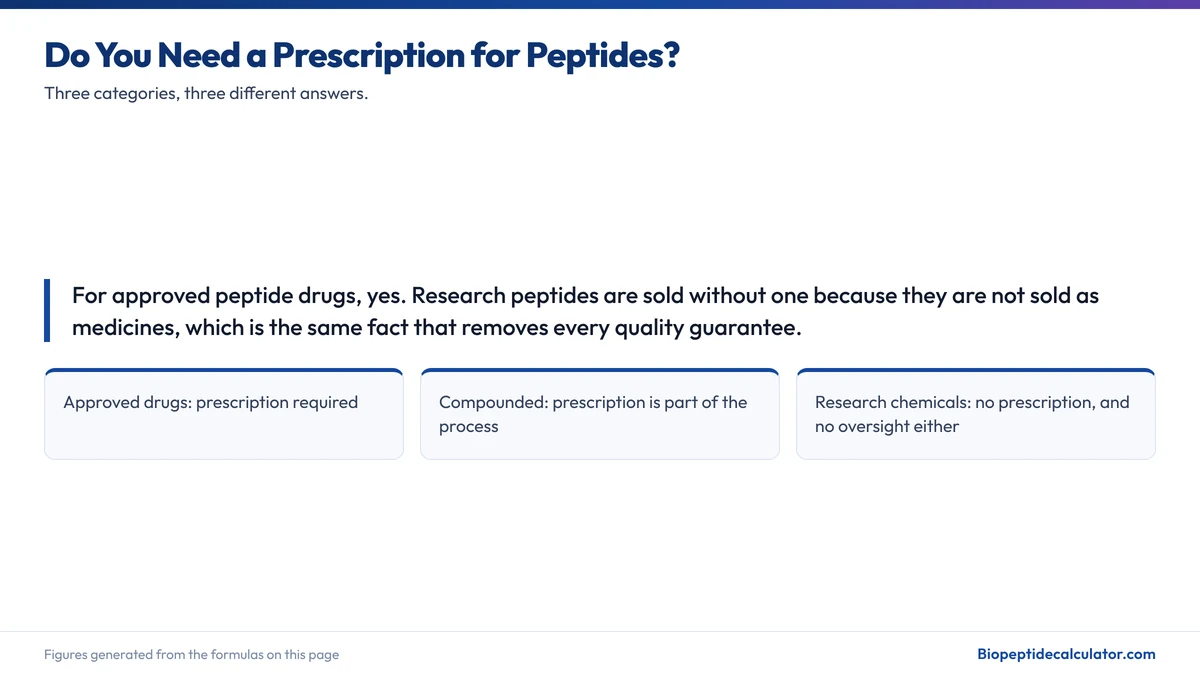
- Approved drugs: prescription required
- Compounded: prescription is part of the process
- Research chemicals: no prescription, and no oversight either
The absence of a prescription requirement is not a loophole in the system. It is a description of a product that was never placed inside the system.
It depends which peptide
Approved peptide drugs
Semaglutide, tirzepatide, liraglutide, tesamorelin and bremelanotide are approved medicines, and in the US they are prescription only.
Tesamorelin is approved in the United States, under the brand name EGRIFTA WR, for the reduction of excess abdominal fat in HIV-infected adult patients with lipodystrophy.
Vyleesi is approved for the treatment of premenopausal women with acquired, generalized hypoactive sexual desire disorder, excluding cases caused by a co-existing medical or psychiatric condition, relationship problems, or the effects of a medication.
Compounded peptides
Compounding is a pharmacy preparing a medicine for an individual patient against a prescription, where a commercially available product does not meet that patient’s need.
The Federal Register notice states plainly that compounded drugs are not FDA-approved, which means FDA does not review their safety, effectiveness, or quality before they are marketed.
So a compounded peptide involves a prescriber and a licensed pharmacy, and still is not an approved drug. Those two facts sit together.
Research peptides sold online
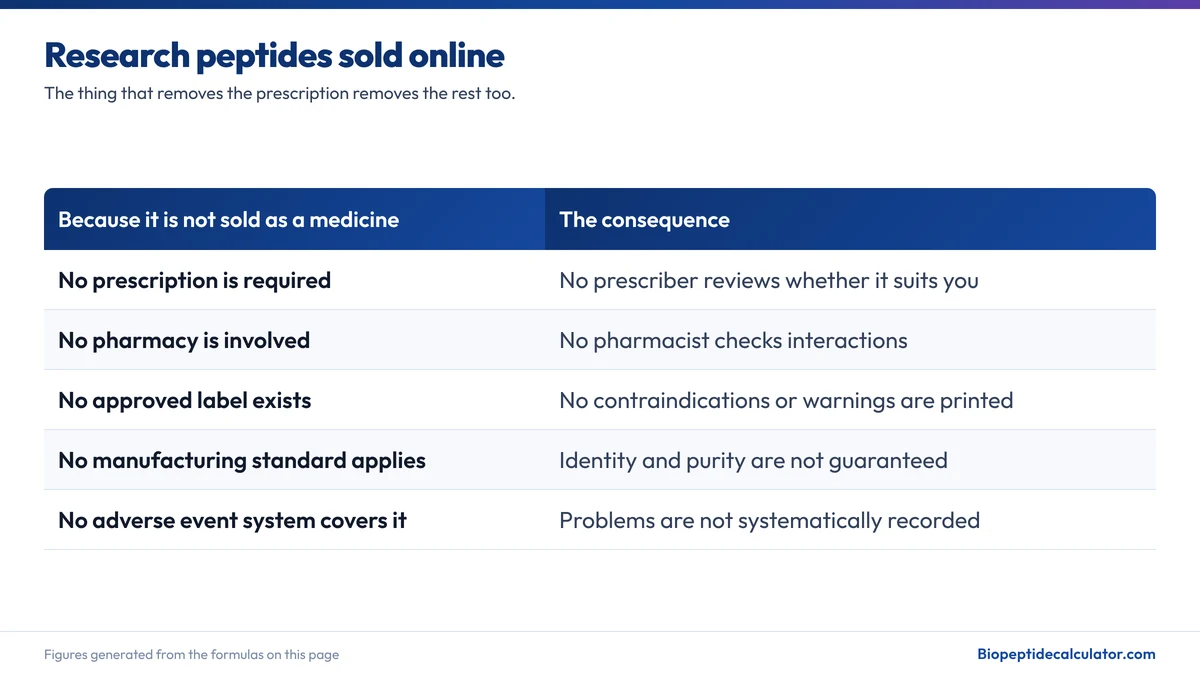
Peptides sold online as research chemicals are labeled for laboratory research use only and are not sold as medicines, which means they are not manufactured, tested or labeled to the standard required of a drug intended for human use.
What the 2026 changes did to this question
Less than most coverage suggested.
On October 30, 2026 the Department of Health and Human Services published a notice of availability for a draft enforcement discretion policy covering 503A compounding with six peptide bulk drug substances: BPC 157, Epitalon, KPV, MOTS-c, Semax and TB 500. The comment period, under docket HHS-OASH-2026-0496, closed on November 13, 2026.
The draft policy applies only where all ten of its conditions are met, including a certificate of analysis from an FDA registered source, a single active ingredient, Not for resale labeling, and adverse event reporting to MedWatch.
That is a policy about pharmacy compounding, which already involved a prescriber. It changed nothing about buying research chemicals online, and it approved nothing. None of these 2026 actions approved any peptide. Enforcement discretion is a statement about what a regulator intends to prioritize, not a finding that a substance is safe or effective.
What a prescription actually buys you
Worth spelling out, because the prescription is often treated as an obstacle rather than a service.
- Someone reviews whether the compound suits you. Your history, your other medication, your conditions.
- Someone is accountable. A named prescriber and a licensed pharmacy.
- The product has a known identity. Manufactured to a standard, tested.
- There is a route if something goes wrong. Reporting, follow-up, adjustment.
None of that exists on the other path. That is the actual trade.
Frequently asked questions
Do you need a prescription for peptides?
For approved peptide drugs such as semaglutide and tirzepatide, yes. For compounded peptides, a prescription is part of how compounding works. Research peptides are sold without one because they are not sold as medicines at all.
Can you buy peptides without a prescription?
Research peptides are sold online labeled for laboratory research use only, which is how they are supplied without a prescription. That labeling is also why nothing about their identity, purity or sterility is guaranteed.
Is it legal to buy research peptides?
The legal position differs between selling, possessing and administering, and it varies by jurisdiction and over time. What is clear is that these are not approved medicines and are not sold as medicines. This is not legal advice.
Did the 2026 FDA changes make peptides prescription available?
Not directly. The October 2026 draft HHS policy concerns enforcement discretion for pharmacy compounding under ten specific conditions. It does not approve any peptide or add any to the 503A bulks list.
What is the difference between a compounded peptide and a research peptide?
A compounded preparation is made by a licensed pharmacy against a prescription for an individual patient. A research peptide is a bulk chemical sold for laboratory use with no prescriber, no pharmacy and no patient-specific preparation.
Run your own vial and dose through the peptide dosage calculator.
Sources & Scientific References
The science on this page traces to the peer-reviewed and reference sources below. We link only to research and reference material.
Reference & Regulatory
- Federal Register: Enforcement Discretion Policy Regarding 503A Compounding Using Certain Peptide Bulk Drug Substances. HHS, 91 FR, October 30, 2026. Docket HHS-OASH-2026-0496. – the official notice of the draft enforcement discretion policy, which states that compounded drugs are not FDA-approved
- Holland & Knight: HHS issues interim enforcement discretion policy for compounding of 6 peptides, November 2026. – a breakdown of the ten conditions attached to the policy
- FDA prescribing information: EGRIFTA WR (tesamorelin) for injection, NDA 022505. – the current label, including the limitation that it is not indicated for weight loss management
- FDA approval letter, NDA 210557: Vyleesi (bremelanotide) injection, June 21, 2019. – the approval letter and the exact indication granted
More at Bio Peptide Calculator
- FDA status of research peptides – the regulatory position in full
- Are peptides safe – product risk versus molecule risk
- What is peptide therapy – the three categories compared