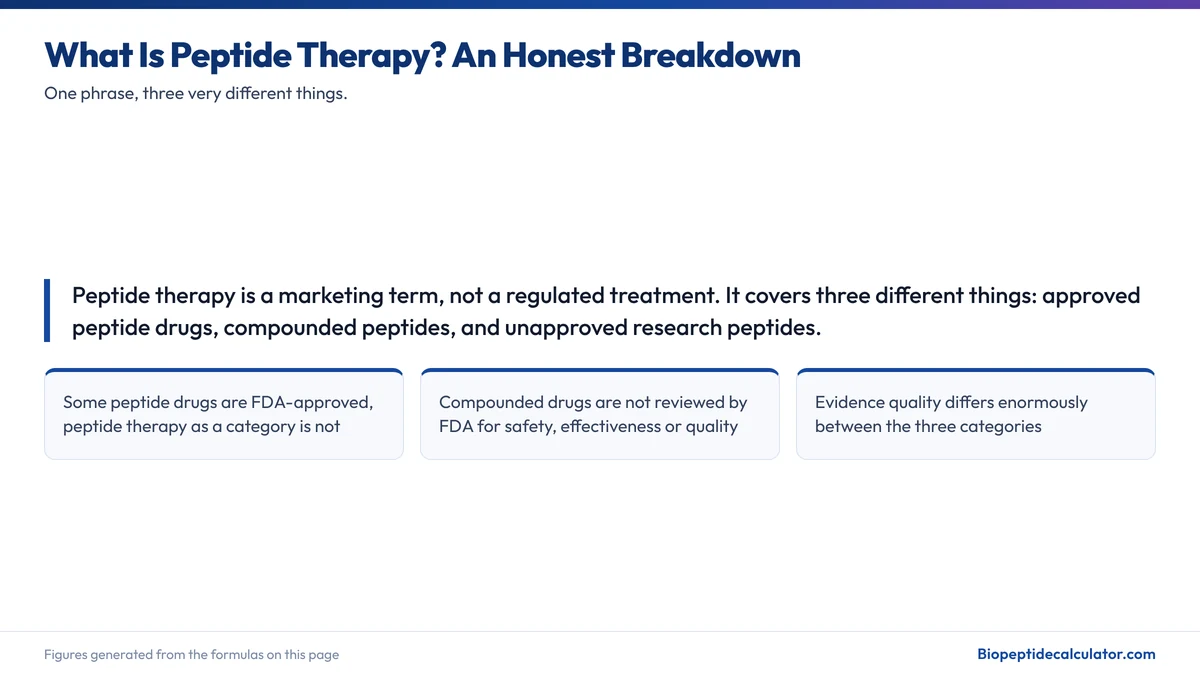
- Some peptide drugs are FDA-approved, peptide therapy as a category is not
- Compounded drugs are not reviewed by FDA for safety, effectiveness or quality
- Evidence quality differs enormously between the three categories
The phrase does a lot of hiding. Semaglutide prescribed for obesity and an unlabeled vial bought online both get called peptide therapy, and they have almost nothing in common.
What the term covers
No regulator defines peptide therapy. No medical board certifies it. It is a term clinics and suppliers use, and its meaning shifts depending on who is using it.
That is not automatically sinister. It is a reason to ask what is actually being offered, because the answer varies from a licensed medicine to a vial with no quality assurance at all.
Three very different categories
Approved peptide drugs
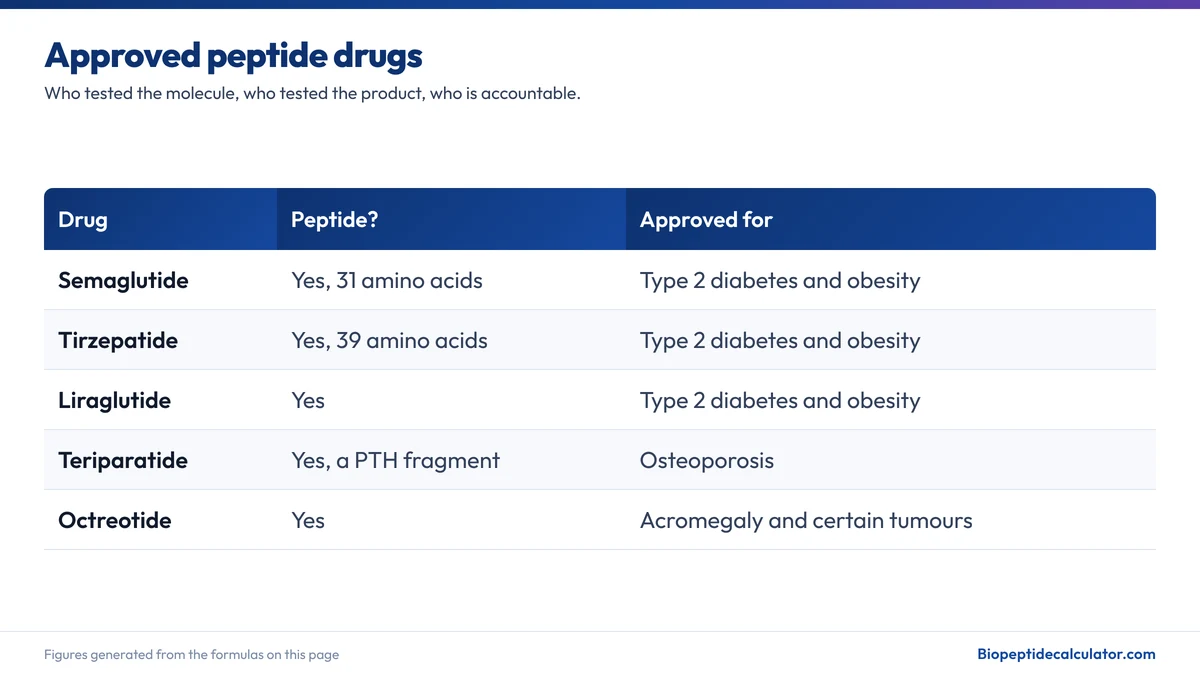
A number of peptides are approved medicines with full trial data behind them.
Semaglutide is a peptide, a modified 31 amino acid analogue of human GLP-1, and tirzepatide is a synthetic 39 amino acid peptide acting at both the gip and glp-1 receptors.
These are the strongest evidence in the field by a wide margin, because they went through the process that produces strong evidence.
Compounded peptides and the 2026 rule changes
This is where most of the 2026 news sat, and where most reporting got it wrong.
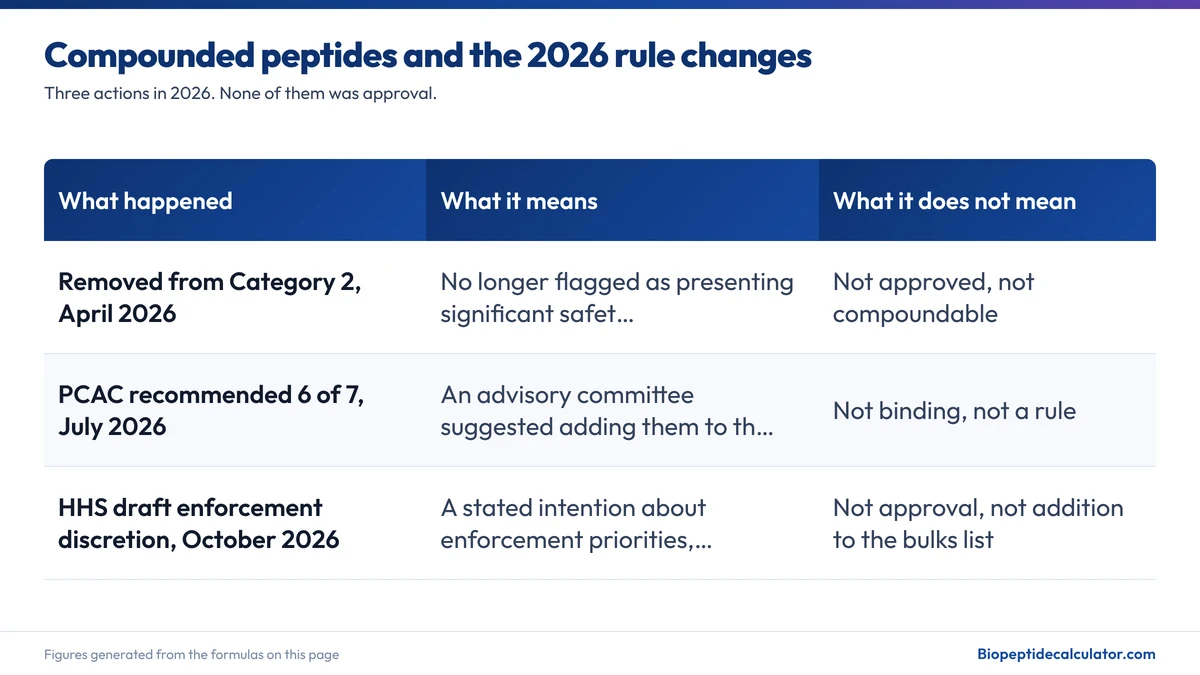
On April 15, 2026 the FDA announced its intent to remove twelve peptide bulk drug substances from Category 2 of the 503A bulks list review, among them BPC 157, TB 500, Epitalon, KPV, MOTS-c, Semax and Melanotan II.
Removal from Category 2 did not make those substances eligible for compounding and did not place them in Category 1. It removed them from a list of substances identified as presenting significant safety risks, nothing more.
At the Pharmacy Compounding Advisory Committee meeting held on July 23 and 24, 2026, the committee voted to recommend six of seven peptides for the 503A bulks list. BPC 157, KPV and TB 500 each passed 8 to 6 with one abstention, Epitalon 7 to 4, Semax 8 to 5 and MOTS-c 7 to 5. Emideltide, also called DSIP, was the only one voted against, 6 to 7.
On October 30, 2026 the Department of Health and Human Services published a notice of availability for a draft enforcement discretion policy covering 503A compounding with six peptide bulk drug substances: BPC 157, Epitalon, KPV, MOTS-c, Semax and TB 500. The comment period, under docket HHS-OASH-2026-0496, closed on November 13, 2026.
The advisory committee’s recommendation is not binding. Adding a substance to the 503A bulks list requires formal notice and comment rulemaking, which had not concluded as of November 2026.
Research peptides sold online
Peptides sold online as research chemicals are labeled for laboratory research use only and are not sold as medicines, which means they are not manufactured, tested or labeled to the standard required of a drug intended for human use.
That labeling is not a formality. It is the reason there is no requirement that the vial contains what the label says, at the purity claimed, free of contaminants. Third-party testing by the seller is better than nothing and is not the same as pharmaceutical manufacturing standards.
What the evidence actually supports
Honest summary, compound by compound, rather than a verdict on the category.
BPC 157 has not been through published human clinical trials. The evidence base is preclinical, overwhelmingly rodent studies.
Retatrutide is investigational. It is not approved by the FDA or any other regulator for any use.
Questions worth asking a clinic
If you are considering a clinic, these questions separate the careful from the careless.
- Is this an approved drug, a compounded preparation, or a research chemical?
- If compounded, which pharmacy, and is it a 503A or 503B facility?
- What human trial evidence exists for this compound and this use?
- What is the source of the bulk substance, and is there a certificate of analysis?
- Who is prescribing, and what happens if there is an adverse reaction?
Cost, and what drives it
Three cost tiers, matching the three categories, and the price difference is mostly a difference in oversight rather than a difference in molecule.
That last cell is the honest version of why research peptides are cheap.
Frequently asked questions
What is peptide therapy?
Peptide therapy is a loose marketing term for using peptide compounds to target a health goal. It is not a single regulated treatment. It covers FDA-approved peptide drugs, compounded peptides prepared by pharmacies, and unapproved research peptides, which are three very different things legally and in evidence quality.
Is peptide therapy FDA approved?
Some individual peptide drugs are approved, such as semaglutide and tirzepatide. Peptide therapy as a category is not. Most peptides offered by wellness clinics are not approved drugs, and compounded preparations are not FDA-reviewed for safety, effectiveness or quality.
Is peptide therapy legal?
Approved peptide drugs prescribed normally are. The position for others changed repeatedly through 2026, and as of November 2026 six peptides sit under a draft HHS enforcement discretion policy that explicitly does not approve them or add them to the 503A bulks list.
What conditions is peptide therapy used for?
Clinics market it for weight loss, recovery, sleep, skin and general wellness. The strength of evidence varies enormously between those uses, and is strongest where an approved drug exists for a defined condition.
Is peptide therapy safe?
That depends entirely on which peptide, from what source, at what dose. An approved drug has a known safety profile from clinical trials. An unapproved research peptide of unknown purity does not, and absence of reported harm is not evidence of safety.
How much does peptide therapy cost?
It varies widely by compound and provider. The main drivers are whether the peptide is an approved drug covered by insurance, a compounded preparation paid out of pocket, or bought as a research chemical, which is cheapest and carries the least oversight.
Run your own vial and dose through the peptide calculator.
Sources & Scientific References
The science on this page traces to the peer-reviewed and reference sources below. We link only to research and reference material.
Peer-Reviewed Research
- Jozwiak M, et al. Multifunctionality and Possible Medical Application of the BPC 157 Peptide: Literature and Patent Review. Pharmaceuticals, 2025;18:185 (PMC). – the current review of what BPC 157 research does and does not show
- Jastreboff AM, et al. Triple-Hormone-Receptor Agonist Retatrutide for Obesity: A Phase 2 Trial. N Engl J Med, 2023. – the 48 week phase 2 trial reporting up to 24% mean weight reduction
Reference & Regulatory
- Federal Register: Enforcement Discretion Policy Regarding 503A Compounding Using Certain Peptide Bulk Drug Substances. HHS, 91 FR, October 30, 2026. Docket HHS-OASH-2026-0496. – the official notice of the draft enforcement discretion policy, which states that compounded drugs are not FDA-approved
- Frier Levitt: FDA to remove 12 peptides from the Category 2 do not compound list, April 2026. – the April 15, 2026 action and what removal from Category 2 does and does not mean
- McDermott Will & Schulte: PCAC backs majority of peptides in two-day public meeting, July 2026. – the recorded vote counts from the July 23 to 24, 2026 advisory committee meeting
- Holland & Knight: HHS issues interim enforcement discretion policy for compounding of 6 peptides, November 2026. – a breakdown of the ten conditions attached to the policy
More at Bio Peptide Calculator
- Are peptides safe – risk by category and compound
- FDA status of research peptides – the regulatory position in detail
- Peptide library – evidence notes compound by compound