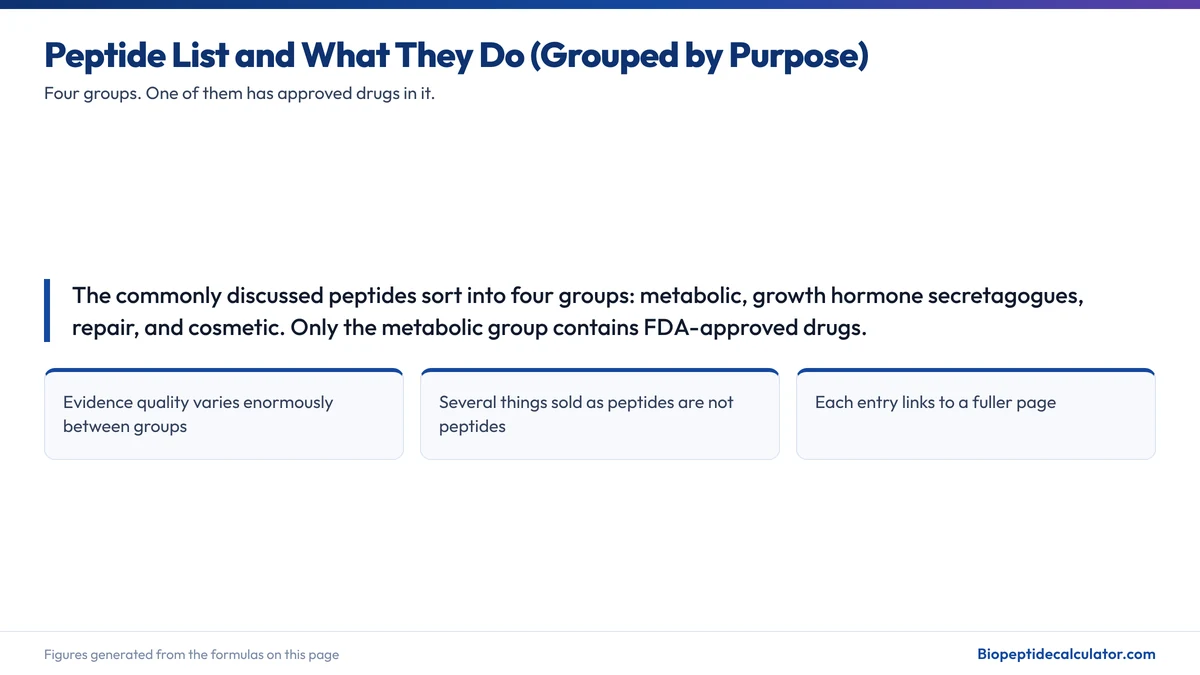
- Evidence quality varies enormously between groups
- Several things sold as peptides are not peptides
- Each entry links to a fuller page
A reference list, grouped by what the compound is reaching for. The evidence column is the one worth reading.
Reached for is doing deliberate work in these tables. It describes what people use a compound hoping to achieve, which is not the same as what it has been shown to do. Where those two line up, the evidence column says so. Where they do not, it says that too.
How to read this list
Three columns, and the third is the honest one.
Status means regulatory status in the US. Evidence means published human clinical trial evidence, not preclinical work, not anecdote, and not mechanism.
Metabolic and weight peptides
In the 48 week phase 2 trial published in the New England Journal of Medicine in 2023, participants on the highest dose saw mean weight reduction of about 24%.
Growth hormone secretagogues
A secretagogue does not supply growth hormone. It signals the pituitary to release its own, which is a meaningfully different mechanism from injecting HGH. Human growth hormone is a 191 amino acid chain, long enough that it is classed as a protein rather than a peptide.
Repair and recovery peptides
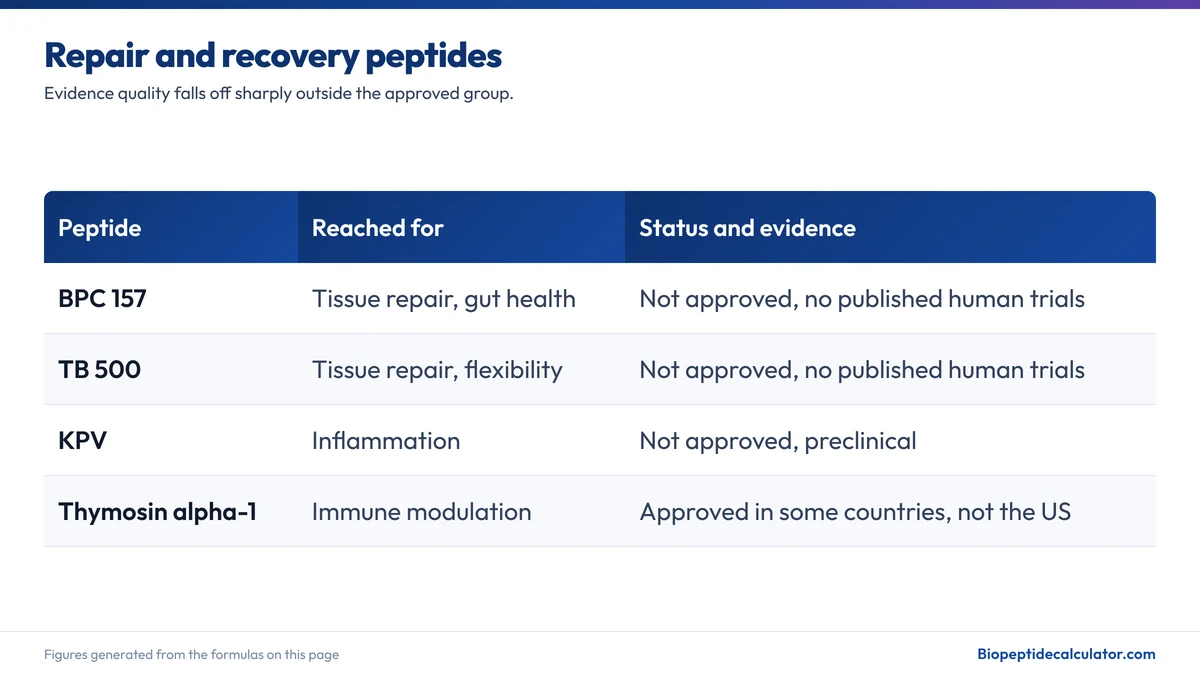
BPC 157 has not been through published human clinical trials. The evidence base is preclinical, overwhelmingly rodent studies.
Cosmetic and skin peptides
Cosmetic peptides are the one group where topical application is the norm rather than the exception, because the target tissue is the skin itself. The GHK-Cu peptide page covers the research.
Other commonly discussed peptides
Not peptides, despite the marketing
Four compounds that appear on peptide lists and are not peptides.
NAD+ is a dinucleotide, not a peptide. It contains no amino acids and no peptide bonds.
Creatine is a single amino acid derivative, not a peptide. With no second residue there is no peptide bond.
Being mislabeled is not an accusation about whether something works. Creatine has more human evidence behind it than most of the compounds above. It is simply not a peptide, and a list that calls it one is a list assembled by marketing rather than chemistry.
What the evidence column is telling you
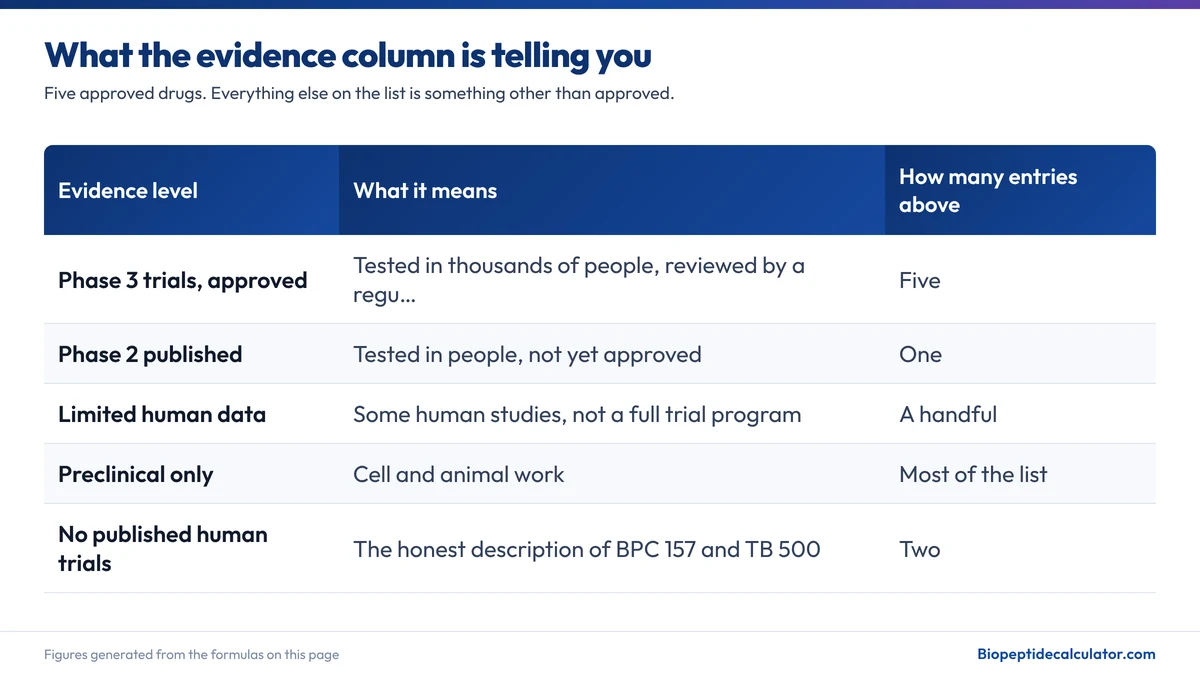
Scan the third column across all six tables and a pattern appears.
Approved drugs cluster in one group. Everything reached for in fitness, recovery and longevity contexts sits in the other, and most of those entries read the same way: not approved, preclinical, or no published human trials.
Frequently asked questions
What are the most common peptides and what do they do?
The most discussed fall into four groups: metabolic peptides such as semaglutide and tirzepatide, growth hormone secretagogues such as ipamorelin and CJC-1295, repair peptides such as BPC 157 and TB 500, and cosmetic peptides such as GHK-Cu.
Which peptides are FDA approved?
Semaglutide, tirzepatide, liraglutide, teriparatide and octreotide are among the approved peptide drugs. Most peptides discussed in fitness and wellness contexts, including BPC 157 and TB 500, are not approved.
What is the difference between a peptide and a secretagogue?
A secretagogue is a peptide or other molecule that triggers release of something else. Growth hormone secretagogues such as ipamorelin prompt the pituitary to release growth hormone rather than supplying it directly.
Which peptides have human clinical trial evidence?
The approved drugs do, extensively. Retatrutide has published phase 2 data and remains investigational. BPC 157 and TB 500 have no published human clinical trials, and their evidence base is preclinical.
Is there one peptide that does everything?
No. Peptides are signaling molecules, and each one acts at particular receptors. Breadth of claimed effects usually tracks thinness of evidence rather than versatility.
Run your own vial and dose through the peptide calculator.
Sources & Scientific References
The science on this page traces to the peer-reviewed and reference sources below. We link only to research and reference material.
Peer-Reviewed Research
- Jozwiak M, et al. Multifunctionality and Possible Medical Application of the BPC 157 Peptide: Literature and Patent Review. Pharmaceuticals, 2025;18:185 (PMC). – the current review of what BPC 157 research does and does not show
- Jastreboff AM, et al. Triple-Hormone-Receptor Agonist Retatrutide for Obesity: A Phase 2 Trial. N Engl J Med, 2023. – the 48 week phase 2 trial reporting up to 24% mean weight reduction
- Pickart L, Margolina A. Regenerative and Protective Actions of the GHK-Cu Peptide. Int J Mol Sci, 2018 (PMC). – the review documenting GHK-Cu’s effects across thousands of human genes
Reference & Regulatory
- Federal Register: Enforcement Discretion Policy Regarding 503A Compounding Using Certain Peptide Bulk Drug Substances. HHS, 91 FR, October 30, 2026. Docket HHS-OASH-2026-0496. – the official notice of the draft enforcement discretion policy, which states that compounded drugs are not FDA-approved
More at Bio Peptide Calculator
- Peptide library – a full page for each compound
- What is a peptide – the definition and the boundary
- Peptide dosage charts – dosing by compound