
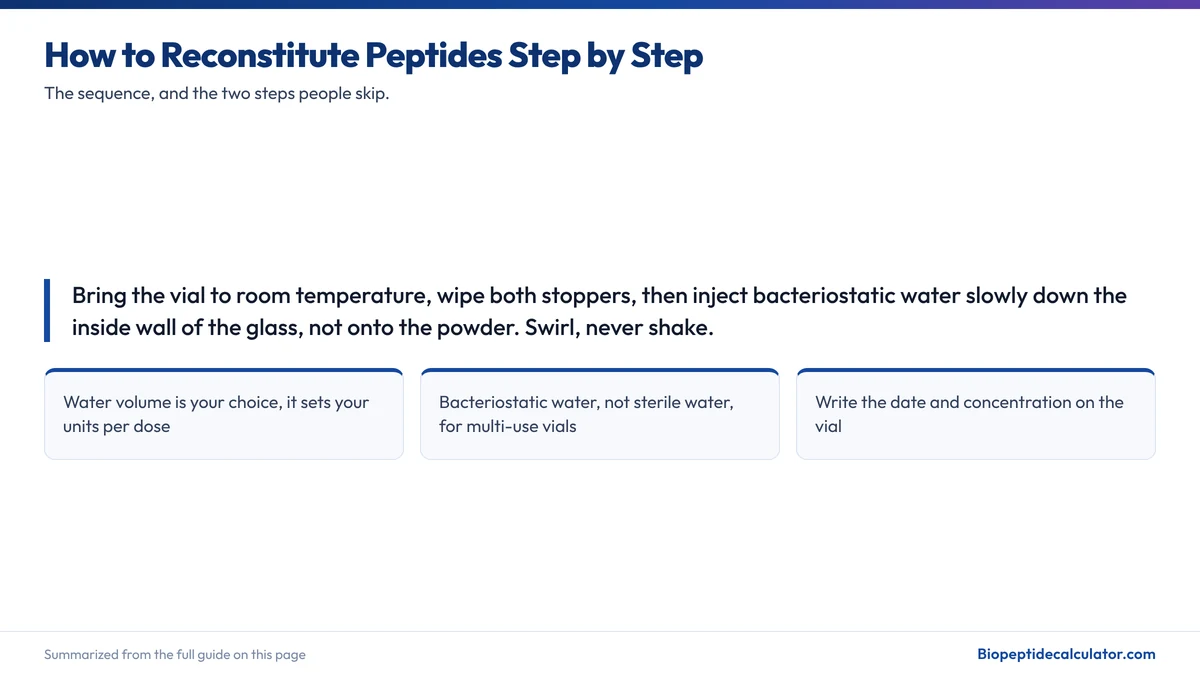
- Water volume is your choice, it sets your units per dose
- Bacteriostatic water, not sterile water, for multi-use vials
- Write the date and concentration on the vial
Reconstitution is simple and easy to do slightly wrong. The steps below are the ones that matter. The rest is patience.
What you need
The steps
- Let both vials reach room temperature.
Cold glass and cold liquid make dissolution slower and the stopper harder to pierce.
- Wipe both rubber stoppers with alcohol.
The peptide vial and the water vial. Let them dry.
- Draw your measured volume of bacteriostatic water.
Measured, not estimated. This number sets every dose you will take from the vial.
- Insert the needle at an angle and aim at the glass wall.
You want the water to run down the inside of the vial, not jet into the powder.
- Let it flow in slowly.
The vacuum in the vial will often pull it in on its own. Let it.
- Swirl gently until clear.
Roll the vial between your fingers. Give it minutes if it needs them.
- Label the vial.
Concentration and date. Covered below, and worth the ten seconds.
How much water to use
There is no single right answer, and anyone who tells you otherwise is guessing. The volume is a readability decision.
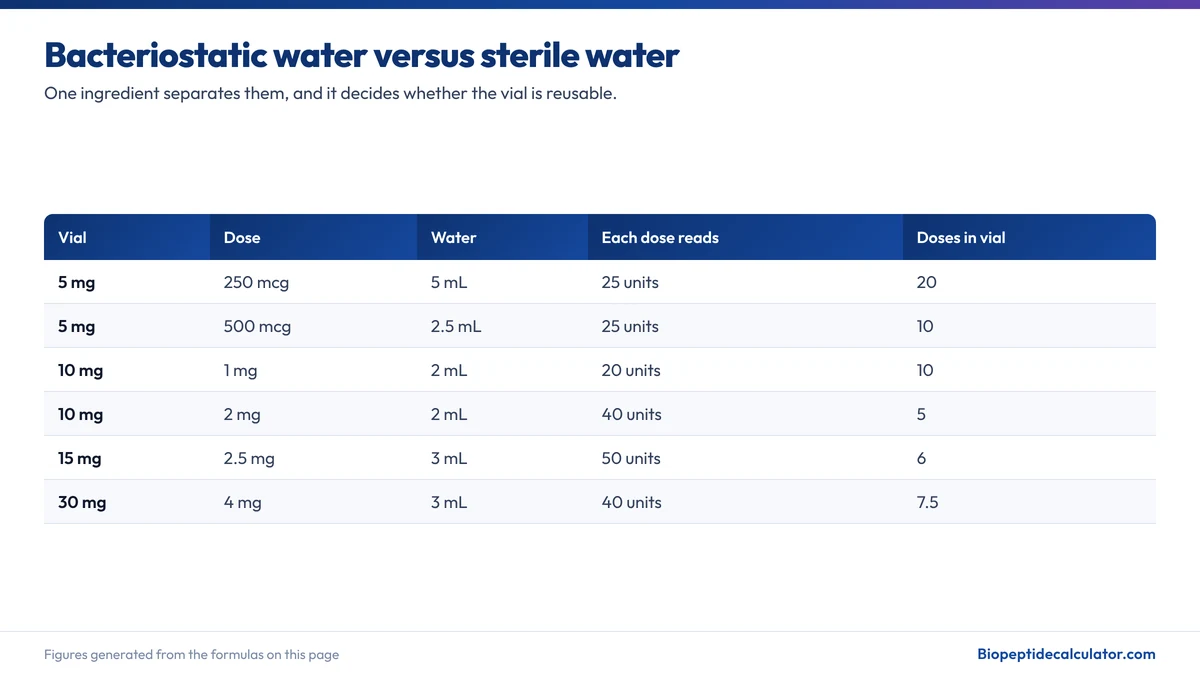
Use the BAC water calculator to solve it backwards: choose the units you want a dose to be, and it returns the water. Or read across this table.
Bacteriostatic water versus sterile water
These are not interchangeable, and the difference is one ingredient.
Bacteriostatic water contains 0.9% benzyl alcohol, which suppresses bacterial growth and allows a vial to be entered more than once. Sterile water contains no preservative and is single use.
Why the water runs down the glass
Because a peptide is a chain, and chains can be broken by force.
A jet of liquid hitting dry powder at speed applies shear. Running the same volume down the glass wall lets it reach the powder gently instead. The dissolved result is identical, the handling is not.
Do not shake it
Same reason. Shaking generates foam, and foam means air and liquid interfaces where peptide can denature.
Swirl. Wait. Swirl again.
If it has not dissolved after a few minutes of patience, put it in the fridge and come back to it. Time dissolves things that force would damage.
Label the vial
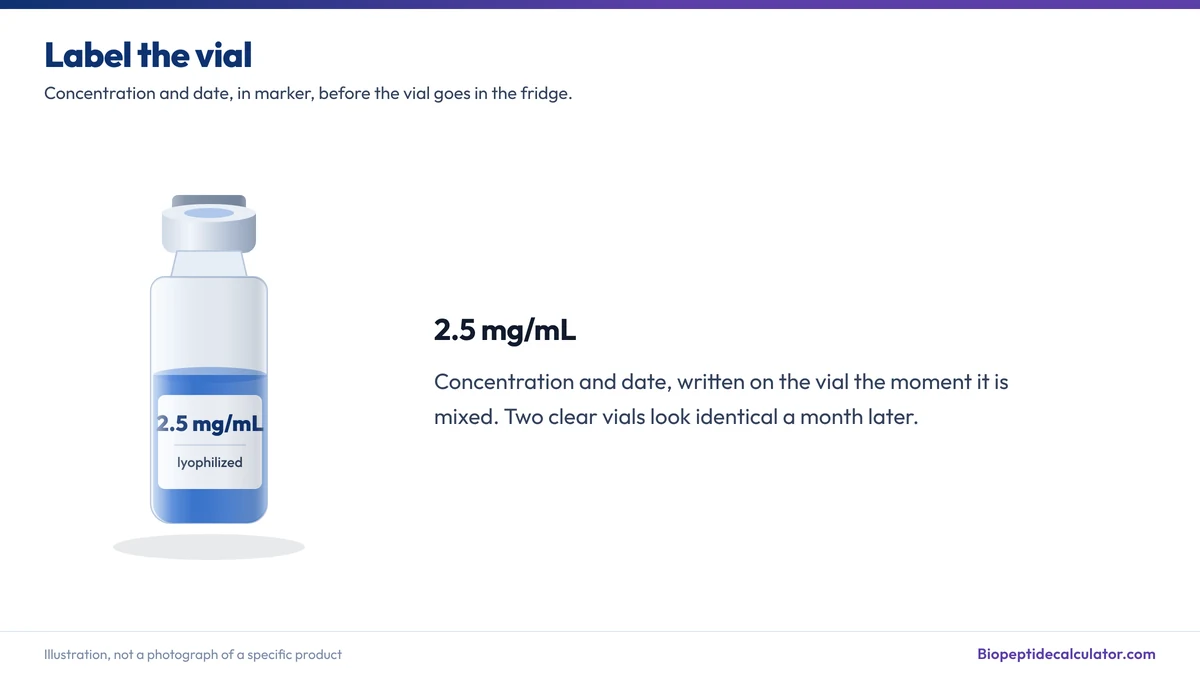
Two things on the vial, in marker, the moment you mix it.
- The concentration. Not the water you added, the resulting mg/mL. That is the number you will need.
- The date you reconstituted it. Because the clock starts now, not when you bought it.
Storage after mixing
Lyophilized peptide is normally stored cold and away from light, and is far more stable than the same peptide once reconstituted.
Once reconstituted, peptide is normally refrigerated and used within weeks rather than months, with the exact window depending on the peptide and the diluent.
What can go wrong
Frequently asked questions
How do you reconstitute a peptide?
Let the vial reach room temperature, wipe both stoppers with alcohol, draw your bacteriostatic water, and inject it slowly down the inside wall of the peptide vial. Swirl gently until clear. Do not shake, and do not aim the stream directly at the powder.
How much bacteriostatic water do I add to a peptide vial?
Whatever makes your dose land on a readable mark and still fit your syringe. There is no fixed correct volume. A common choice is enough to make one dose between 10 and 50 units on a U-100 syringe.
Can I use regular water to reconstitute peptides?
No. Tap and distilled water are not sterile. Bacteriostatic water contains 0.9% benzyl alcohol as a preservative, which is what allows a vial to be entered more than once.
Why should you not shake a reconstituted peptide?
Shaking creates foam and shear forces that can damage the peptide chain. Swirling slowly is enough, and if the powder is slow to dissolve, time will do it without agitation.
How long does reconstituted peptide last?
It depends on the peptide and the diluent, and it is measured in weeks rather than months once mixed. Lyophilized powder is far more stable than the same peptide in solution.
What if the solution is cloudy after reconstitution?
Give it time, as some peptides dissolve slowly. If it stays cloudy, has visible particles, or changes color, that is a reason to stop and not use it.
Run your own vial and dose through the peptide dosage calculator.
Sources & Scientific References
The science on this page traces to the peer-reviewed and reference sources below. We link only to research and reference material.
Reference & Regulatory
- PubChem: Copper tripeptide-1. – the chemical database entry for the GHK-Cu complex
More at Bio Peptide Calculator
- Peptide reconstitution calculator – turn your vial and dose into units
- BAC water calculator – decide how much water to add
- Peptide library – what each peptide is and does