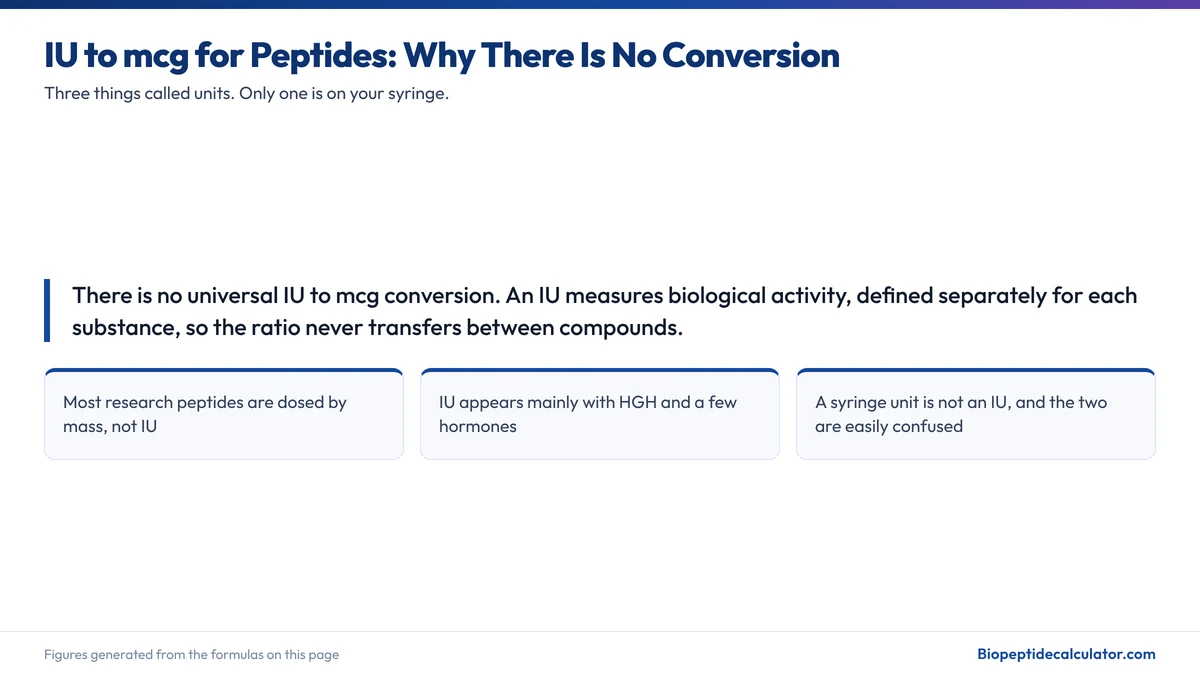
- Most research peptides are dosed by mass, not IU
- IU appears mainly with HGH and a few hormones
- A syringe unit is not an IU, and the two are easily confused
Three different things are called units in this hobby. Keeping them apart matters more than converting between them.
IU and mcg measure different things
Where IU actually applies
IU exists for substances where biological activity was easier to measure reliably than mass, historically before purification methods improved.
It persists for vitamins, some hormones, insulin and HGH. It is largely absent from research peptides, which are supplied and dosed by weight.
The HGH case, which is the common one
Human growth hormone is where most people meet this question.
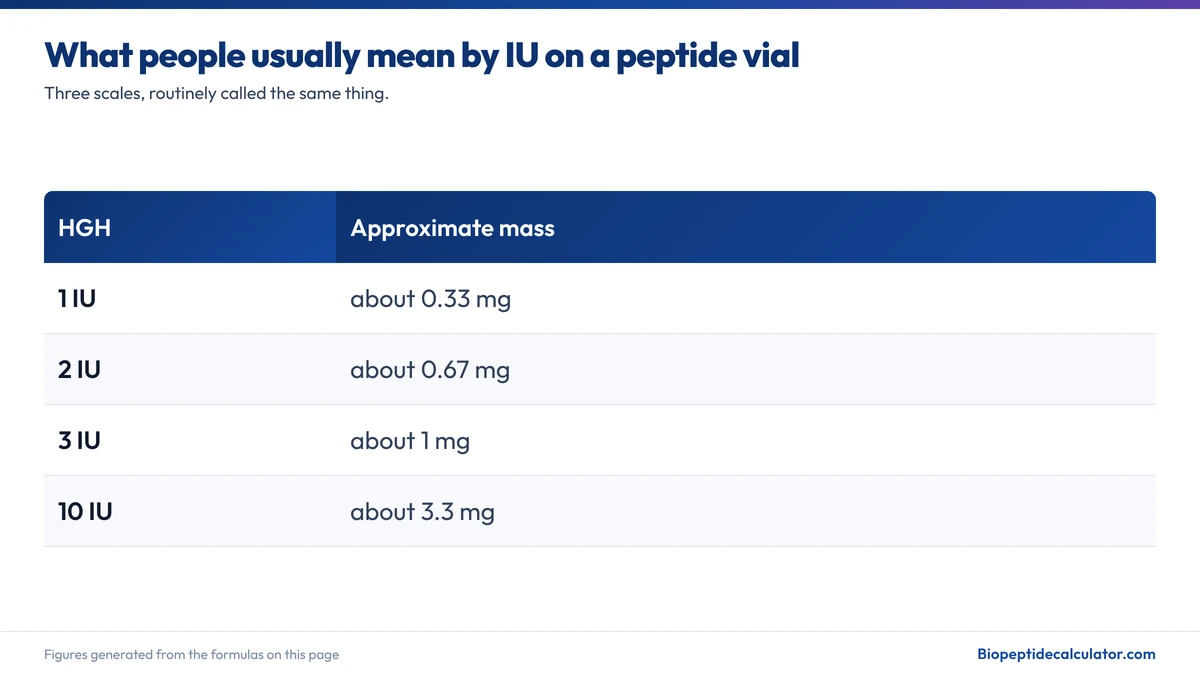
A conversion of roughly 3 IU per mg is conventionally used for HGH against a reference standard. That ratio is specific to HGH.
Human growth hormone is a 191 amino acid chain, long enough that it is classed as a protein rather than a peptide, which is one reason it sits in a different measurement tradition from the short peptides on this site.
What people usually mean by IU on a peptide vial
Usually, syringe units.
When someone says their research peptide dose is 20 IU, they almost always mean 20 marks on an insulin syringe, which is 0.2 mL. The compound is not measured in international units at all, and the usage is loose rather than technical.
How to avoid the error
- Ask what the vial is labeled in. If it says mg, you are working in mass and IU does not enter into it.
- Treat IU figures as compound specific. Never carry a ratio across.
- When someone says IU about a research peptide, assume they mean syringe units. Then confirm.
- Work in mg and units. Both are unambiguous once the concentration is known.
Frequently asked questions
How do you convert IU to mcg for peptides?
There is no universal conversion. An international unit is defined separately for each substance by biological activity, not by mass, so the IU to mass ratio differs from one compound to another and cannot be carried across.
What is an IU?
An international unit is a measure of biological activity rather than weight. It is defined per substance against a reference standard, which is why one IU of one substance has no fixed relationship to one IU of another.
Is an IU the same as a syringe unit?
No, and confusing them is a common and serious error. A syringe unit is a volume, 0.01 mL on a U-100 barrel. An international unit is a measure of biological activity.
Do research peptides use IU?
Most do not. Research peptides are almost always dosed by mass in mg or mcg. IU appears mainly with HGH and with a few hormone preparations such as HCG.
How many IU is 1 mg of HGH?
For human growth hormone, a conversion of roughly 3 IU per milligram is commonly used, based on a reference standard. That figure applies to HGH only and must never be applied to another compound.
Run your own vial and dose through the peptide calculator.
Sources & Scientific References
The science on this page traces to the peer-reviewed and reference sources below. We link only to research and reference material.
Reference & Regulatory
- PubChem: Copper tripeptide-1. – the chemical database entry for the GHK-Cu complex
More at Bio Peptide Calculator
- Insulin syringe units to mg – the conversion that does apply
- Peptide dosages explained – mcg, mg and units in full
- Is HGH a peptide – why HGH sits apart from the short peptides