
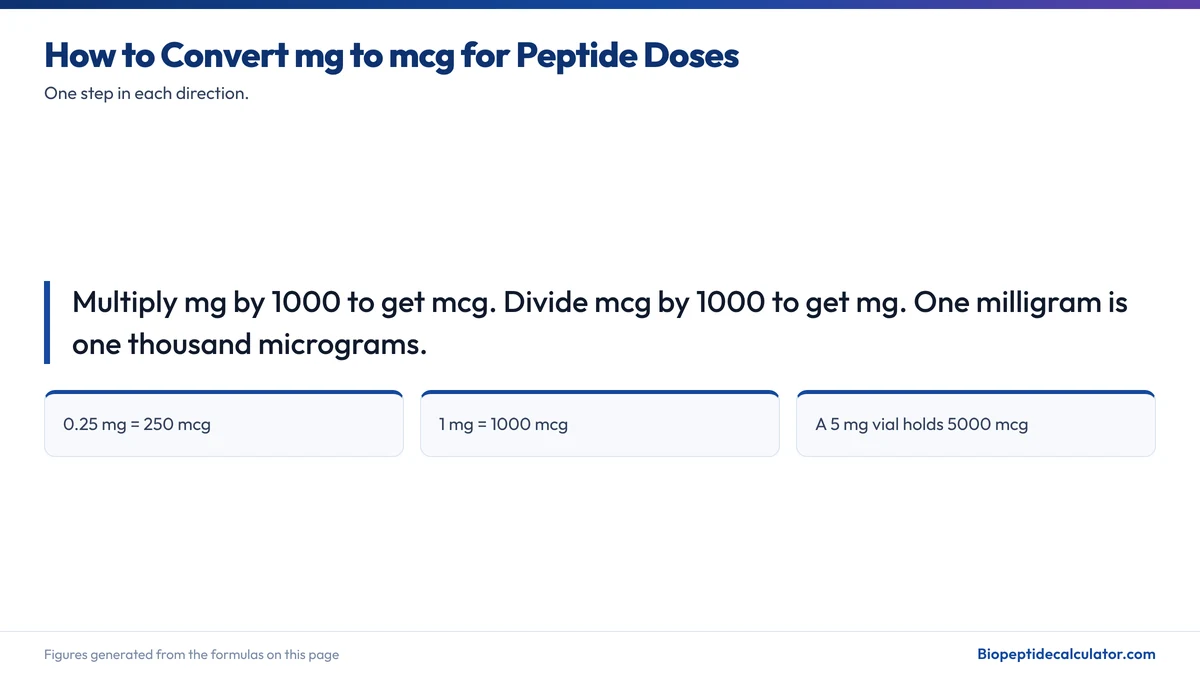
- 0.25 mg = 250 mcg
- 1 mg = 1000 mcg
- A 5 mg vial holds 5000 mcg
A three place decimal shift. That is the entire conversion, and it still causes more dosing errors than anything else in this subject.
The conversion
1 mg equals 1000 mcg.
Why it matters so much here
Because the two units are used side by side, in the same workflow, on the same vial.
The label says milligrams. The protocol says micrograms. The formula wants milligrams. Three steps, two units, and one chance to get it wrong in the middle.
Conversion table
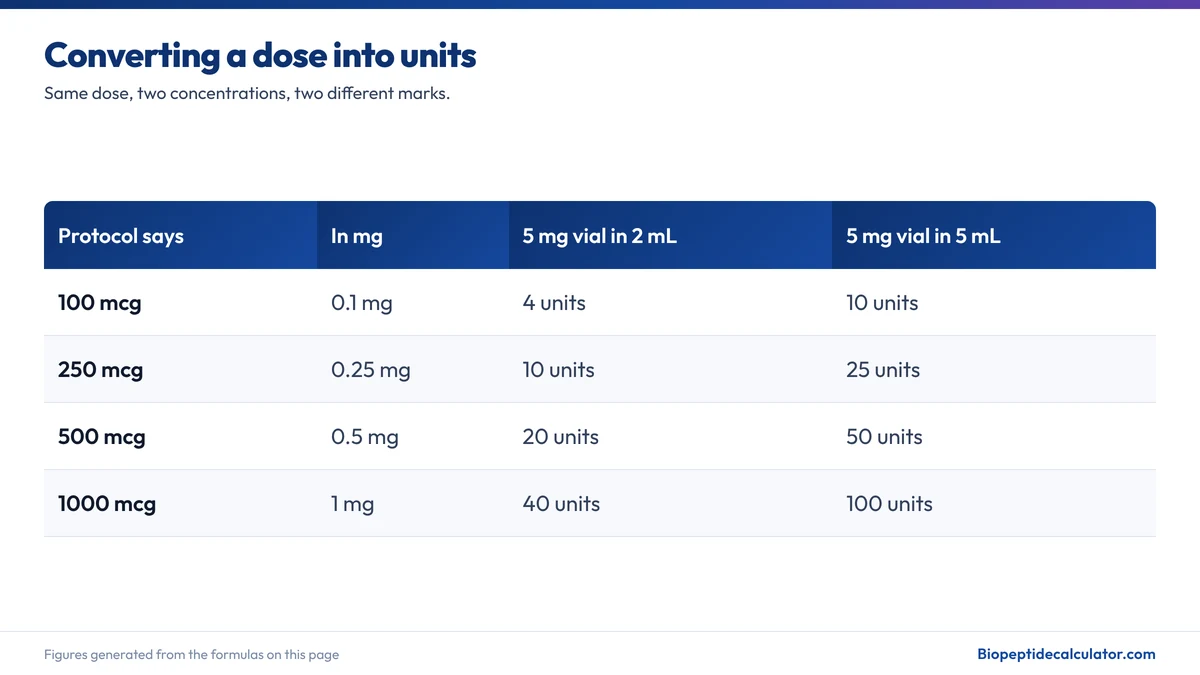
Converting a dose into units
Once the dose is in milligrams the rest is one division and one multiplication.
Units to draw equals the dose in mg divided by the concentration in mg/mL, multiplied by 100.
Notice the last two columns differ for the same dose. That is concentration, not a conversion error.
The decimal point errors to watch for
Frequently asked questions
How do you convert mg to mcg for peptides?
Multiply milligrams by 1000. One milligram is 1000 micrograms, so 0.25 mg is 250 mcg and 2.5 mg is 2500 mcg. To go the other way, divide micrograms by 1000.
How many mcg are in a 5 mg peptide vial?
Five thousand. A 5 mg vial contains 5000 mcg of peptide, which is twenty 250 mcg doses or ten 500 mcg doses.
Is 250 mcg the same as 0.25 mg?
Yes. They are two ways of writing the same quantity. Protocols usually use micrograms for doses this small because it avoids a leading decimal point.
Why are peptide vials labeled in mg but doses written in mcg?
Convention and readability. Vial contents are convenient numbers in milligrams, while individual doses are often fractions of a milligram, which are tidier written as whole numbers of micrograms.
What is the most common mg to mcg mistake?
Using micrograms in a formula that expects milligrams, or the reverse. That is a thousandfold error, and it is the single most consequential arithmetic mistake in peptide dosing.
Run your own vial and dose through the peptide dosage calculator.
Sources & Scientific References
The science on this page traces to the peer-reviewed and reference sources below. We link only to research and reference material.
Reference & Regulatory
- PubChem: Copper tripeptide-1. – the chemical database entry for the GHK-Cu complex
More at Bio Peptide Calculator
- Peptide dosages explained – mcg, mg and units in full
- Peptide reconstitution calculator – the conversion done for you
- How to read an insulin syringe – the third scale in play