
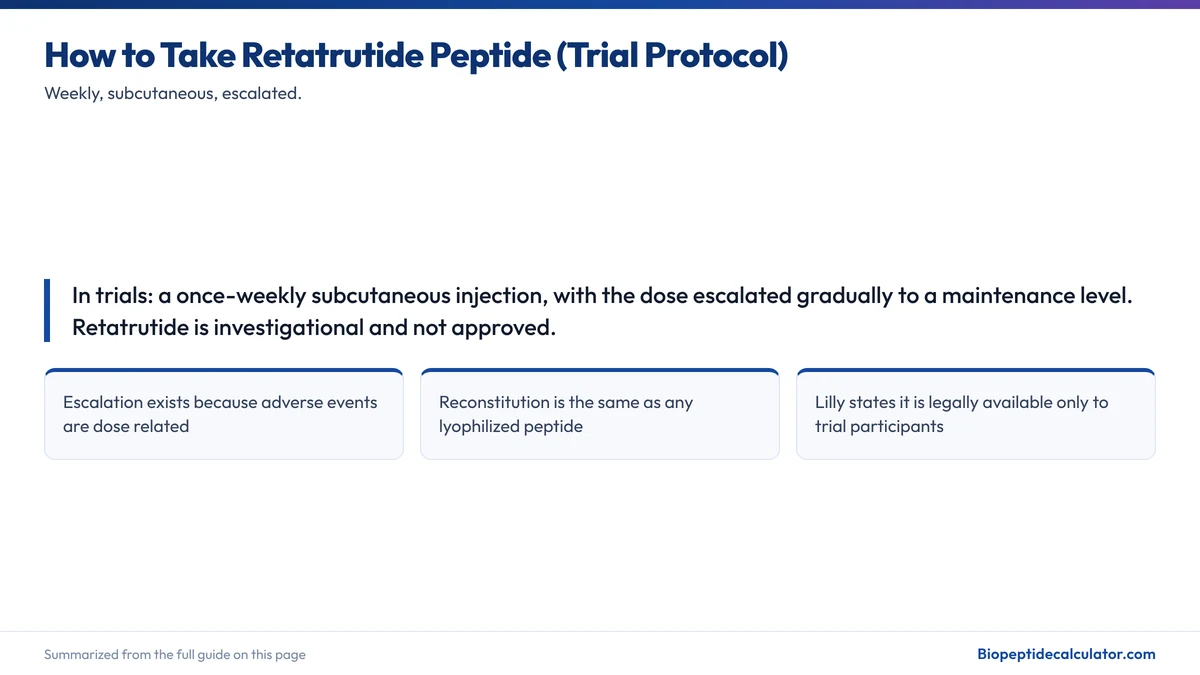
- Escalation exists because adverse events are dose related
- Reconstitution is the same as any lyophilized peptide
- Lilly states it is legally available only to trial participants
This page describes how the compound was administered in its clinical trials. That is a description, not an instruction.
The status question first
Retatrutide is investigational. It is not approved by the FDA or any other regulator for any use.
Eli Lilly’s own announcement describes retatrutide as investigational and states that it is legally available only to participants in Lilly’s clinical trials.
How it was administered in trials
TRIUMPH-1 randomised participants to maintenance doses of 4 mg, 9 mg or 12 mg weekly, each reached through a stepped escalation.
The retatrutide dosage chart sets out the escalation schedule in detail.
Why escalation exists
Because tolerability is a dose problem, and the trial data shows it clearly.
Discontinuation due to adverse events in TRIUMPH-1 was 4.1% on 4 mg, 6.9% on 9 mg and 11.3% on 12 mg, against 4.9% on placebo.
Every column rises with dose. Escalation is how trials get people to a maintenance dose they can stay on.
Reconstitution math
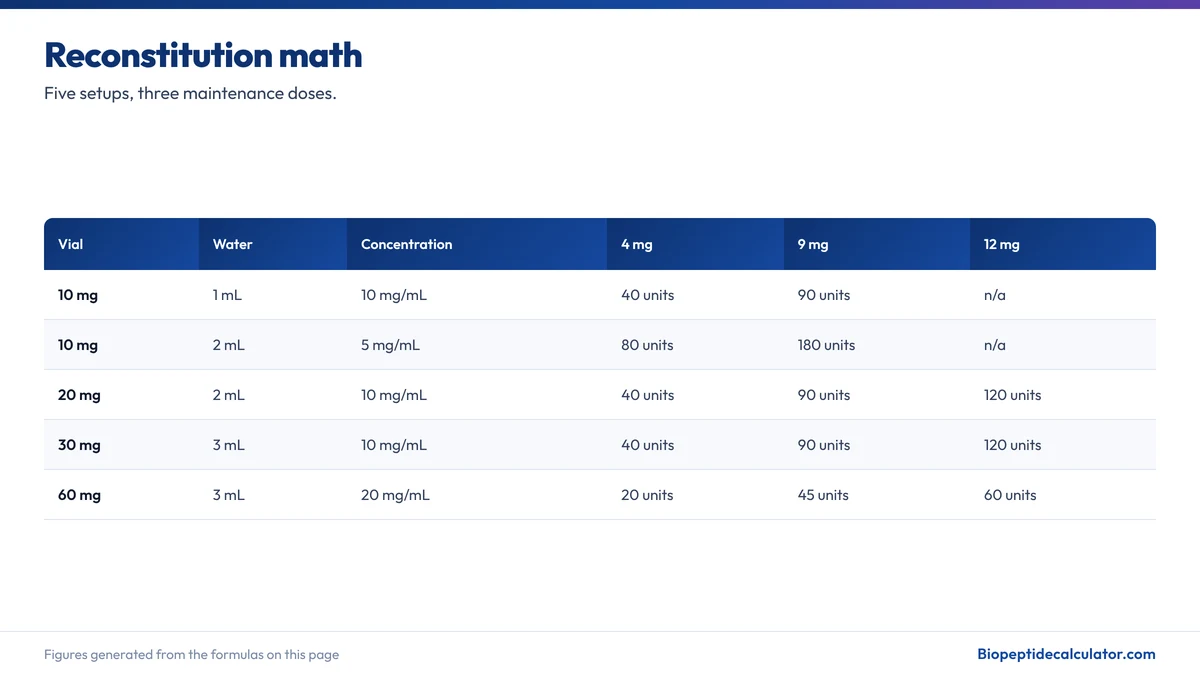
Standard peptide arithmetic. Concentration equals vial strength divided by the volume of bacteriostatic water added, so a 5 mg vial reconstituted with 2 mL gives 2.5 mg/mL.
Run your own vial through the retatrutide dosage calculator rather than copying a figure built on a different water volume.
Injection practicalities
A weekly subcutaneous injection is the same procedure as any other.
- Rotate sites rather than reusing one, as covered in peptide injections.
- Let the solution reach room temperature first, which reduces discomfort.
- Read from the flat front edge of the plunger, not the tapered tip.
- Single-use needle, every time.
Storage
Once reconstituted, peptide is normally refrigerated and used within weeks rather than months, with the exact window depending on the peptide and the diluent.
Write the concentration and the date on the vial when you mix it. At weekly dosing a vial lasts a long time, which makes both the date and the storage conditions matter more than they would at daily dosing.
Frequently asked questions
How do you take retatrutide?
In trials it was given as a once-weekly subcutaneous injection, with the dose escalated gradually to a maintenance level rather than started at target. Retatrutide is investigational and Lilly states it is legally available only to trial participants.
How often is retatrutide injected?
Once weekly. It is engineered for weekly dosing, which is standard across this drug class.
Why does retatrutide dosing start low?
Tolerability. Gastrointestinal adverse events are dose related, and discontinuation in TRIUMPH-1 rose from 4.1% on 4 mg to 11.3% on 12 mg. Escalating gradually gives the body time to adjust.
Where do you inject retatrutide?
Subcutaneously, into the fat layer, with sites rotated. The abdomen, outer thigh and back of the upper arm are the usual areas for a weekly subcutaneous injection.
How do you reconstitute a retatrutide vial?
The same way as any lyophilized peptide. Bring it to room temperature, wipe the stopper, inject bacteriostatic water slowly down the inside glass wall, and swirl rather than shake.
Run your own vial and dose through the peptide dosage calculator.
Sources & Scientific References
The science on this page traces to the peer-reviewed and reference sources below. We link only to research and reference material.
Peer-Reviewed Research
- Jastreboff AM, et al. Triple-Hormone-Receptor Agonist Retatrutide for Obesity: A Phase 2 Trial. N Engl J Med, 2023. – the 48 week phase 2 trial reporting up to 24% mean weight reduction
Reference & Regulatory
- Eli Lilly: Lilly’s triple agonist, retatrutide, delivered powerful weight loss in pivotal Phase 3 obesity trial. May 21, 2026. – the manufacturer’s topline TRIUMPH-1 results, with adverse event rates against placebo
More at Bio Peptide Calculator
- Retatrutide dosage calculator – the arithmetic for your vial
- Retatrutide dosage chart – the trial escalation schedule
- Is reta peptide safe – the adverse events behind the escalation