
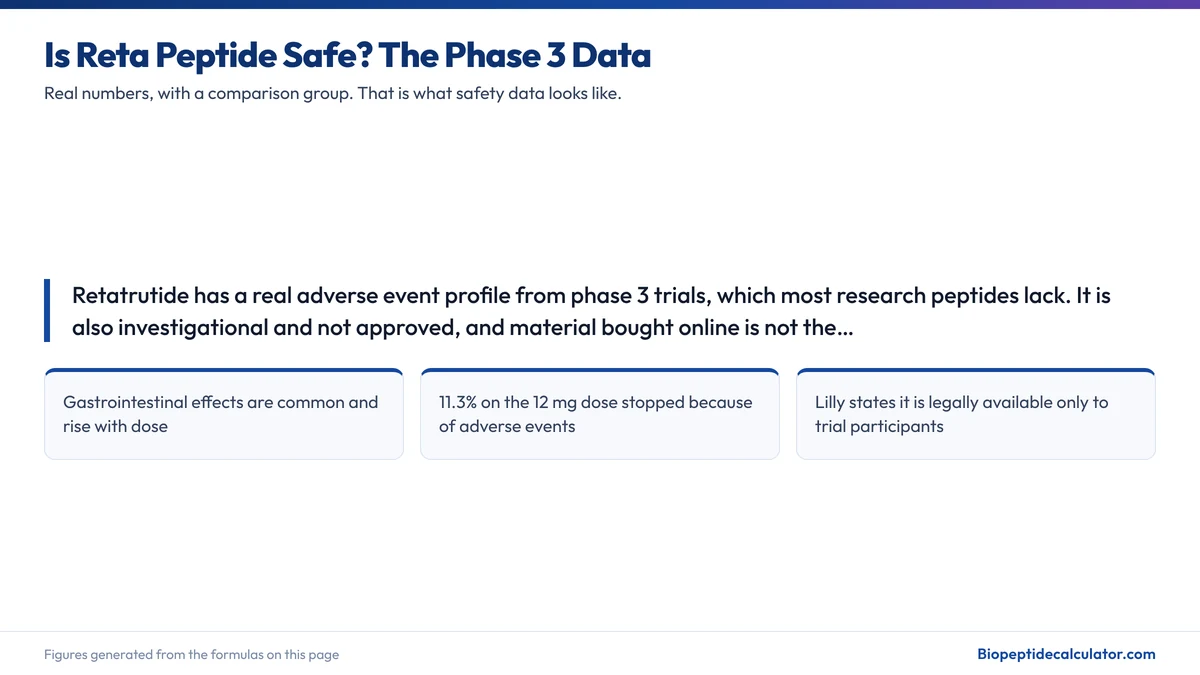
- Gastrointestinal effects are common and rise with dose
- 11.3% on the 12 mg dose stopped because of adverse events
- Lilly states it is legally available only to trial participants
This question has a better answer than most peptide safety questions, because somebody actually ran the trial. The answer is still not a simple yes.
What is actually known
Retatrutide is a triple agonist, acting at the GIP, GLP-1 and glucagon receptors.
In TRIUMPH-1, the phase 3 trial of 2,339 adults with obesity or overweight without diabetes, mean weight reduction at 80 weeks was 19.0% on 4 mg, 25.9% on 9 mg and 28.3% on 12 mg, against 2.2% on placebo.
That is a large trial with a placebo arm, published adverse event rates and a defined duration. Compared with the evidence base for most compounds discussed on peptide forums, it is in a different league.
The phase 3 adverse event table
The most common adverse events in TRIUMPH-1 were gastrointestinal and rose with dose. On 12 mg, nausea affected 42.4% of participants against 14.8% on placebo, diarrhea 32.0% against 13.5%, constipation 26.1% against 10.9% and vomiting 25.3% against 4.8%.
Two things to read out of that table. The gastrointestinal effects are common and clearly dose related. The respiratory infection row is barely different from placebo, which is how you can tell the others are real.
How many people stopped
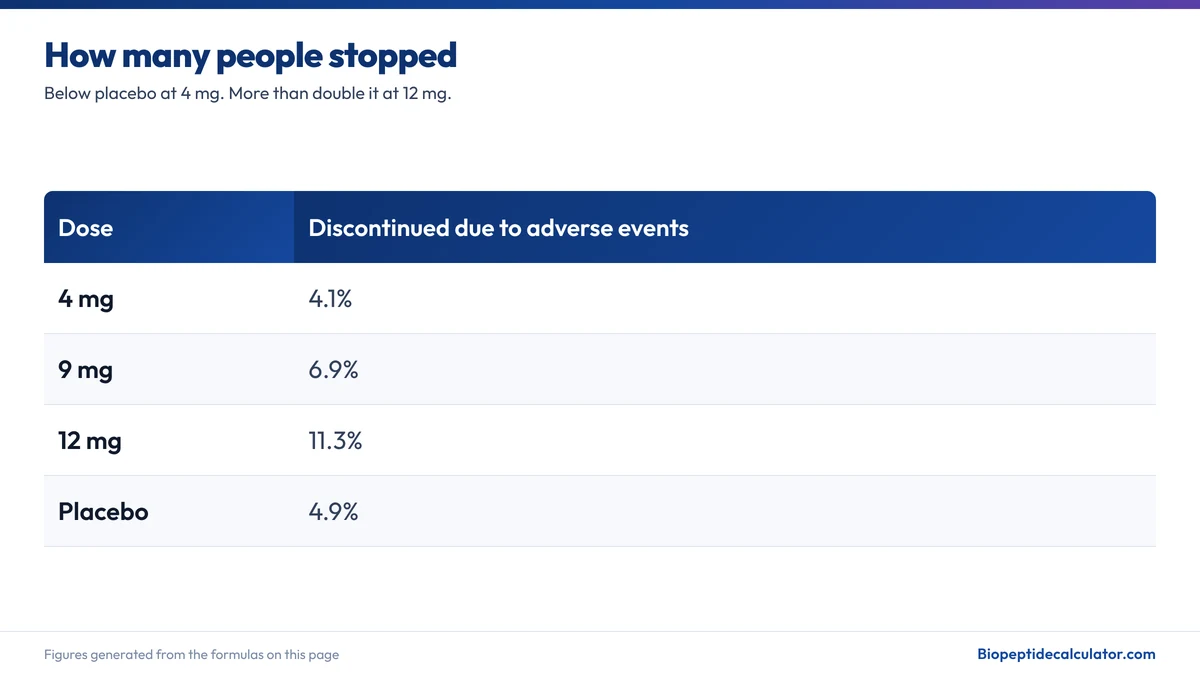
Adverse event percentages tell you how many people noticed something. Discontinuation tells you how many found it bad enough to stop.
Discontinuation due to adverse events in TRIUMPH-1 was 4.1% on 4 mg, 6.9% on 9 mg and 11.3% on 12 mg, against 4.9% on placebo.
Dysesthesia, the less familiar one
Dysesthesia, an altered or unpleasant sensation in the skin, was reported by 12.5% of participants on 12 mg against 0.9% on placebo, which makes it one of the more distinctive adverse events in the trial.
It is worth separating out because people expect the gastrointestinal effects and are not expecting this one. A rate of 12.5% against 0.9% on placebo is a wide enough gap to be a genuine finding rather than noise.
What trial data does not tell you
Trial data is the strongest evidence available and it has edges.
- It describes supervised use. Dose escalation, monitoring, and a clinician who can stop the trial.
- It describes 80 weeks. Longer-term effects are a separate question.
- It describes a selected population. Adults with obesity or overweight, without diabetes, who met entry criteria.
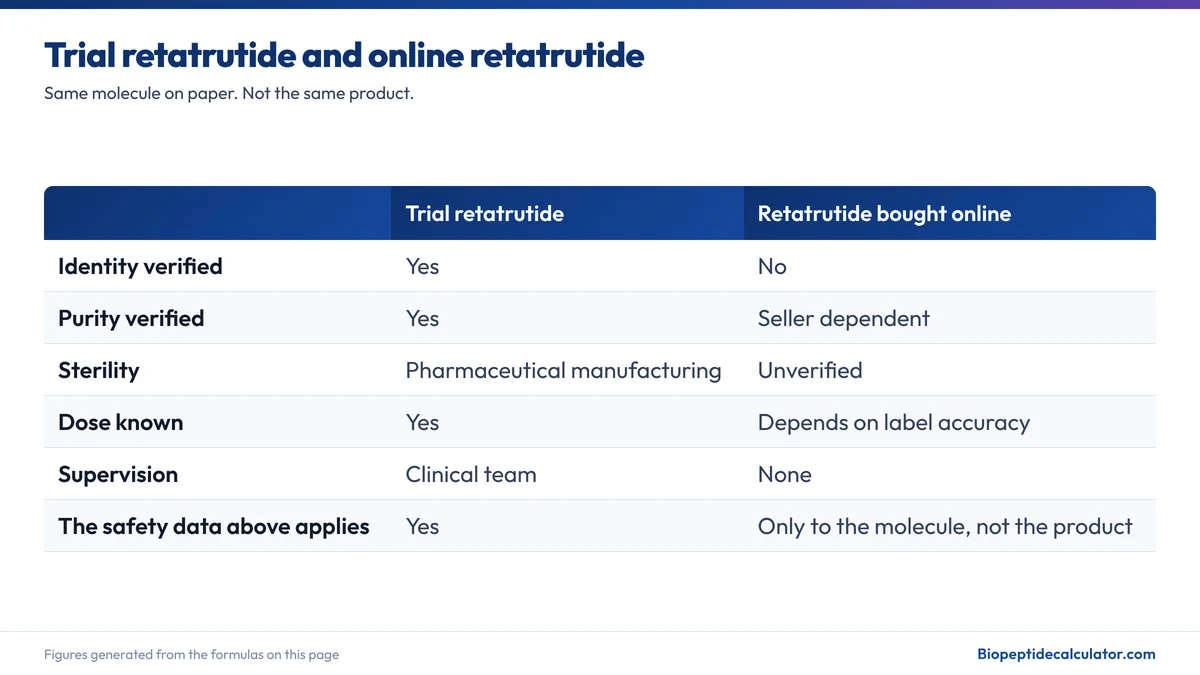
- It describes the manufacturer’s product. Known identity, known purity, known dose.
- Topline is not the full publication. Topline numbers precede the peer-reviewed paper and the complete dataset.
Trial retatrutide and online retatrutide
This distinction is the one that matters most for anyone reading this page, so it gets stated plainly.
Eli Lilly’s own announcement describes retatrutide as investigational and states that it is legally available only to participants in Lilly’s clinical trials.
Who should not be using it
Trial exclusion criteria are informative even outside a trial.
This is general information drawn from how this drug class is handled, not personal medical advice. A prescriber who has your history is the right person to ask.
The honest summary
Retatrutide is one of the better studied compounds people discuss, and it is still investigational.
The molecule has documented effects and documented adverse events at known doses in a supervised setting. That is genuinely more than can be said for BPC 157 or TB 500. It is not approval, no regulator has reviewed the full dataset, and the product most readers of this page could actually obtain is not the product that was tested.
Both halves of that are true at once.
Frequently asked questions
Is reta peptide safe?
Retatrutide has a documented adverse event profile from phase 3 trials, which is more than most research peptides can say. It is also investigational and not approved, and Eli Lilly states it is legally available only to participants in its clinical trials. Material bought online is not the trial product and carries separate unverified risks.
What are the side effects of retatrutide?
Predominantly gastrointestinal, and they rise with dose. In the TRIUMPH-1 phase 3 trial at 12 mg, nausea affected 42.4% of participants against 14.8% on placebo, diarrhea 32.0% against 13.5%, constipation 26.1% against 10.9% and vomiting 25.3% against 4.8%.
How many people stopped taking retatrutide due to side effects?
In TRIUMPH-1, discontinuation due to adverse events was 4.1% on 4 mg, 6.9% on 9 mg and 11.3% on 12 mg, against 4.9% on placebo. The rate on the lowest dose was below placebo.
Is retatrutide FDA approved?
No. Retatrutide is investigational. Phase 3 topline results were announced in May 2026, and Lilly announced no regulatory submission timing alongside them.
What is dysesthesia and why does it matter with retatrutide?
Dysesthesia is an altered or unpleasant skin sensation. It was reported by 12.5% of participants on 12 mg against 0.9% on placebo, which makes it one of the more distinctive findings in the trial and something less familiar than the gastrointestinal effects.
Is retatrutide bought online the same as trial retatrutide?
Not necessarily, and there is no way to confirm it from the outside. The trial data describes a pharmaceutical-grade product administered under supervision at known doses. A vial bought as a research chemical has no verified identity, purity or sterility.
Run your own vial and dose through the peptide dosage calculator.
Sources & Scientific References
The science on this page traces to the peer-reviewed and reference sources below. We link only to research and reference material.
Peer-Reviewed Research
- Jastreboff AM, et al. Triple-Hormone-Receptor Agonist Retatrutide for Obesity: A Phase 2 Trial. N Engl J Med, 2023. – the 48 week phase 2 trial reporting up to 24% mean weight reduction
- PubMed record: Retatrutide phase 2 trial (NEJM 2023). – the indexed record for the trial above
Reference & Regulatory
- Eli Lilly: Lilly’s triple agonist, retatrutide, delivered powerful weight loss in pivotal Phase 3 obesity trial. May 21, 2026. – the manufacturer’s topline TRIUMPH-1 results, with adverse event rates against placebo
- Federal Register: Enforcement Discretion Policy Regarding 503A Compounding Using Certain Peptide Bulk Drug Substances. HHS, 91 FR, October 30, 2026. Docket HHS-OASH-2026-0496. – the official notice of the draft enforcement discretion policy, which states that compounded drugs are not FDA-approved
More at Bio Peptide Calculator
- What is retatrutide peptide – the compound, its targets and its trial history
- Retatrutide dosage calculator – reconstitution math for a retatrutide vial
- Retatrutide dosage chart – the dose escalation schedule used in trials