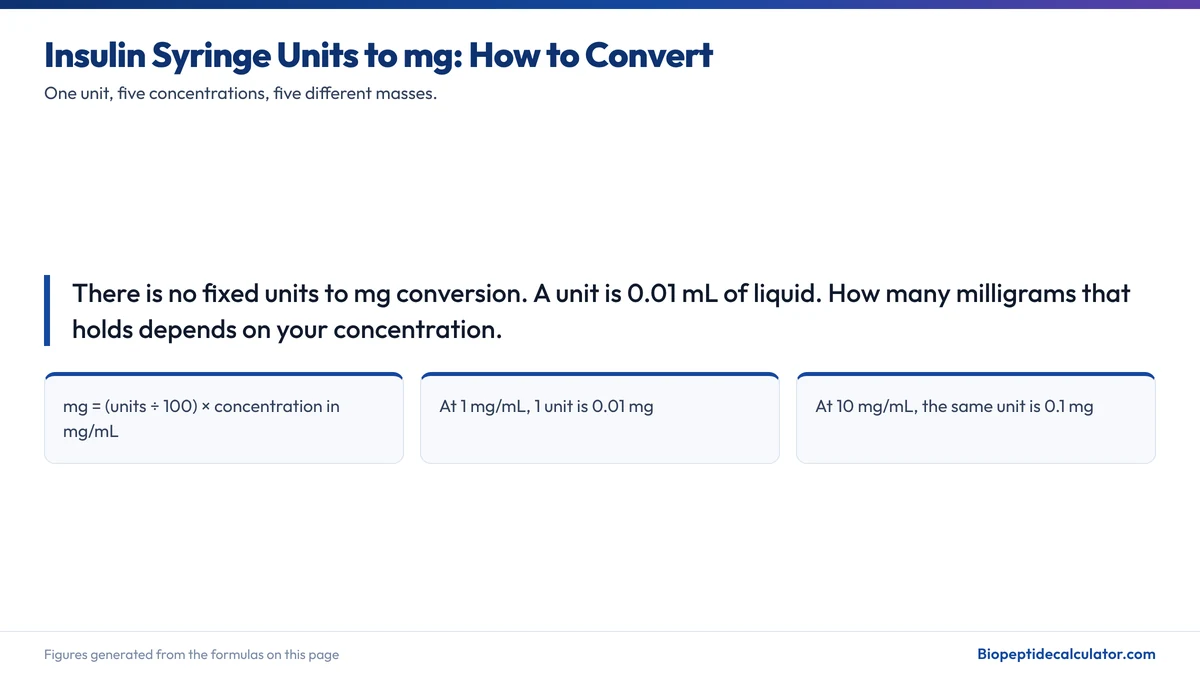
- mg = (units ÷ 100) × concentration in mg/mL
- At 1 mg/mL, 1 unit is 0.01 mg
- At 10 mg/mL, the same unit is 0.1 mg
This question comes up constantly and it has no single answer. Anyone who gives you one without asking about your vial has made an assumption on your behalf.
There is no fixed conversion
Units measure volume. Milligrams measure mass. Converting between them needs a density, and here the density is your concentration.
Which you chose. When you added the water.
What a unit actually measures
On a U-100 insulin syringe 100 units equals 1 mL, so each unit is 0.01 mL.
The conversion, once you know your concentration
- Find your concentration.
Vial strength divided by the water you added.
- Turn units into milliliters.
Divide by 100.
- Multiply.
Milliliters times concentration gives milligrams.
Worked: 30 units from a 10 mg vial reconstituted with 2 mL. Concentration is 5 mg/mL. Thirty units is 0.3 mL. Multiply and you get 1.5 mg.
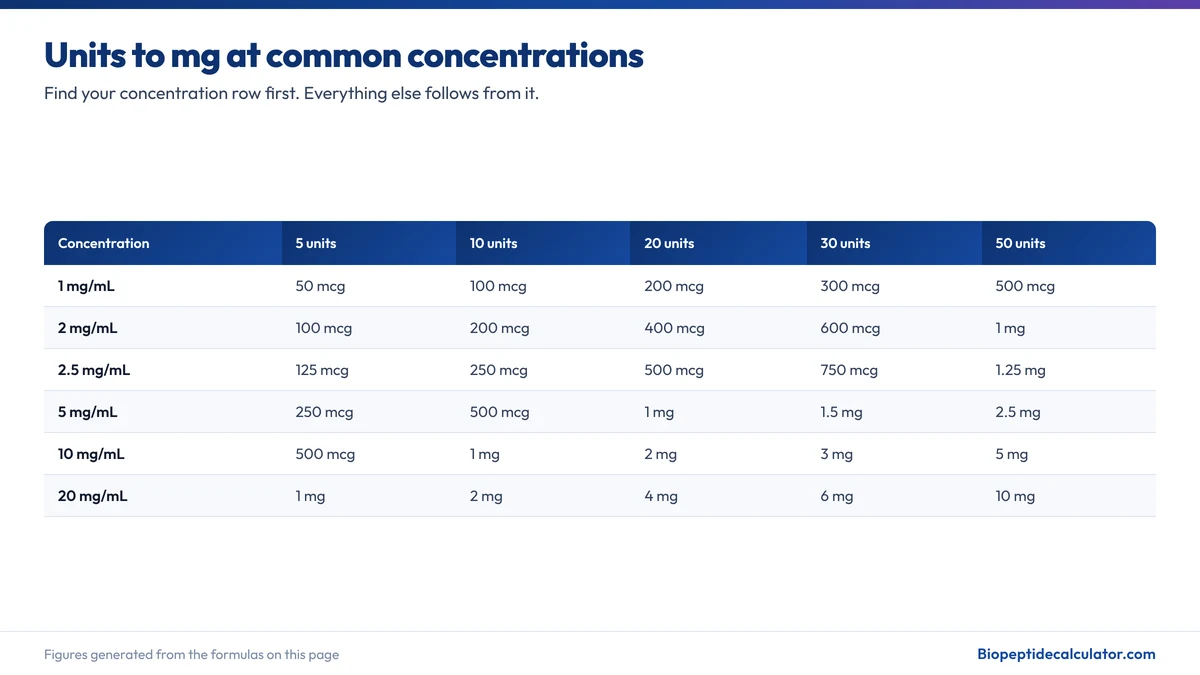
Units to mg at common concentrations
Why borrowed numbers are dangerous here
Someone says they take 20 units. That tells you almost nothing.
Run your own vial through the peptide reconstitution calculator instead.
Frequently asked questions
How many mg is one unit on an insulin syringe?
There is no fixed answer. A unit is 0.01 mL of liquid, so the milligrams it contains depend entirely on your concentration. At 1 mg/mL one unit is 0.01 mg. At 10 mg/mL the same unit is 0.1 mg.
How do you convert insulin syringe units to mg?
Divide the units by 100 to get milliliters, then multiply by your concentration in mg/mL. So 20 units at 5 mg/mL is 0.2 mL times 5, which is 1 mg.
Is 1 unit always the same amount of peptide?
No. One unit is always the same volume of liquid, 0.01 mL, but the amount of peptide in that volume changes with how much water you added to the vial.
Why do people give peptide doses in units?
Because units are what the syringe is marked in, so they are what you actually read. A dose in units is only meaningful alongside the concentration it refers to.
How many mg is 10 units of a 10 mg vial in 2 mL?
That vial is 5 mg/mL. Ten units is 0.1 mL, so it contains 0.5 mg, which is 500 mcg.
Run your own vial and dose through the peptide dosage calculator.
Sources & Scientific References
The science on this page traces to the peer-reviewed and reference sources below. We link only to research and reference material.
Reference & Regulatory
- PubChem: Copper tripeptide-1. – the chemical database entry for the GHK-Cu complex
More at Bio Peptide Calculator
- How to read an insulin syringe – the barrel markings themselves
- Peptide dosages explained – why a unit is not a dose
- Peptide reconstitution calculator – your own numbers, not someone else’s