
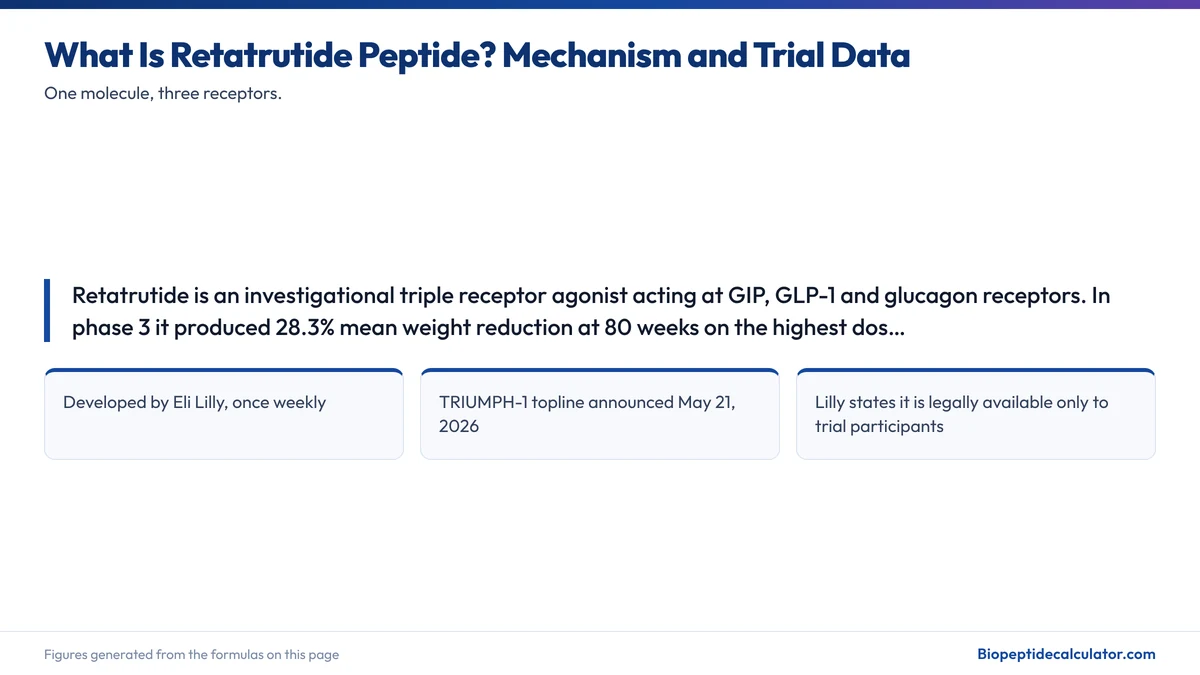
- Developed by Eli Lilly, once weekly
- TRIUMPH-1 topline announced May 21, 2026
- Lilly states it is legally available only to trial participants
Three receptors instead of one or two. That is the whole design idea, and the phase 3 numbers are the reason the compound gets talked about as much as it does.
What retatrutide is
Retatrutide is a triple agonist, acting at the GIP, GLP-1 and glucagon receptors.
Retatrutide is investigational. It is not approved by the FDA or any other regulator for any use.
It is a once-weekly injectable, developed by Eli Lilly, aimed primarily at obesity with parallel work in type 2 diabetes.
Three receptors, and why that is the point
The glucagon receptor is the interesting one, because adding it looks counterintuitive.
Glucagon raises blood glucose, which is the opposite of what a diabetes drug normally wants. The theory is that paired with GLP-1 and GIP activity, the glucagon arm adds energy expenditure without the glucose penalty.
How it compares with semaglutide and tirzepatide
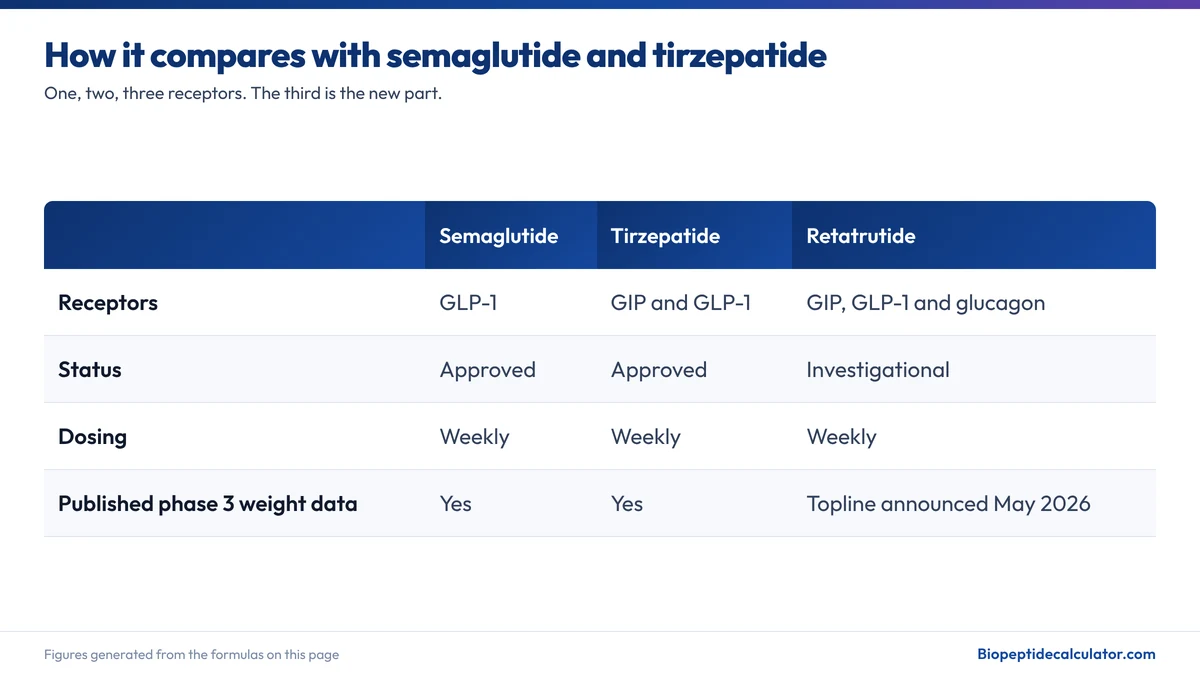
Semaglutide is a peptide, a modified 31 amino acid analogue of human GLP-1. Tirzepatide is a synthetic 39 amino acid peptide acting at both the GIP and GLP-1 receptors.
The phase 2 trial
In the 48 week phase 2 trial published in the New England Journal of Medicine in 2023, participants on the highest dose saw mean weight reduction of about 24%.
That was the 2023 result in the New England Journal of Medicine that put the compound on the map. It is also the figure most sites still quote, which is now out of date by one full trial phase.
The phase 3 results
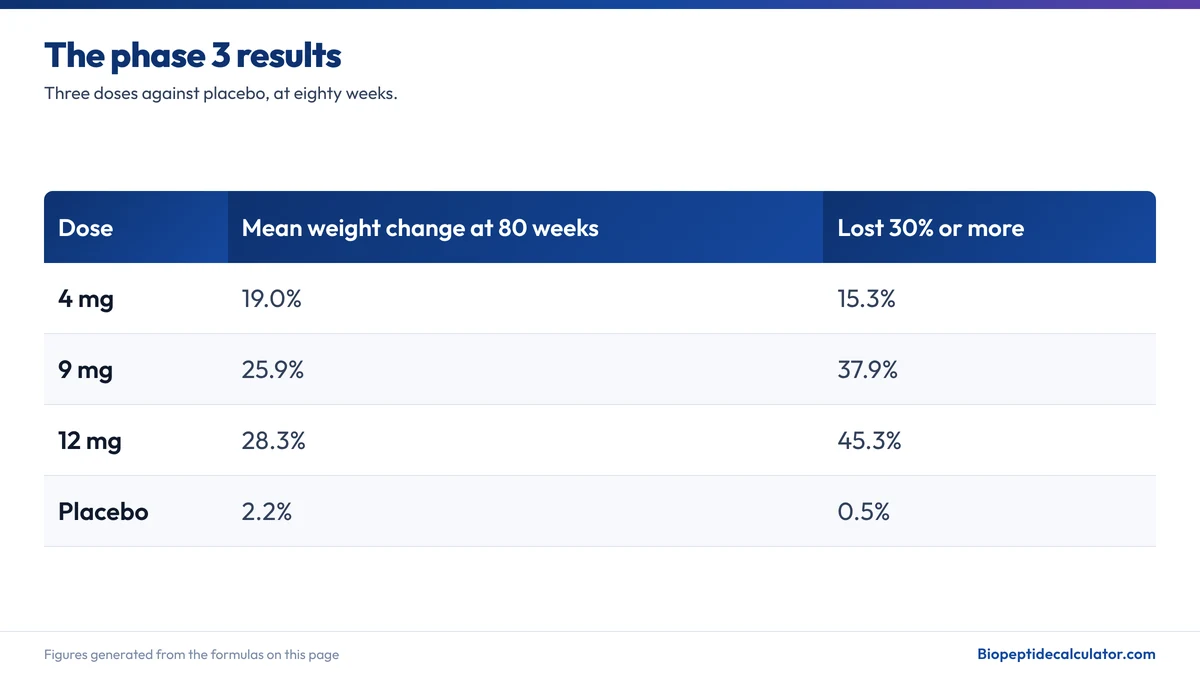
In TRIUMPH-1, the phase 3 trial of 2,339 adults with obesity or overweight without diabetes, mean weight reduction at 80 weeks was 19.0% on 4 mg, 25.9% on 9 mg and 28.3% on 12 mg, against 2.2% on placebo.
In TRIUMPH-1, 45.3% of participants on the 12 mg dose lost at least 30% of their body weight at 80 weeks, against 0.5% on placebo.
TRIUMPH-1 topline results were announced on May 21, 2026. Lilly said further results from the TRIUMPH program, including TRIUMPH-2 and TRIUMPH-3, would follow, and announced no regulatory submission timing alongside the topline data.
Adverse events
The most common adverse events in TRIUMPH-1 were gastrointestinal and rose with dose. On 12 mg, nausea affected 42.4% of participants against 14.8% on placebo, diarrhea 32.0% against 13.5%, constipation 26.1% against 10.9% and vomiting 25.3% against 4.8%.
The retatrutide safety page goes through these in detail, including the discontinuation pattern and what dysesthesia means.
Dosing in the trials
Trials escalate the dose rather than starting at the target, which is standard for this drug class and is the reason tolerability differs between people who titrate and people who do not.
TRIUMPH-1 randomised participants to maintenance doses of 4 mg, 9 mg or 12 mg weekly, reached through a stepped escalation rather than from the first injection. The retatrutide dosage chart sets out the escalation schedule.
Regulatory status as of November 2026
Eli Lilly’s own announcement describes retatrutide as investigational and states that it is legally available only to participants in Lilly’s clinical trials.
Retatrutide was not among the peptides affected by the 2026 compounding changes. It is an investigational drug in an active trial program, which is a different regulatory track entirely from the research peptides covered by the FDA status page.
Reconstitution math for a retatrutide vial
The arithmetic is the same as for any peptide. Vial strength divided by water gives concentration, dose divided by concentration times 100 gives units.
Run your own vial through the retatrutide dosage calculator rather than copying a figure from a table built on someone else’s water volume.
Frequently asked questions
What is retatrutide peptide?
Retatrutide is an investigational peptide that acts on three receptors at once: GIP, GLP-1 and glucagon. It is being developed by Eli Lilly for obesity and is not approved by any regulator. Phase 3 topline results were announced in May 2026.
How much weight do people lose on retatrutide?
In the TRIUMPH-1 phase 3 trial, mean weight reduction at 80 weeks was 19.0% on 4 mg, 25.9% on 9 mg and 28.3% on 12 mg, compared with 2.2% on placebo. Just over 45% of participants on 12 mg lost at least 30% of their body weight.
Is retatrutide better than tirzepatide?
They have not been compared head to head in a published trial, so any ranking is inference rather than evidence. Retatrutide adds a third receptor target, glucagon, and its phase 3 weight reduction figures are numerically higher than those reported for tirzepatide in separate trials of different populations.
Is retatrutide FDA approved?
No. Retatrutide is investigational. Eli Lilly’s own announcement states it is legally available only to participants in its clinical trials, and no regulatory submission timing was announced alongside the phase 3 topline data.
What is the difference between retatrutide and semaglutide?
Semaglutide acts at one receptor, GLP-1, and is an approved drug. Retatrutide acts at three, adding GIP and glucagon, and is investigational. The glucagon component is the part neither semaglutide nor tirzepatide has.
How many amino acids does retatrutide have?
Retatrutide is a synthetic peptide built on a GIP analogue backbone with modifications that extend its duration of action, allowing once-weekly administration.
Run your own vial and dose through the peptide calculator.
Sources & Scientific References
The science on this page traces to the peer-reviewed and reference sources below. We link only to research and reference material.
Peer-Reviewed Research
- Jastreboff AM, et al. Triple-Hormone-Receptor Agonist Retatrutide for Obesity: A Phase 2 Trial. N Engl J Med, 2023. – the 48 week phase 2 trial reporting up to 24% mean weight reduction
- PubMed record: Retatrutide phase 2 trial (NEJM 2023). – the indexed record for the trial above
Reference & Regulatory
- Eli Lilly: Lilly’s triple agonist, retatrutide, delivered powerful weight loss in pivotal Phase 3 obesity trial. May 21, 2026. – the manufacturer’s topline TRIUMPH-1 results, with adverse event rates against placebo
More at Bio Peptide Calculator
- Is reta peptide safe – the adverse event data in full
- Retatrutide dosage calculator – reconstitution math for your vial
- Retatrutide dosage chart – the trial escalation schedule