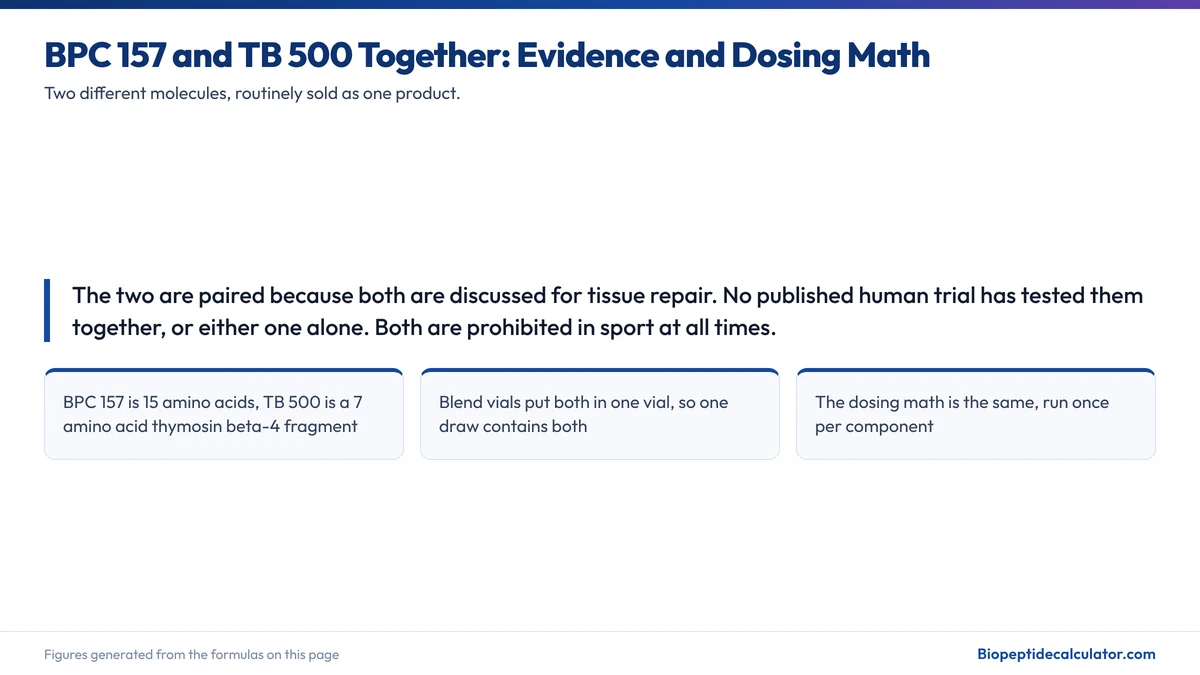
- BPC 157 is 15 amino acids, TB 500 is a 7 amino acid thymosin beta-4 fragment
- Blend vials put both in one vial, so one draw contains both
- The dosing math is the same, run once per component
This is the most searched peptide pairing there is, and the evidence behind it is thinner than almost anyone discussing it assumes.
Why the two get paired
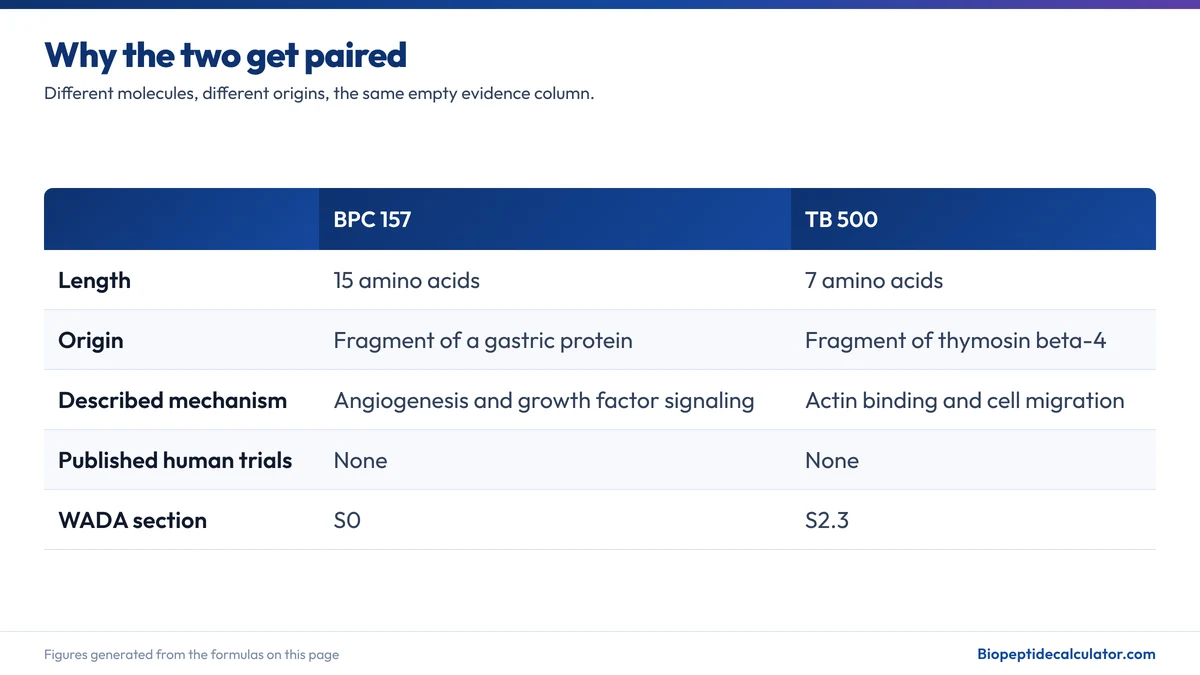
Both compounds appear in the same preclinical literature on tissue repair, and the argument for combining them is that they are described as acting through different mechanisms.
What TB 500 actually is
TB 500 is a synthetic fragment of thymosin beta-4. The FDA’s own listing names it as Thymosin Beta-4, Fragment (LKKTETQ), which is the seven amino acid active sequence rather than the full 43 amino acid protein.
TB 500 and thymosin beta-4 are not the same molecule. Thymosin beta-4 is the full-length natural protein, while TB 500 is a short fragment of it, and research on one does not automatically transfer to the other.
That distinction gets lost constantly. Sources citing thymosin beta-4 research in support of TB 500 are citing work on a different, much larger molecule.
What evidence exists for the combination
No published human clinical trial has tested BPC 157 and TB 500 together. Neither compound has published human trials individually, so a combination has no human evidence of any kind behind it.
BPC 157 has not been through published human clinical trials. The evidence base is preclinical, overwhelmingly rodent studies. TB 500 has not been through published human clinical trials. As with BPC 157, the evidence base is preclinical.
Blend vials versus separate vials
Blends are sold as a single vial containing both. The practical difference is control.
Reconstitution math for a blend
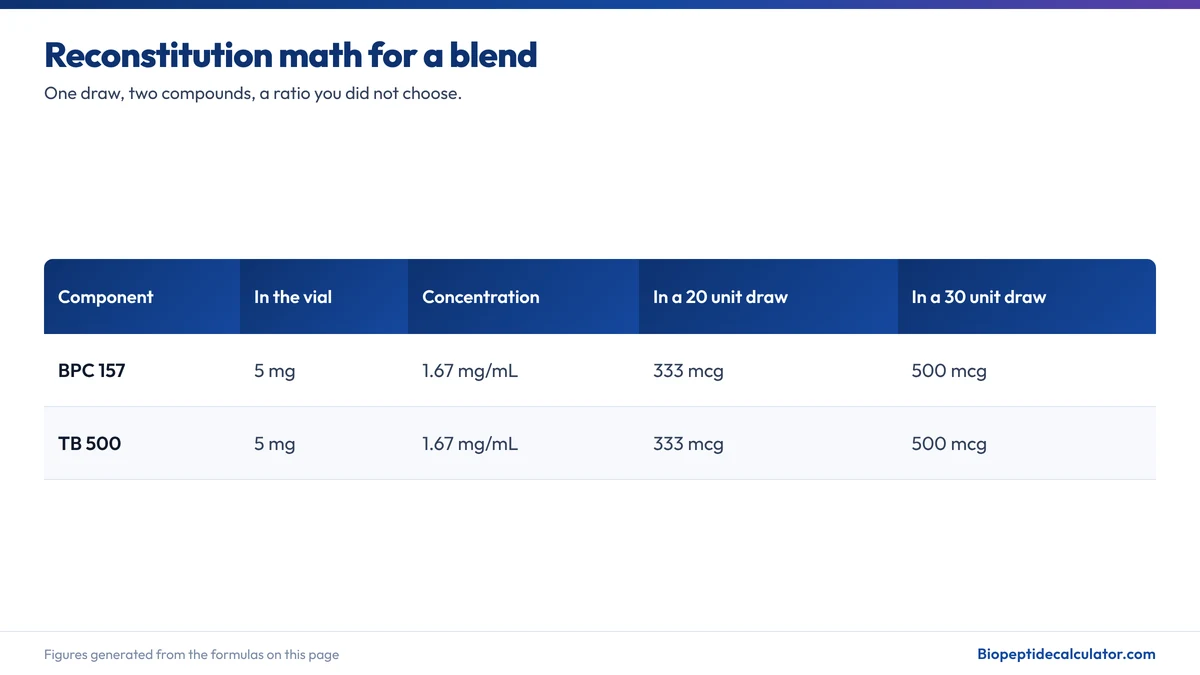
A blend vial lists two strengths. Both dissolve in the same water, so every draw contains both in the ratio the manufacturer set.
Take a 5 mg BPC 157 and 5 mg TB 500 blend, reconstituted with 3 mL.
Because the two strengths are equal here, one draw delivers the same amount of each. A blend listing 10 mg and 5 mg would deliver twice as much of the first, and the ratio is fixed whatever volume you draw.
Reconstitution math for separate vials
With separate vials each one is an ordinary reconstitution problem, and you set the ratio yourself.
Run your own numbers through the peptide reconstitution calculator rather than borrowing a figure built on a different water volume.
Anti-doping status of both
Both compounds are named on the World Anti-Doping Agency 2026 Prohibited List, and both are prohibited at all times rather than in competition only. They sit in different sections: BPC 157 is named under S0, non-approved substances, while TB 500 is named under S2.3, growth factors and growth factor modulators, as Thymosin-beta4 and its derivatives e.g. TB-500.
Section S2.3 closes with a catch-all covering any other growth factor or growth factor modulator that affects protein synthesis or breakdown in muscle, tendon or ligament, or that affects blood vessel formation, energy use, regenerative capacity or muscle fiber type, so a compound does not have to be named to be prohibited.
Regulatory status of both
Both were among the twelve peptides removed from FDA Category 2 in April 2026, both were recommended for the 503A bulks list by the advisory committee in July, and both are named in the October 2026 draft enforcement discretion policy.
None of these 2026 actions approved any peptide. Enforcement discretion is a statement about what a regulator intends to prioritize, not a finding that a substance is safe or effective.
What to weigh before stacking anything
Stacking multiplies every unknown rather than adding to them.
- Attribution. Two compounds at once means any effect, good or bad, cannot be assigned to either.
- Interaction. Not studied, which is not the same as absent.
- Product risk doubles. Two vials, two chances the contents are not what the label says.
- Dose errors compound. Two calculations instead of one, or a blend where one number controls both.
- Anti-doping. Both prohibited at all times, if that applies to you.
None of that is an argument that the combination does nothing. It is an argument that nobody currently knows, including the people selling it.
Frequently asked questions
Can you take BPC 157 and TB 500 together?
People do, and they are sold together as blends. No published human clinical trial has tested the combination, and neither compound has published human trials individually, so there is no human evidence for the pairing.
What is the difference between BPC 157 and TB 500?
BPC 157 is a 15 amino acid synthetic peptide described as a fragment of a gastric protein. TB 500 is a seven amino acid fragment of thymosin beta-4. They are different molecules with different origins, paired because both are discussed in tissue repair contexts.
How do you calculate doses from a BPC 157 and TB 500 blend vial?
A blend vial lists two strengths, for example 5 mg of each in one vial. Both dissolve in the same water, so one draw contains both. Calculate the units from whichever component sets your target dose, then check what that same volume delivers of the other.
Is TB 500 the same as thymosin beta-4?
No. Thymosin beta-4 is the full 43 amino acid natural protein. TB 500 is a short fragment of it, the LKKTETQ sequence. Research on the full protein does not automatically apply to the fragment.
Are BPC 157 and TB 500 banned in sport?
Both are on the World Anti-Doping Agency 2026 Prohibited List and both are prohibited at all times. BPC 157 is listed under S0 and TB 500 under S2.3 as a thymosin beta-4 derivative.
Is the BPC 157 and TB 500 stack safe?
There is no safety data for the combination in humans, because the trials that would produce it have not been run. That is unknown rather than safe, and combining two compounds introduces questions neither one answers alone.
Run your own vial and dose through the peptide calculator.
Sources & Scientific References
The science on this page traces to the peer-reviewed and reference sources below. We link only to research and reference material.
Peer-Reviewed Research
- Jozwiak M, et al. Multifunctionality and Possible Medical Application of the BPC 157 Peptide: Literature and Patent Review. Pharmaceuticals, 2025;18:185 (PMC). – the current review of what BPC 157 research does and does not show
- Sikiric P, et al. Reply on BPC 157 therapy, angiogenesis and nitric oxide. Pharmaceuticals (PMC). – the exchange between research groups on mechanism
Reference & Regulatory
- World Anti-Doping Agency: The 2026 Prohibited List, in force January 1 to December 31, 2026. – the official list, which names BPC 157 under S0 and TB 500 under S2.3
- Federal Register: Enforcement Discretion Policy Regarding 503A Compounding Using Certain Peptide Bulk Drug Substances. HHS, 91 FR, October 30, 2026. Docket HHS-OASH-2026-0496. – the official notice of the draft enforcement discretion policy, which states that compounded drugs are not FDA-approved
- McDermott Will & Schulte: PCAC backs majority of peptides in two-day public meeting, July 2026. – the recorded vote counts from the July 23 to 24, 2026 advisory committee meeting
More at Bio Peptide Calculator
- What is BPC 157 peptide – the compound on its own
- Peptide reconstitution calculator – run a blend or a single vial through it
- What is the Wolverine peptide stack – the name this pairing is often sold under