
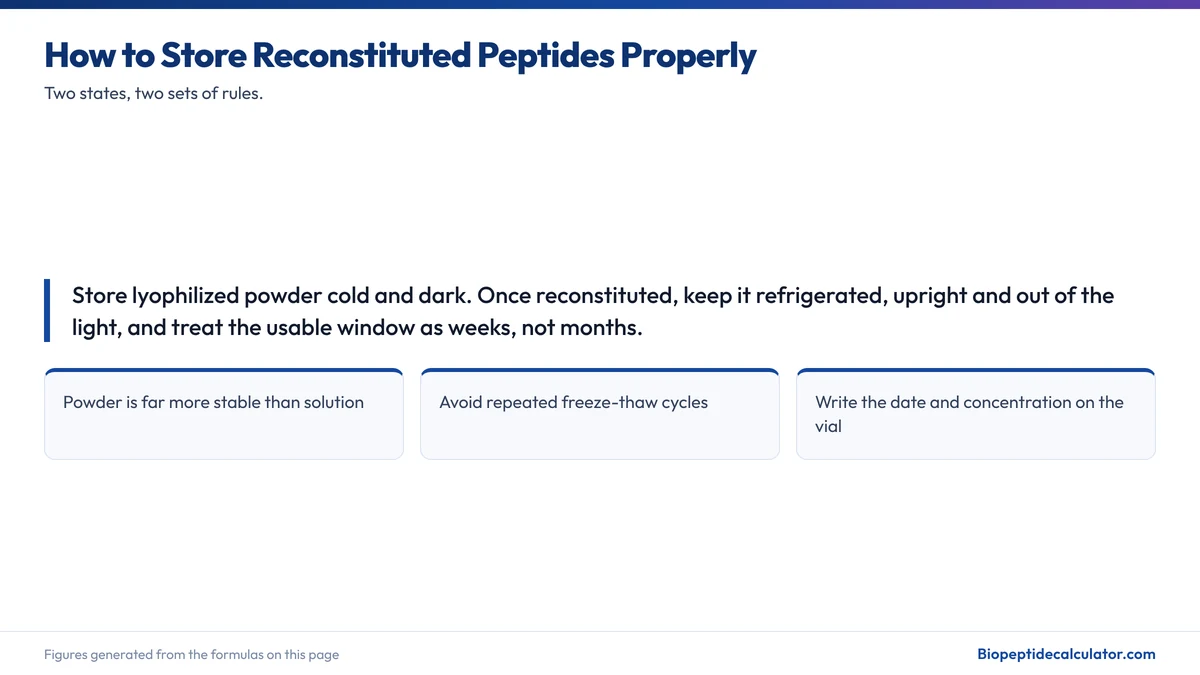
- Powder is far more stable than solution
- Avoid repeated freeze-thaw cycles
- Write the date and concentration on the vial
Storage is where a correctly calculated dose quietly becomes the wrong dose. Not because the number changed, but because the peptide did.
Powder and solution are different problems
A peptide in a vial exists in one of two states, and they do not behave alike.
Lyophilized peptide is normally stored cold and away from light, and is far more stable than the same peptide once reconstituted.
Storing lyophilized powder
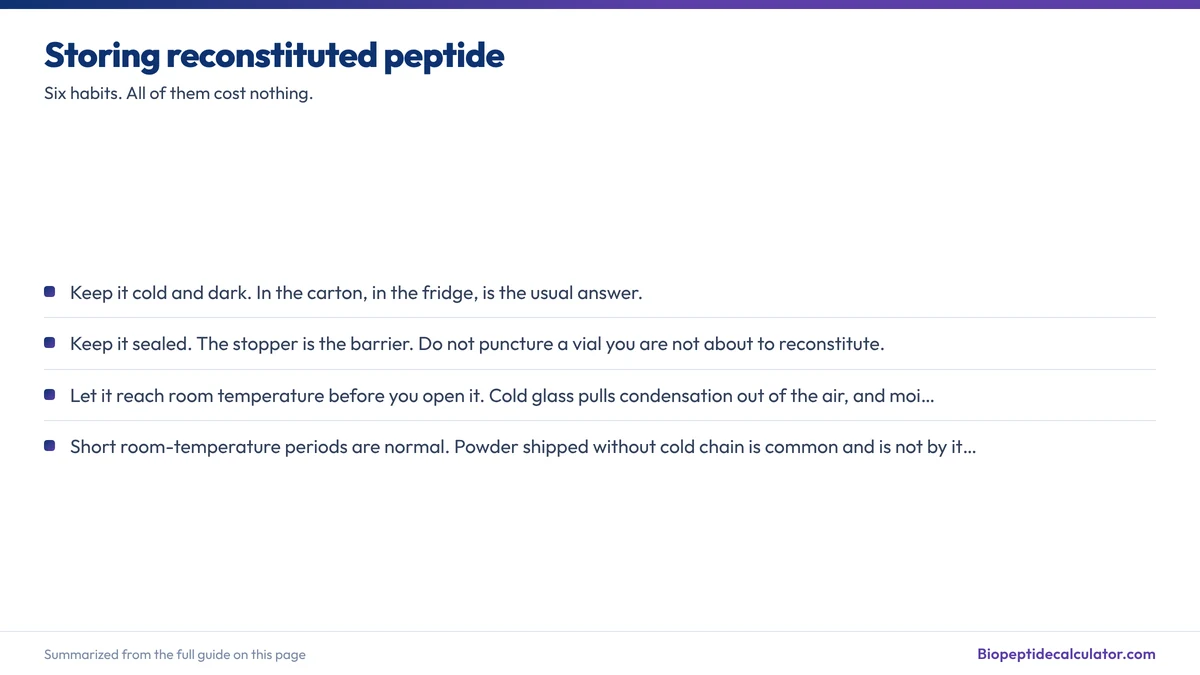
- Keep it cold and dark. In the carton, in the fridge, is the usual answer.
- Keep it sealed. The stopper is the barrier. Do not puncture a vial you are not about to reconstitute.
- Let it reach room temperature before you open it. Cold glass pulls condensation out of the air, and moisture is the thing powder is being protected from.
- Short room-temperature periods are normal. Powder shipped without cold chain is common and is not by itself a problem.
Storing reconstituted peptide
Once reconstituted, peptide is normally refrigerated and used within weeks rather than months, with the exact window depending on the peptide and the diluent.
Why benzyl alcohol matters here
Bacteriostatic water contains 0.9% benzyl alcohol, which suppresses bacterial growth and allows a vial to be entered more than once. Sterile water contains no preservative and is single use.
That is the storage consequence: a vial reconstituted with bacteriostatic water can be entered repeatedly over its usable life. The same vial reconstituted with plain sterile water has no preservative in it, so every entry carries more risk and the sensible window is much shorter.
Light, heat and freeze-thaw
Three things degrade peptides, and all three are avoidable.
Repeated cycles are the problem more than cold itself. One trip through a freezer is not the same as ten.
Travel and transport
A cool bag and an ice pack, with the vial not touching the ice pack directly.
Direct contact can take a solution below freezing, which is the one thing you were trying to avoid. A layer of cloth or a small box between them is enough.
- Keep vials upright in transit so solution stays off the stopper.
- Carry powder rather than solution where you have the choice.
- Short periods out of the fridge are normal, extended ones are not.
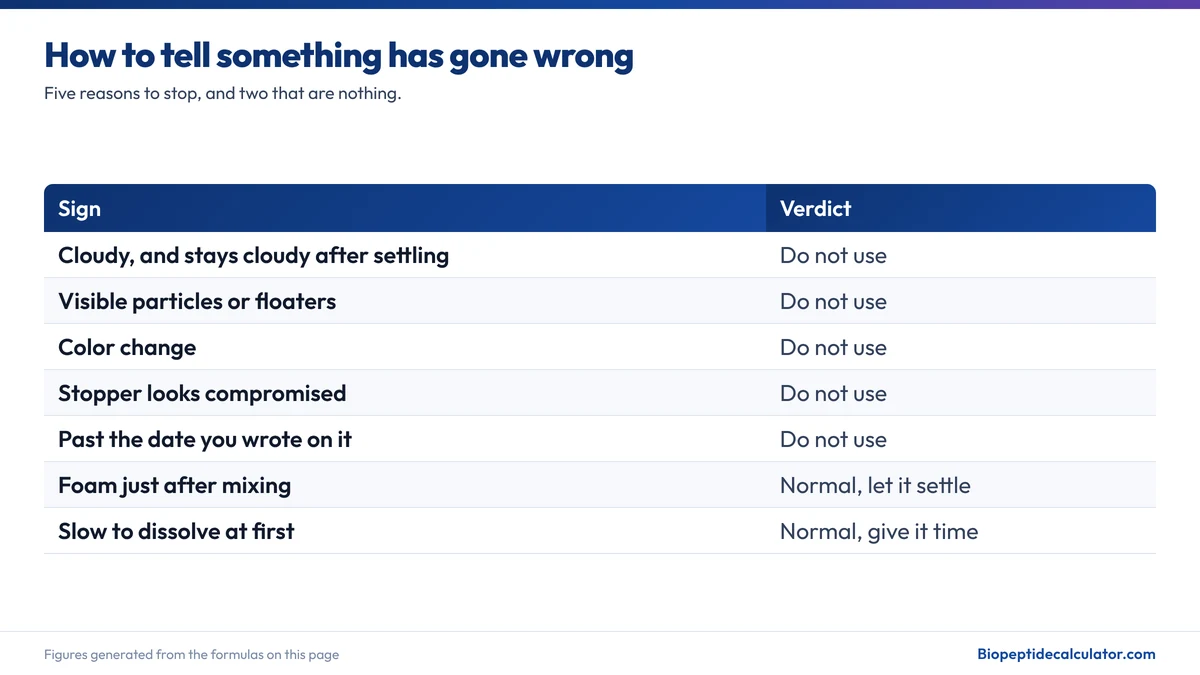
How to tell something has gone wrong
Labeling, which is half of storage
Two numbers in marker, written the moment you mix.
Concentration. Date.
Without the first you cannot calculate a dose. Without the second you cannot judge whether the vial is still worth using. Both take ten seconds and neither can be reconstructed later from looking at the glass.
Does storage change your dose math?
No, and this is worth separating out because people conflate the two.
Concentration is mass divided by volume at the moment you mixed it. Nothing in a fridge changes how much liquid is in the vial or how many milligrams went in, so the units you calculated on day one are still the units you draw on day twenty.
What degradation changes is how much of that peptide is still intact. That is a different question, and no calculator can answer it. It is also the real argument for mixing a volume you will finish inside a sensible window rather than making up a vial that will sit for months.
Frequently asked questions
How should reconstituted peptides be stored?
Refrigerated, upright, away from light, and used within weeks rather than months. The exact window depends on the peptide and the diluent, and the supplier’s own documentation is the authority for a specific product.
Do peptides need to be refrigerated before reconstitution?
Lyophilized powder is much more stable than solution and is normally kept cold and dark, though short periods at room temperature during shipping are usual. Once water is added, refrigeration matters considerably more.
Can you freeze reconstituted peptides?
Freezing solution is generally avoided because each freeze-thaw cycle stresses the peptide, and repeated cycles are worse than a single one. Lyophilized powder tolerates cold storage far better than solution does.
How long does reconstituted peptide last in the fridge?
Weeks rather than months, varying by peptide and by diluent. Bacteriostatic water extends usable life compared with plain sterile water because the benzyl alcohol suppresses bacterial growth.
What does a degraded peptide look like?
Cloudiness that does not clear, visible particles, or a change in color. Any of those is a reason to stop. A solution can also degrade with no visible change at all, which is why dates on the vial matter.
Does light actually damage peptides?
Light exposure is a recognized degradation route for many peptides, which is why vials are typically amber or kept in a box. Keeping the vial in its carton inside the fridge costs nothing.
Run your own vial and dose through the peptide dosage calculator.
Sources & Scientific References
The science on this page traces to the peer-reviewed and reference sources below. We link only to research and reference material.
Reference & Regulatory
- PubChem: Copper tripeptide-1. – the chemical database entry for the GHK-Cu complex
More at Bio Peptide Calculator
- How to reconstitute peptides – the mixing step that starts the clock
- Peptide reconstitution calculator – the concentration you should be writing on the vial
- Peptide library – handling notes by compound