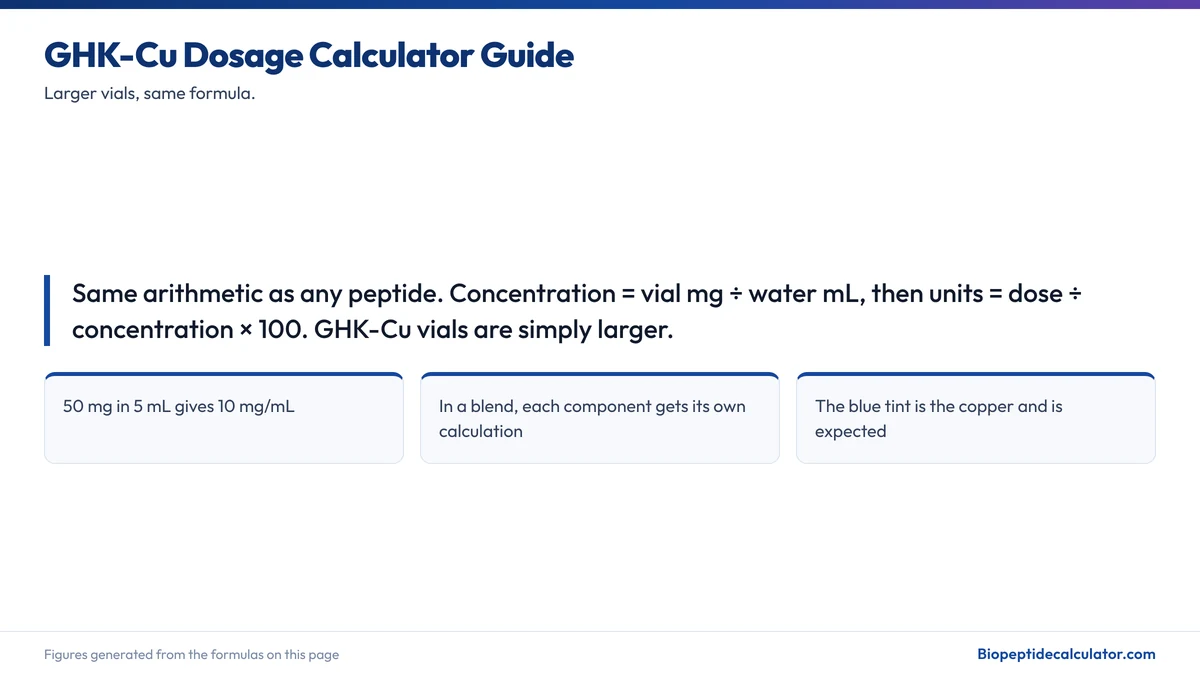
- 50 mg in 5 mL gives 10 mg/mL
- In a blend, each component gets its own calculation
- The blue tint is the copper and is expected
Nothing about copper changes the math. The only thing that changes is the scale of the numbers, because GHK-Cu vials are typically ten times the size of a BPC 157 vial.
The math is the same as any peptide
Concentration equals vial strength divided by the volume of bacteriostatic water added, so a 5 mg vial reconstituted with 2 mL gives 2.5 mg/mL. Units to draw equals the dose in mg divided by the concentration in mg/mL, multiplied by 100.
Worked: a 50 mg vial with 5 mL of water is 10 mg/mL. A 2 mg dose is 0.20 mL, which is 20 units.
Common GHK-Cu vial sizes
Units by vial and water volume
GHK-Cu inside a blend
In a blend, GHK-Cu has its own concentration like every other component.
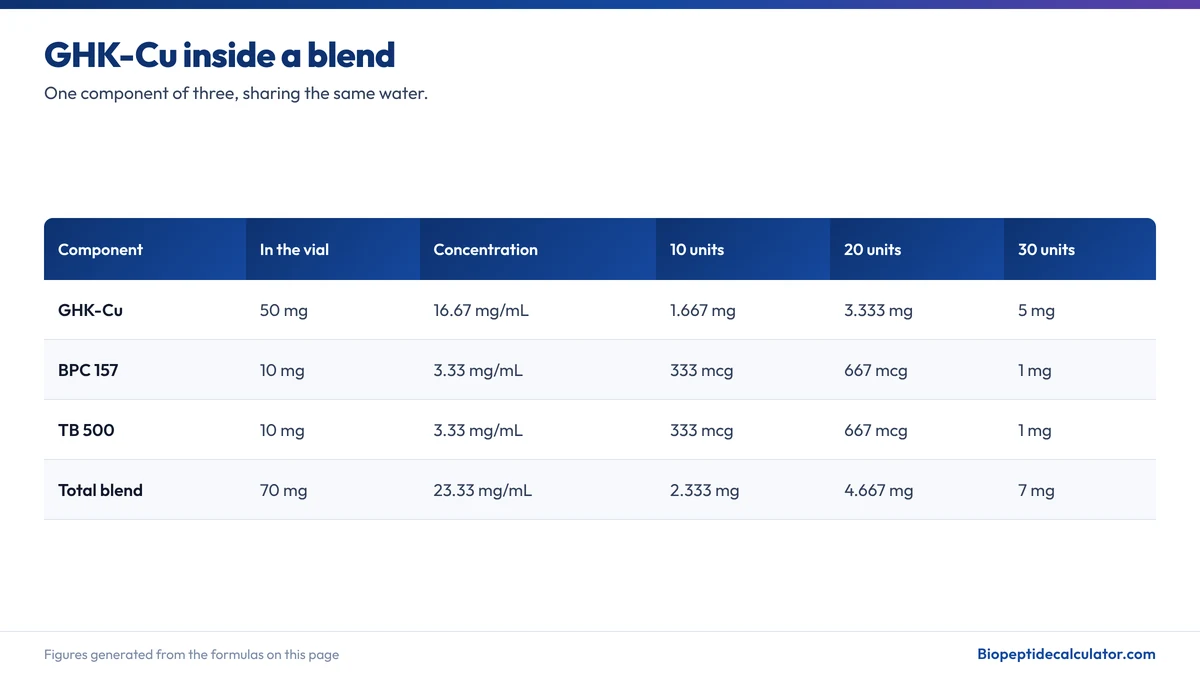
GLOW is a blend of GHK-Cu, BPC 157 and TB 500 in a single vial. A typical commercial vial is 70 mg in total, split 50 mg GHK-Cu, 10 mg BPC 157 and 10 mg TB 500, though ratios vary by supplier.
Because GHK-Cu is five times the mass of anything else in that vial, it is usually the component that sets the draw. The peptide mixing calculator covers blends in general.
Topical concentration is a different calculation
Topical products are described as a percentage rather than in units, which is a different calculation entirely.
A 1% GHK-Cu serum contains 1 gram per 100 mL, which is 10 mg/mL. That happens to be the same concentration as a 50 mg vial in 5 mL, which is a useful coincidence for intuition and nothing more, since the routes are not comparable.
Frequently asked questions
How do you calculate a GHK-Cu dose?
Divide the vial strength by the bacteriostatic water you added to get concentration, then divide your dose by that and multiply by 100 for units. A 50 mg vial in 5 mL is 10 mg/mL, at which a 2 mg dose is 20 units.
How much bacteriostatic water for a 50 mg GHK-Cu vial?
There is no single correct volume. Larger vials often take 3 mL to 5 mL, which keeps typical doses in a readable range on a U-100 syringe.
How do I calculate GHK-Cu in a GLOW or KLOW blend?
Treat each component separately against the same water volume. In a 70 mg GLOW vial with 50 mg GHK-Cu reconstituted in 3 mL, the GHK-Cu concentration is 16.67 mg/mL regardless of what else is in the vial.
Does GHK-Cu need different reconstitution from other peptides?
No. The arithmetic and the handling are the same. The one difference worth expecting is that the solution turns blue, because copper complexes are blue.
Why are GHK-Cu vials so much larger than BPC 157 vials?
Because the doses discussed are larger. A 50 mg GHK-Cu vial and a 5 mg BPC 157 vial both reflect the dose scale each compound is used at, not a difference in potency per milligram.
Run your own vial and dose through the peptide calculator.
Sources & Scientific References
The science on this page traces to the peer-reviewed and reference sources below. We link only to research and reference material.
Peer-Reviewed Research
- Pickart L, Margolina A. Regenerative and Protective Actions of the GHK-Cu Peptide. Int J Mol Sci, 2018 (PMC). – the review documenting GHK-Cu’s effects across thousands of human genes
Reference & Regulatory
- PubChem: Copper tripeptide-1. – the chemical database entry for the GHK-Cu complex
More at Bio Peptide Calculator
- What is GHK-Cu peptide used for – the compound itself
- GHK-Cu peptide – the compound page
- Peptide reconstitution calculator – any vial, any volume