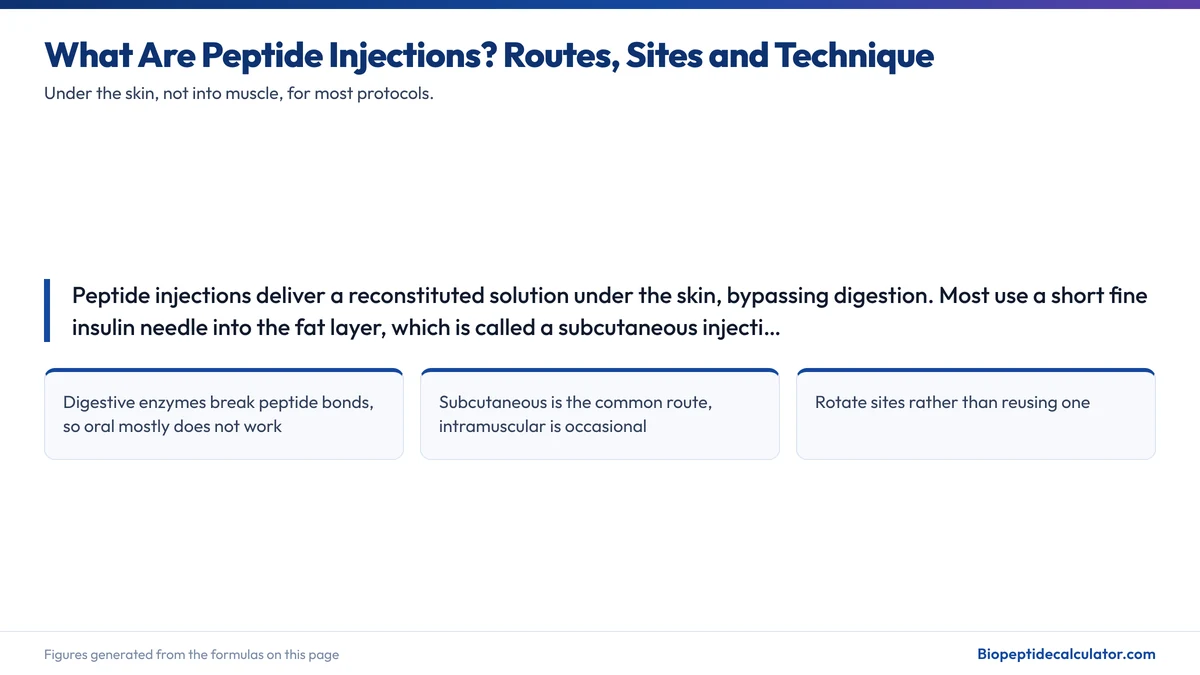
- Digestive enzymes break peptide bonds, so oral mostly does not work
- Subcutaneous is the common route, intramuscular is occasional
- Rotate sites rather than reusing one
The route is a consequence of chemistry, not a preference. A peptide is a chain of amino acids, and the gut exists to take those chains apart.
Why injection is the usual route
Because swallowing one mostly does not work.
A peptide bond is a covalent amide bond formed between the carboxyl group of one amino acid and the amino group of the next, releasing a molecule of water. Protease enzymes reverse that reaction, and they are abundant in the stomach and small intestine. To a digestive enzyme a therapeutic peptide and a piece of chicken are the same chemistry.
Subcutaneous versus intramuscular
What a subcutaneous injection involves
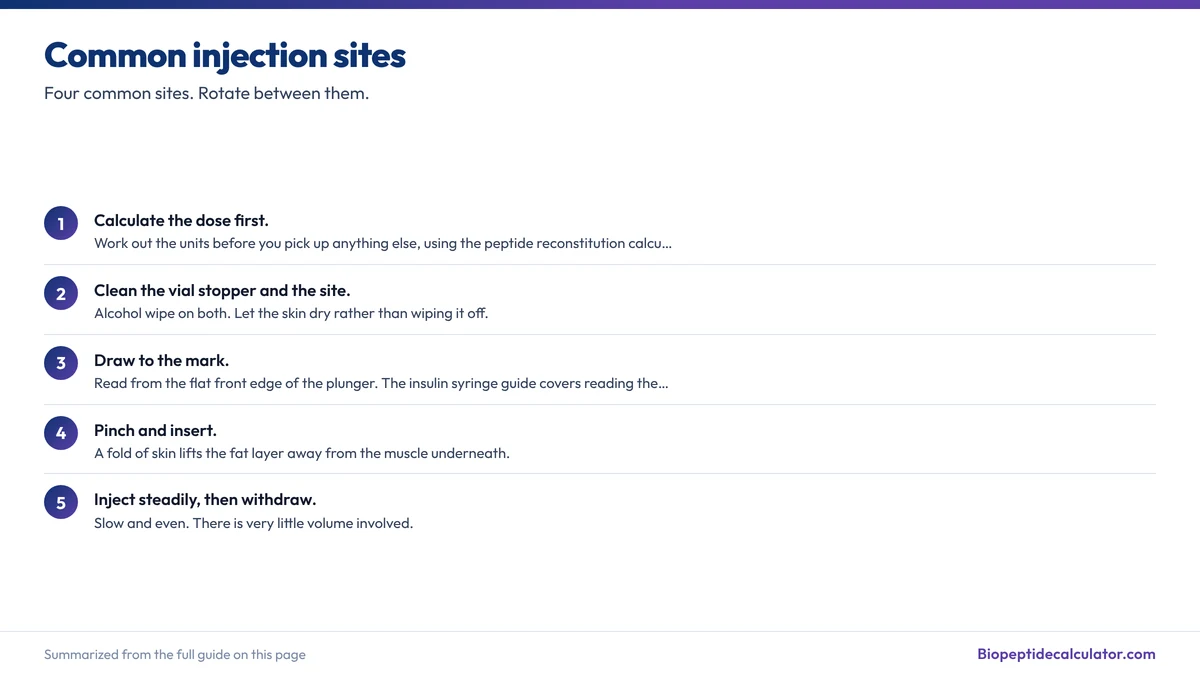
- Calculate the dose first.
Work out the units before you pick up anything else, using the peptide reconstitution calculator.
- Clean the vial stopper and the site.
Alcohol wipe on both. Let the skin dry rather than wiping it off.
- Draw to the mark.
Read from the flat front edge of the plunger. The insulin syringe guide covers reading the barrel.
- Pinch and insert.
A fold of skin lifts the fat layer away from the muscle underneath.
- Inject steadily, then withdraw.
Slow and even. There is very little volume involved.
- Dispose of the syringe in a sharps container.
Single use, every time. Needles dull on first use.
Common injection sites
Avoid skin that is bruised, scarred, inflamed, or has a mole or broken skin on it.
Site rotation and why it matters
Injecting the same spot repeatedly changes the tissue there.
Repeated trauma to one small area can cause lumps, hardening and local irritation, and tissue that has changed does not absorb at the same rate as healthy tissue. That turns a consistent dose into an inconsistent one without anything changing on the syringe.
Needle size for subcutaneous peptides
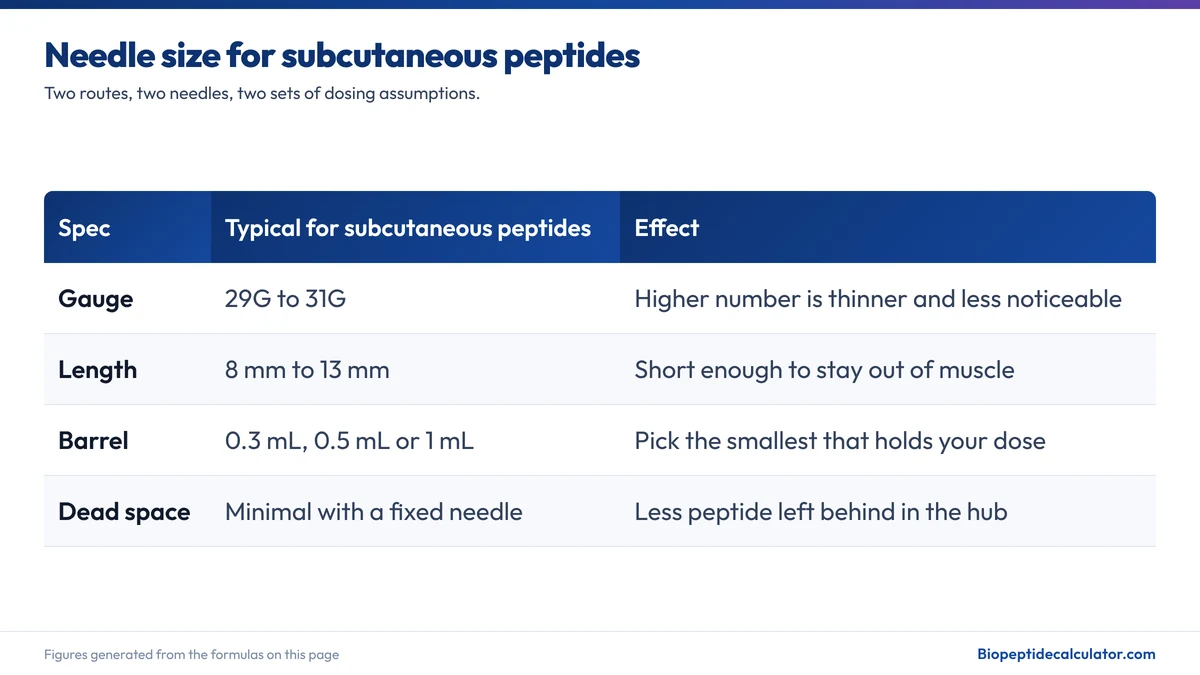
Insulin syringes usually arrive with the needle fixed, so the choice is made for you in most cases.
What people get wrong
When an injection is not the right answer
Worth saying, because the injection is the part people fixate on and it is the easiest part.
The harder questions sit upstream. Is this compound supported by human evidence for the thing you want it to do? Where did the vial come from, and what is actually in it? Is there a clinician involved? Technique is a solvable problem. Those are not, and no amount of careful injecting compensates for a bad answer to them.
Start there. Not here.
Frequently asked questions
What are peptide injections?
Peptide injections deliver a reconstituted peptide solution under the skin or into muscle, bypassing the digestive system. Injection is used because digestive enzymes break peptide bonds, so most peptides taken orally would be destroyed before absorption.
Are peptide injections subcutaneous or intramuscular?
Most are subcutaneous, into the fat layer just under the skin, using a short fine insulin needle. Some protocols specify intramuscular, which needs a longer needle and a different technique.
Where do you inject peptides?
Subcutaneous injections commonly go into the abdomen a couple of inches away from the navel, the outer thigh, or the back of the upper arm. The site should be rotated rather than reused.
Do peptide injections hurt?
Subcutaneous injections with an insulin needle are usually described as a brief pinch or less. The needle is short and fine, typically 29 to 31 gauge, which is thinner than most needles people have experience with.
How often are peptide injections given?
Frequency comes from the specific protocol, not from the route. Some compounds are dosed daily, some several times a week, some weekly. The injection method is the same regardless.
Can peptides be taken without injection?
Some can. Nasal and topical routes work for certain molecules, and a small number of peptides have oral formulations built around absorption enhancers. For most research peptides, injection is the route the available dosing information assumes.
Run your own vial and dose through the peptide dosage calculator.
Sources & Scientific References
The science on this page traces to the peer-reviewed and reference sources below. We link only to research and reference material.
Reference & Regulatory
- Federal Register: Enforcement Discretion Policy Regarding 503A Compounding Using Certain Peptide Bulk Drug Substances. HHS, 91 FR, October 30, 2026. Docket HHS-OASH-2026-0496. – the official notice of the draft enforcement discretion policy, which states that compounded drugs are not FDA-approved
More at Bio Peptide Calculator
- How to reconstitute peptides – preparing the vial before any injection
- How to read an insulin syringe – drawing to the right mark
- Are peptides safe – the upstream questions this page ends on