
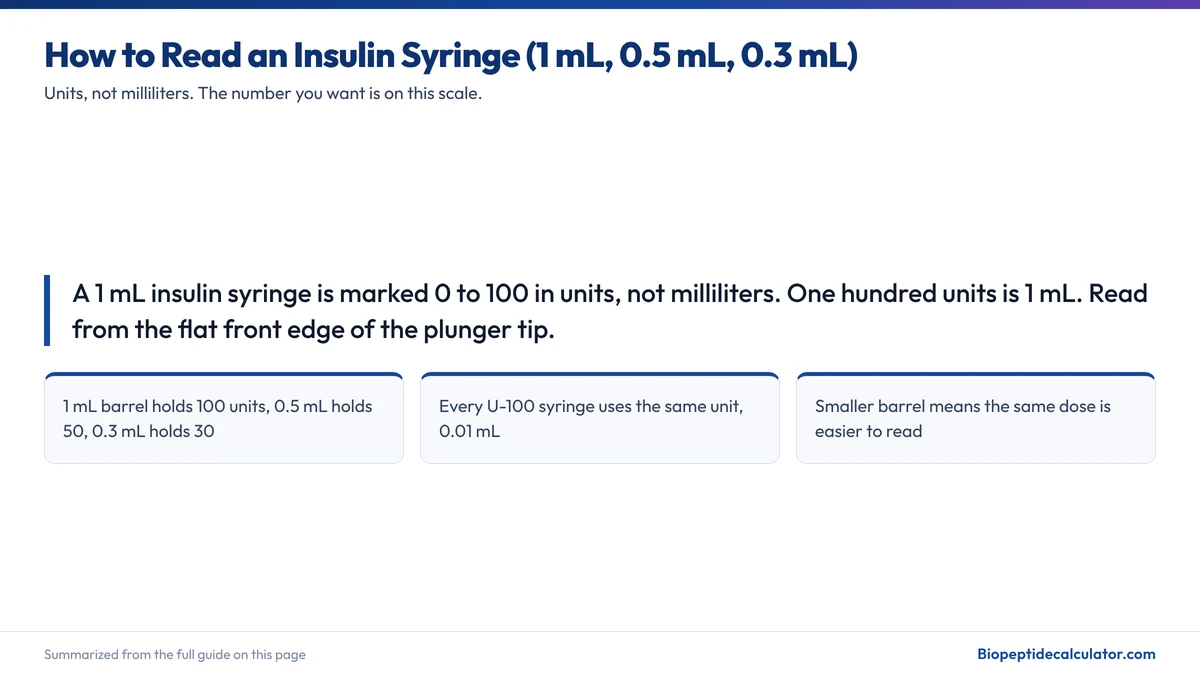
- 1 mL barrel holds 100 units, 0.5 mL holds 50, 0.3 mL holds 30
- Every U-100 syringe uses the same unit, 0.01 mL
- Smaller barrel means the same dose is easier to read
The barrel is not marked in milliliters, which surprises people the first time. It is marked in units, and the conversion is fixed.
What U-100 means
U-100 is a concentration standard borrowed from insulin, and it is the reason the math works out so cleanly.
On a U-100 insulin syringe 100 units equals 1 mL, so each unit is 0.01 mL.
That is a property of the syringe, not of what is in it. Fill a U-100 syringe with water, peptide or coffee and 50 units is still half a milliliter.
The three barrel sizes
All three are U-100. The difference is reach, not scale.
Reading the marks on a 1 mL barrel
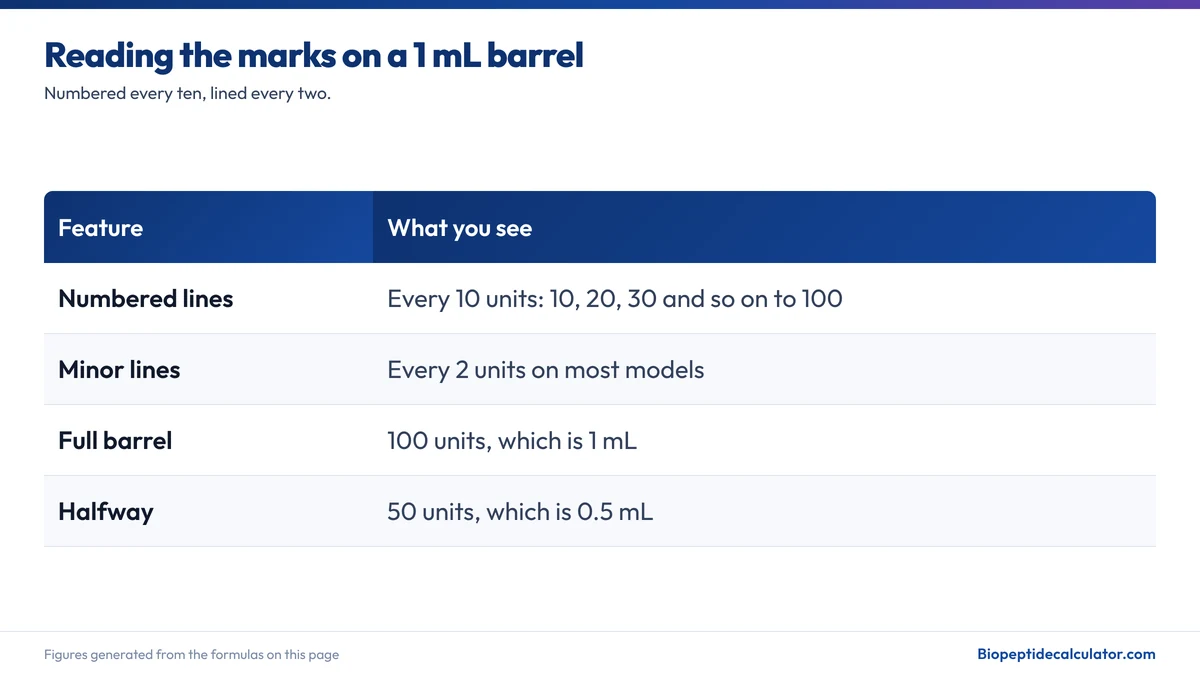
Standard printing on a 1 mL U-100 barrel.
So a line that sits between the 40 and the 50 marks, two lines up, is 44 units.
Reading a 0.5 mL and a 0.3 mL barrel
Smaller barrels print the same scale over a shorter range, so the lines spread out.
Nothing changes about the dose. Only the ease of hitting it exactly.
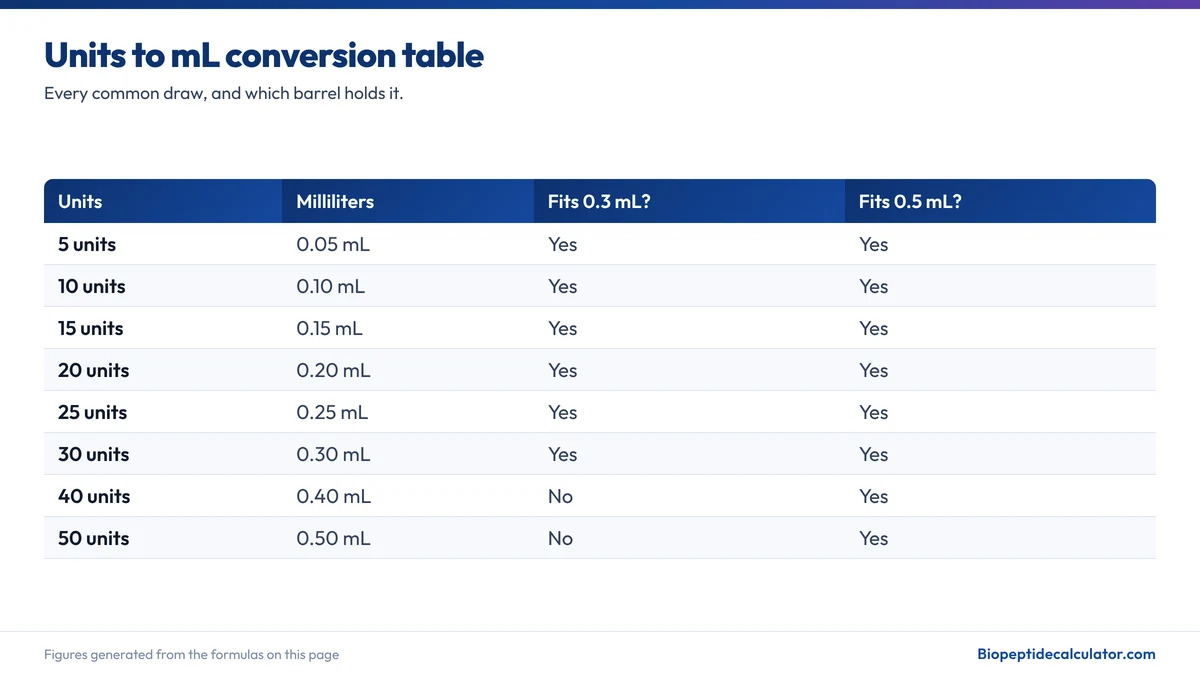
Units to mL conversion table
Picking the right barrel for your dose
Pick the smallest barrel your dose fits in. That is almost the whole rule.
Small barrel, big marks.
- Under 30 units: a 0.3 mL barrel, where a reading error of one line is a small fraction of the dose.
- 30 to 50 units: a 0.5 mL barrel.
- Over 50 units: a 1 mL barrel, because nothing smaller holds it.
- Over 100 units: your concentration is too dilute. Use less water next time, and work it out with the BAC water calculator.
Where to read the plunger from
From the flat front edge of the rubber stopper, the side nearest the needle.
Insulin syringe plungers have a tapered tip, and the taper is not where you read. Reading from the point instead of the flat edge overstates the draw by a unit or two, which matters more on a 0.3 mL barrel than a 1 mL one.
Needle gauge and length
Insulin syringes usually come with the needle fixed to the barrel, so you pick both together.
Frequently asked questions
How do you read a 1 mL insulin syringe?
A 1 mL U-100 insulin syringe is marked 0 to 100 in units, with a line every 2 units and a numbered line every 10. One hundred units is the full barrel, which is 1 mL. Read from the flat front edge of the rubber plunger tip, not the tapered point.
How many units are in 1 mL?
One hundred. A U-100 syringe is defined that way, so 1 mL equals 100 units and each unit is 0.01 mL. This holds for every U-100 syringe regardless of barrel size.
What is the difference between a 0.3 mL, 0.5 mL and 1 mL syringe?
Only the maximum they hold: 30, 50 and 100 units. All three are U-100, so a unit means the same volume on each. The smaller barrels spread the same units over more length, which makes small doses easier to read accurately.
How do I measure half a unit?
Use a 0.3 mL barrel, where the marks are furthest apart. Some 0.3 mL syringes are printed in half-unit increments specifically for this. On a 1 mL barrel, half a unit is smaller than the printing tolerance.
Is a unit on an insulin syringe the same as a microgram?
No. A unit is 0.01 mL of liquid. How many micrograms of peptide that contains depends entirely on the concentration of your solution.
What needle size is used for peptide injections?
Insulin syringes typically come with a short fine needle, commonly in the 29 to 31 gauge range and around 8 to 13 mm long, fixed to the barrel. Higher gauge numbers mean a thinner needle.
Run your own vial and dose through the peptide calculator.
Sources & Scientific References
The science on this page traces to the peer-reviewed and reference sources below. We link only to research and reference material.
Reference & Regulatory
- PubChem: Copper tripeptide-1. – the chemical database entry for the GHK-Cu complex
More at Bio Peptide Calculator
- Peptide reconstitution calculator – work out which mark your dose lands on
- Peptide dosages explained – why a unit is not a dose
- BAC water calculator – choose a water volume that fits your barrel