- Steroids are lipid-soluble, peptides generally are not
- Steroids often act inside the cell, peptides usually at the surface
- Being a peptide says nothing about being safer
They get mentioned together because of where they are sold and discussed, not because they have anything structural in common.
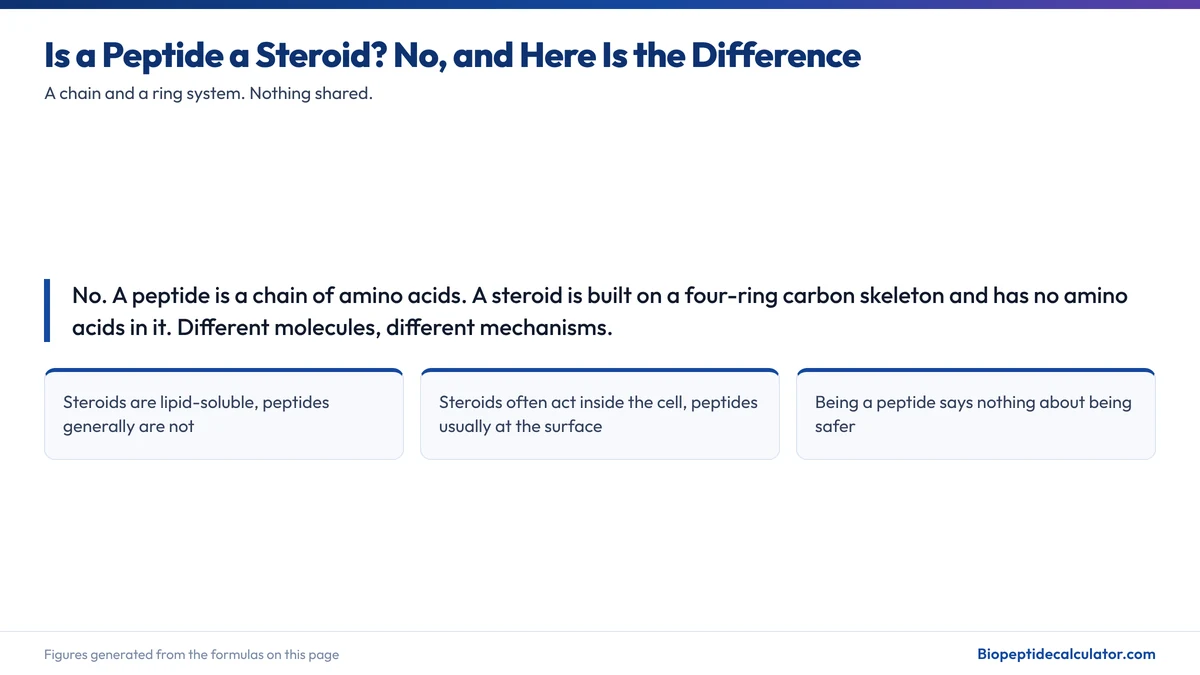
No, they are different classes of molecule
Two different chemical families, with no overlap.
What a steroid is
A steroid is any compound built on a characteriztic four-ring carbon skeleton, three six-membered rings and one five-membered ring fused together.
Cholesterol is a steroid. So are testosterone, cortisol and estradiol. The family is defined by that core structure, with different functional groups attached to it.
What a peptide is
A peptide is a short chain of amino acids joined by peptide bonds, generally counted as fewer than about 50 residues, above which the chain is normally called a protein.
A peptide bond is a covalent amide bond formed between the carboxyl group of one amino acid and the amino group of the next, releasing a molecule of water.
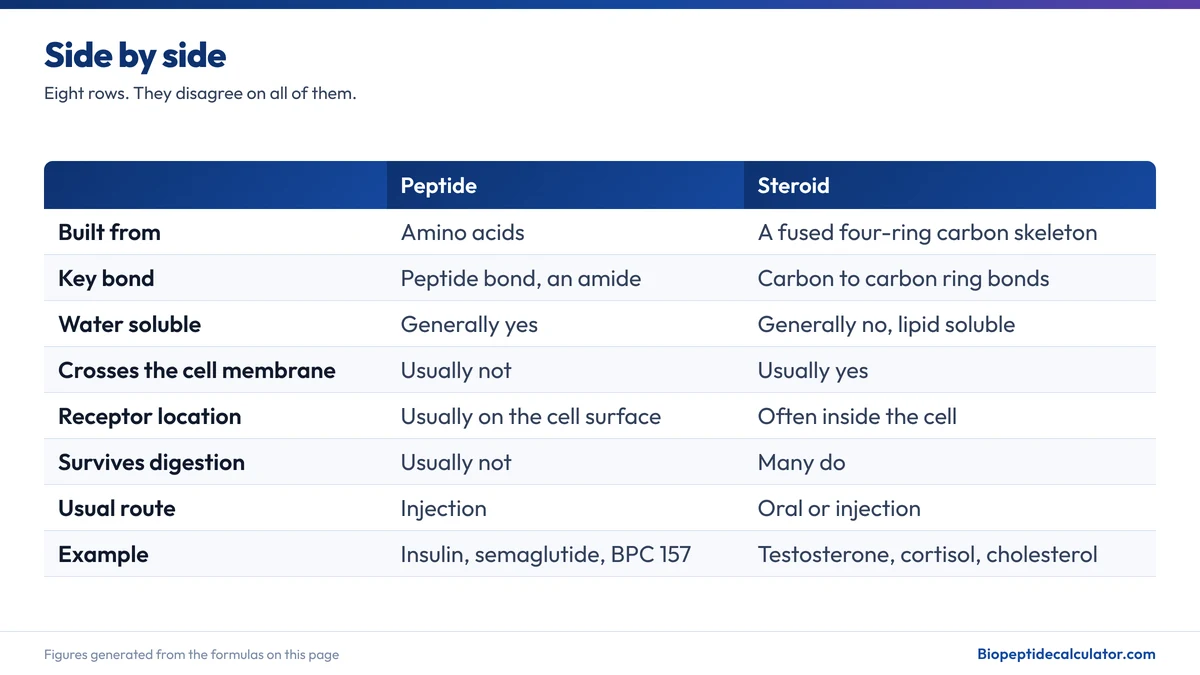
Side by side
Why both are called performance compounds
Shared context, not shared chemistry.
- Both are discussed in performance and physique settings.
- Both are sold by overlapping suppliers.
- Both include compounds that are prohibited in sport.
- Both include compounds sold without prescription oversight.
Different mechanisms, different regulation
Both compounds are named on the World Anti-Doping Agency 2026 Prohibited List, and both are prohibited at all times rather than in competition only. They sit in different sections: BPC 157 is named under S0, non-approved substances, while TB 500 is named under S2.3, growth factors and growth factor modulators, as Thymosin-beta4 and its derivatives e.g. TB-500.
Anabolic steroids sit in their own section of the same list. Both families appear, classified separately, which reflects that they are separately defined groups of compounds rather than variations on one theme.
Frequently asked questions
Is a peptide a steroid?
No. They are entirely different classes of molecule. A peptide is a chain of amino acids joined by peptide bonds. A steroid is built on a four-ring carbon structure and contains no amino acids at all.
What is the difference between peptides and steroids?
Structure, mechanism and how they are handled by the body. Steroids are lipid-soluble four-ring molecules that typically act on receptors inside the cell. Peptides are amino acid chains that usually act on receptors on the cell surface.
Are peptides safer than steroids?
That is not a question structure can answer. Safety depends on the specific compound, the dose and the source, not on which chemical family it belongs to. Several peptides have no human safety data at all.
Can you take peptides orally like some steroids?
Mostly not. Many steroids survive digestion because they are small and lipid-soluble. Peptides are broken apart by digestive enzymes, which is why they are usually injected.
Are peptides banned in sport like steroids?
Several are. The World Anti-Doping Agency 2026 Prohibited List names BPC 157 under S0 and TB 500 under S2.3, both prohibited at all times, alongside anabolic steroids in a separate section.
Run your own vial and dose through the peptide dosage calculator.
Sources & Scientific References
The science on this page traces to the peer-reviewed and reference sources below. We link only to research and reference material.
Reference & Regulatory
- World Anti-Doping Agency: The 2026 Prohibited List, in force January 1 to December 31, 2026. – the official list, which names BPC 157 under S0 and TB 500 under S2.3
- PubChem: Copper tripeptide-1. – the chemical database entry for the GHK-Cu complex
More at Bio Peptide Calculator
- What is a peptide – the definition in full
- WADA banned peptides list – which peptides are prohibited in sport
- Are peptides safe – risk by compound, not by family