
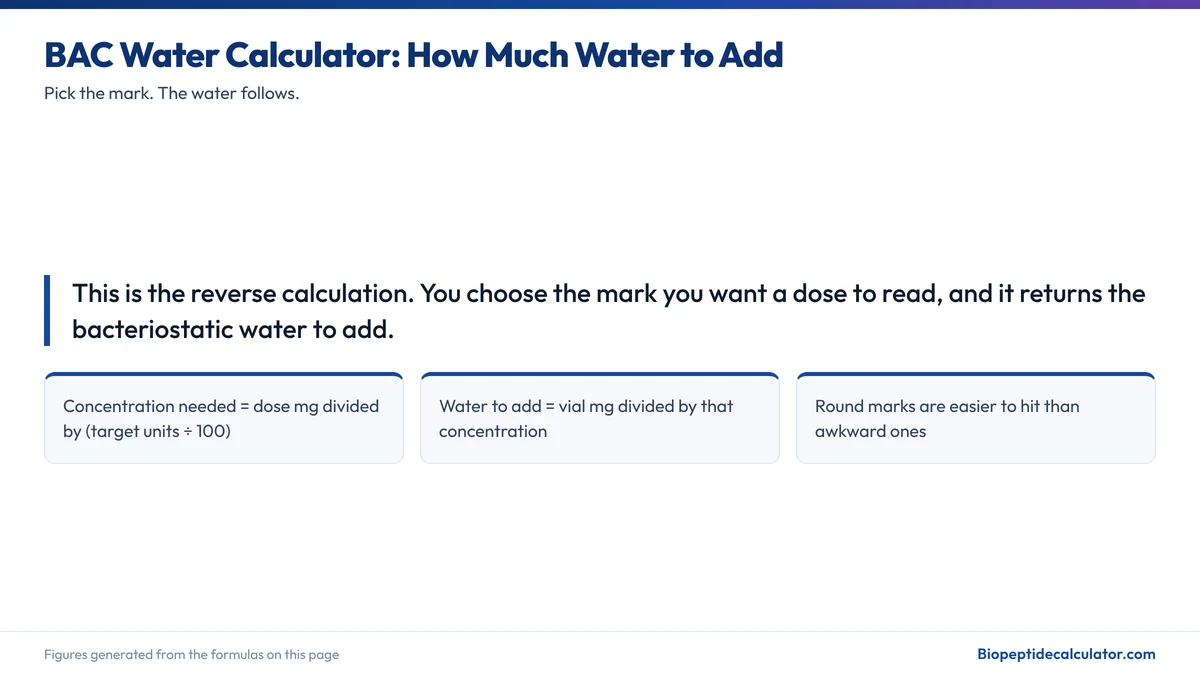
- Concentration needed = dose mg divided by (target units ÷ 100)
- Water to add = vial mg divided by that concentration
- Round marks are easier to hit than awkward ones
Most people calculate forwards and accept whatever number falls out. Deciding the mark first is the better habit.
What this calculation solves
A forward calculator answers what you get. This one answers what to do.
The reverse formula
- Pick your target.
The number of units you want one dose to read.
- Find the concentration that produces it.
Dose in mg divided by target units, then multiplied by 100.
- Divide the vial strength by that concentration.
The answer is the water to add.
Worked example
A 10 mg vial. You want a 2 mg dose to read 20 units.
The last row is the round trip. If it does not return your target, something went wrong upstream.
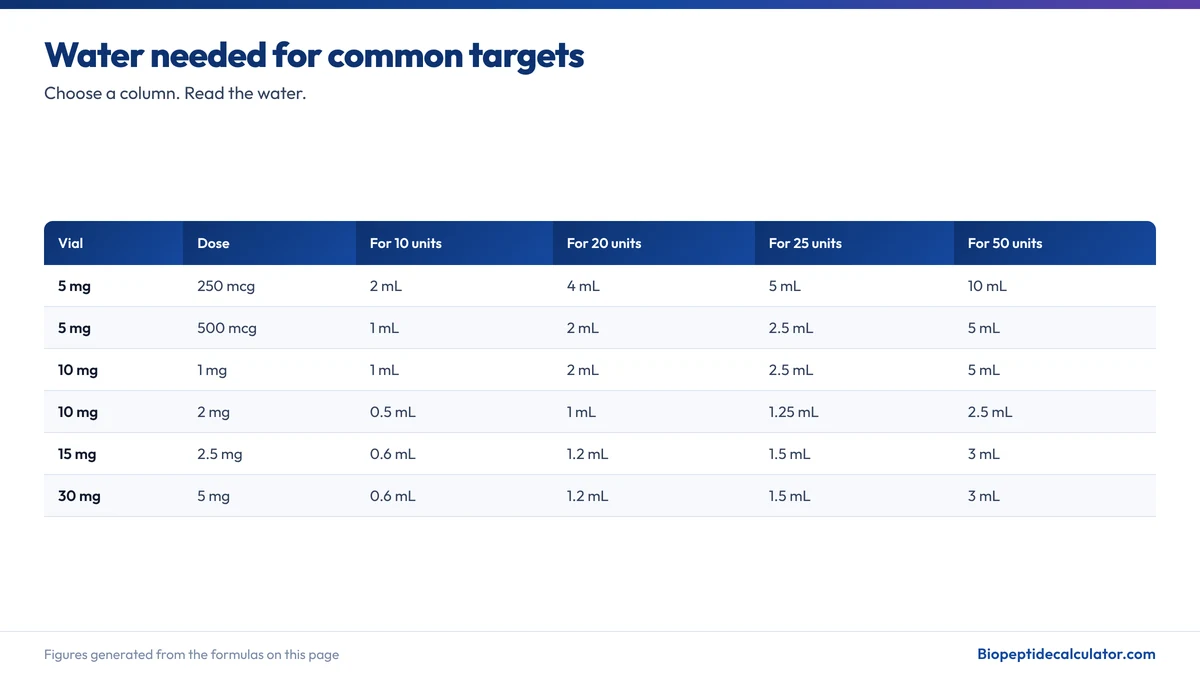
Water needed for common targets
Why round marks are worth designing for
Because you will be reading this mark in poor light, possibly half awake, for weeks.
Twenty units is a numbered line on most barrels. Seventeen and a half is three lines past a numbered one, counted twice to be sure. Over a whole vial the second one accumulates errors that the first does not.
Frequently asked questions
What does a BAC water calculator do?
It works backwards. Instead of telling you how many units a dose is, it tells you how much bacteriostatic water to add so that your dose lands on a mark you choose.
How do I calculate how much bacteriostatic water to add?
Decide the units you want one dose to read. Divide the dose in mg by those units, multiply by 100 to get the concentration you need, then divide the vial strength by that concentration. The result is the water to add.
How much water for a 10 mg vial to make 2 mg equal 20 units?
One milliliter. That gives 10 mg/mL, at which a 2 mg dose occupies 0.2 mL, which is 20 units on a U-100 syringe.
Is there a maximum amount of water I can add to a vial?
Physically, the vial’s capacity. Practically, the point at which one dose no longer fits your syringe. If a dose exceeds 100 units it will not fit a 1 mL barrel.
Does the type of peptide change how much water to add?
No. The calculation is purely about mass and volume, so it is identical for every peptide. What differs is the dose, not the arithmetic.
Run your own vial and dose through the peptide dosage calculator.
Sources & Scientific References
The science on this page traces to the peer-reviewed and reference sources below. We link only to research and reference material.
Reference & Regulatory
- PubChem: Copper tripeptide-1. – the chemical database entry for the GHK-Cu complex
More at Bio Peptide Calculator
- BAC water calculator – the tool that runs this reverse calculation
- How much bacteriostatic water for a 5 mg vial – the most common vial size
- Peptide reconstitution calculator – the forward direction