- Two amino acids joined is already a peptide
- Your body makes thousands of them, including insulin and oxytocin
- Digestion breaks peptide bonds, which is why most are injected
The word gets used loosely enough that it has almost stopped meaning anything. It does have a precise definition, and it is simple.
The definition
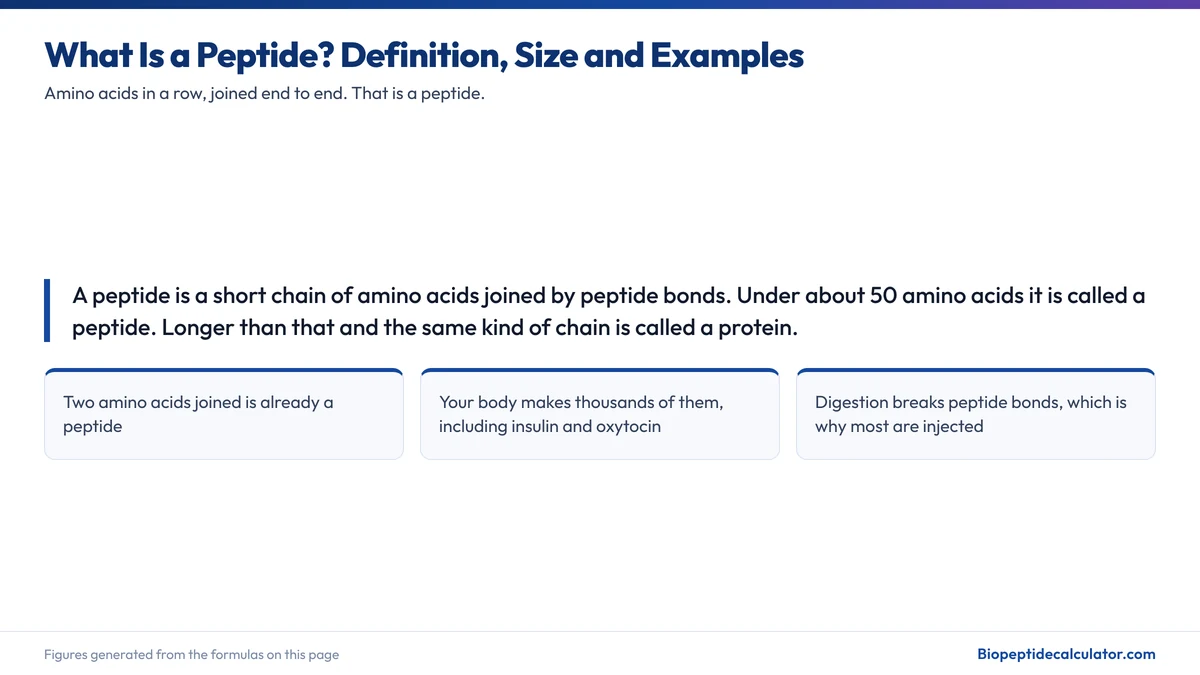
A peptide is a short chain of amino acids joined by peptide bonds, generally counted as fewer than about 50 residues, above which the chain is normally called a protein.
Two things in that sentence are doing work. The chain is made of amino acids, and the links between them are peptide bonds. Miss either and it is not a peptide.
What a peptide bond actually is
A peptide bond is a covalent amide bond formed between the carboxyl group of one amino acid and the amino group of the next, releasing a molecule of water.
A molecule of water comes out. That detail matters more than it sounds, because putting water back in is how the bond is broken again, which is what digestion does and what degradation in a vial does.
Peptide, polypeptide or protein
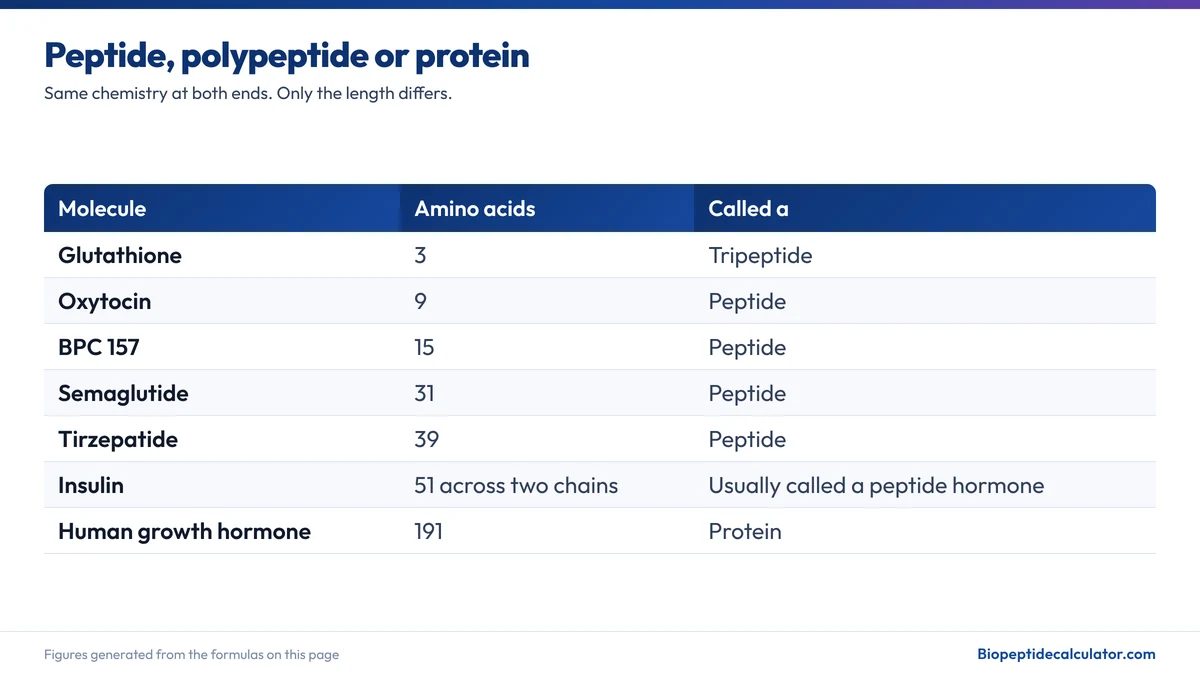
There is no chemical event at the boundary. Nothing changes about the molecule when it crosses from 49 residues to 51.
It is a naming convention.
Insulin sits right on the line and gets called both, which tells you how soft the boundary is.
Peptides your body already makes
Peptides are not an invention. Your body runs on them.
Glutathione is a tripeptide of glutamate, cysteine and glycine, so it is a peptide.
Why peptides are injected and not swallowed
Because your digestive system is specifically built to destroy them.
Protease enzymes in the stomach and small intestine break peptide bonds. That is their entire job, and they do not distinguish between a steak and a therapeutic peptide. A peptide swallowed as a pill is, to the gut, food.
There are exceptions. Oral semaglutide exists, and it works by being co-formulated with an absorption enhancer in large excess. The exception proves how hard the problem is.
Things commonly called peptides that are not
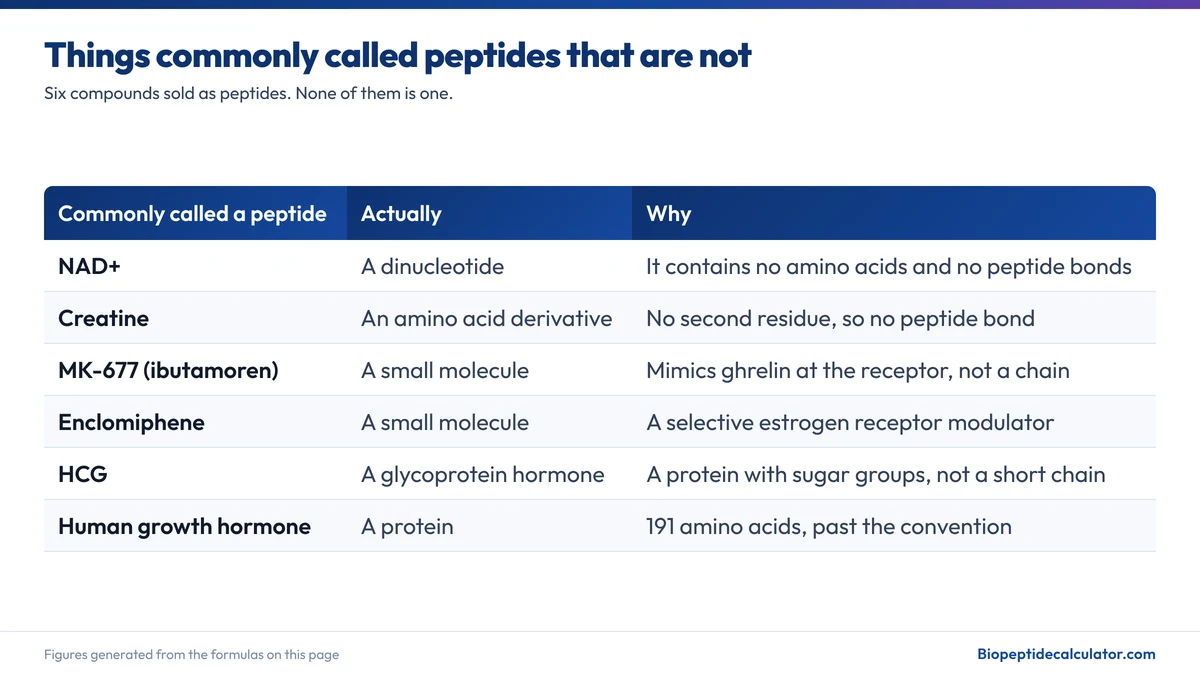
A lot of things get sold as peptides that are not peptides. The test is simple: are there at least two amino acids joined by a peptide bond?
MK-677, ibutamoren, is a non-peptide small molecule that mimics ghrelin at its receptor, which is why it works orally.
How peptides are named
Peptide naming is inconsistent, and knowing the patterns makes the field less opaque.
Natural, synthetic and analogue
Three words worth separating.
- Natural. A sequence the body produces, such as oxytocin or glutathione.
- Synthetic. Made in a lab, but chemically identical to a natural sequence. Synthetic oxytocin is oxytocin.
- Analogue. Deliberately altered so it behaves differently, usually to last longer in the body. Semaglutide is a peptide, a modified 31 amino acid analogue of human GLP-1.
Nearly every peptide drug on the market is an analogue, because the natural versions are cleared too fast to be useful as medicines.
Frequently asked questions
What is a peptide?
A peptide is a short chain of amino acids joined by peptide bonds. The usual cutoff is about 50 amino acids, above which the same kind of chain is called a protein instead. Insulin, oxytocin and glutathione are all peptides.
What is the difference between a peptide and a protein?
Length, and nothing else fundamental. Both are chains of amino acids joined the same way. Chains under roughly 50 residues are called peptides, longer ones proteins. The boundary is a convention, not a chemical change.
Is collagen a peptide?
Collagen itself is a protein. Collagen peptides are that protein broken into short fragments by hydrolysis, so the supplement genuinely is peptide based even though its source material is not.
Is creatine a peptide?
No. Creatine is a derivative of amino acids but it is a single small molecule with no peptide bond in it. A peptide needs at least two amino acids joined by a peptide bond.
Why are peptides injected instead of taken orally?
Digestive enzymes break peptide bonds, which is exactly what they exist to do. Most peptides swallowed as a pill would be digested into their component amino acids before reaching the bloodstream.
How many amino acids are in a peptide?
Anywhere from two upward. A dipeptide has two, a tripeptide three. GHK-Cu is a tripeptide, BPC 157 has 15 amino acids, and semaglutide has 31.
Run your own vial and dose through the peptide calculator.
Sources & Scientific References
The science on this page traces to the peer-reviewed and reference sources below. We link only to research and reference material.
Peer-Reviewed Research
- Pickart L, Margolina A. The Effect of the Human Peptide GHK on Gene Expression Relevant to Skin. BioMed Research International, 2015 (PMC). – GHK’s role in collagen, skin remodeling and gene expression
Reference & Regulatory
- PubChem: Copper tripeptide-1. – the chemical database entry for the GHK-Cu complex
More at Bio Peptide Calculator
- Peptide library – every peptide covered on the site
- Peptide list and what they do – a one-line summary of each
- Peptide calculator – the dosing math once you have a vial