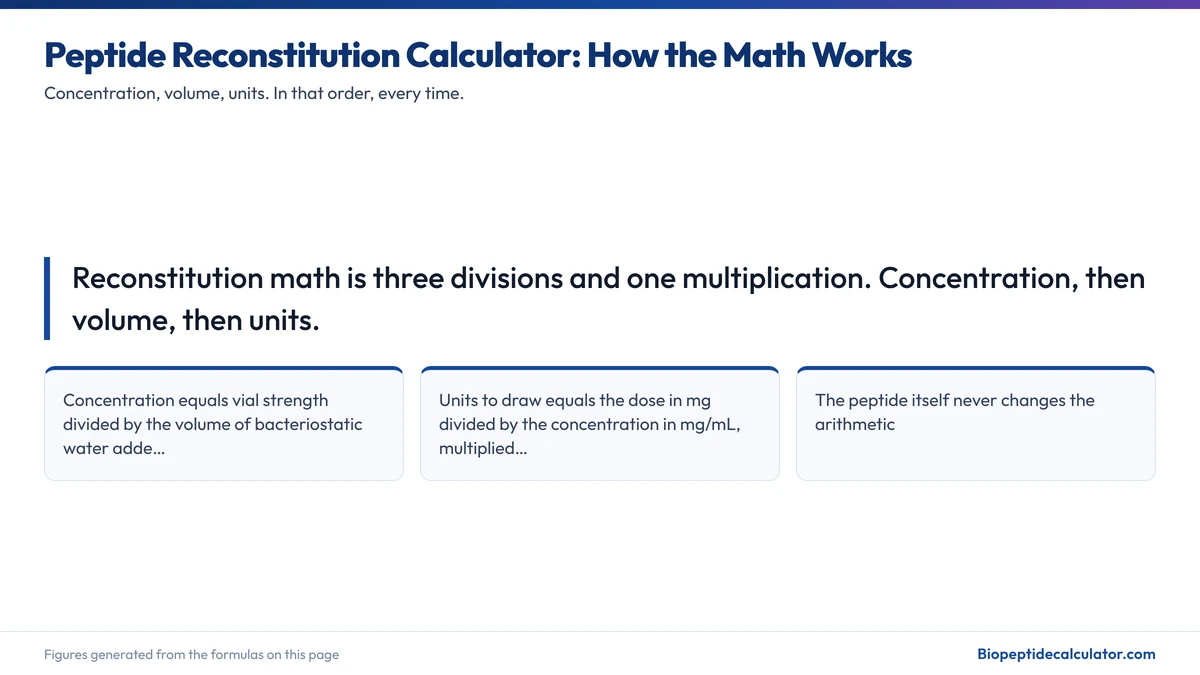
- Concentration equals vial strength divided by the volume of bacteriostatic water added, so a 5 mg vial reconstituted with 2 mL gives 2.5 mg/mL
- Units to draw equals the dose in mg divided by the concentration in mg/mL, multiplied by 100
- The peptide itself never changes the arithmetic
The same three steps work for every peptide on the site. Every one. The numbers change, the method does not.
The formula, written out
Here is the whole thing in three lines.
Steps two and three collapse into one if you prefer: units equals dose divided by concentration, times 100.
Step one: concentration
Concentration is the only number that describes your solution. Get it right and everything else follows.
Concentration equals vial strength divided by the volume of bacteriostatic water added, so a 5 mg vial reconstituted with 2 mL gives 2.5 mg/mL.
Step two: volume per dose
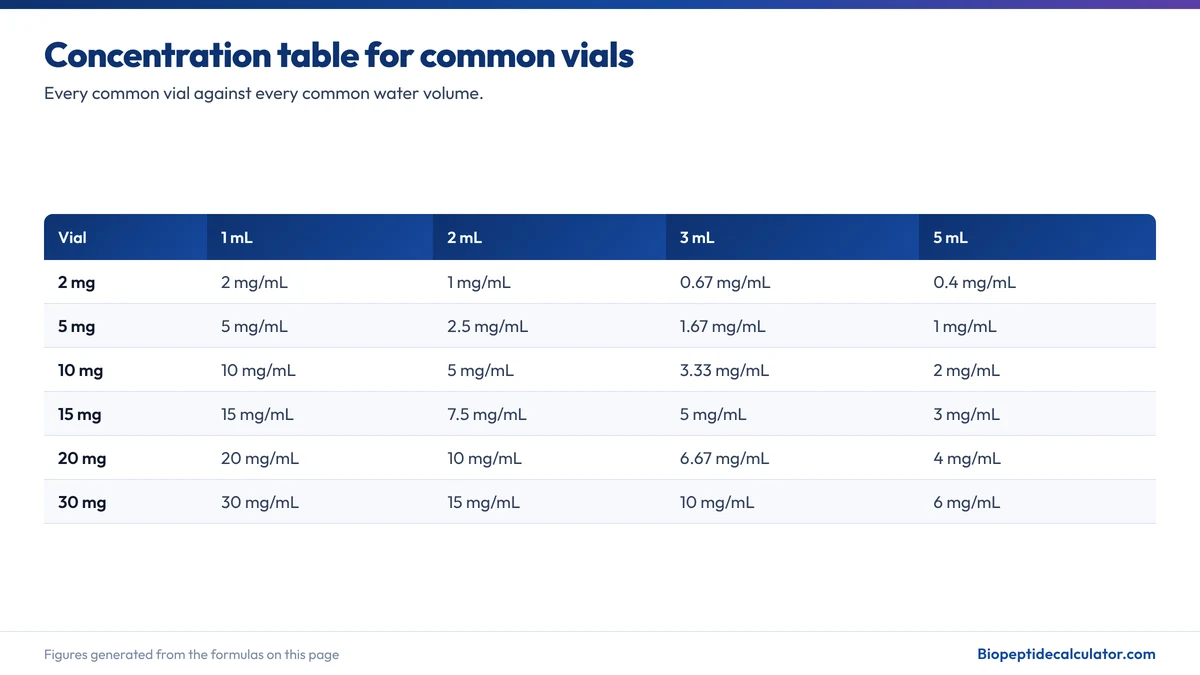
Now divide your dose by that concentration. The answer is how much liquid holds one dose.
Small numbers. This is exactly why the next step exists.
Step three: units on the syringe
Nobody can draw 0.025 mL accurately by eye. Converting to units fixes that, because the syringe is already marked in them.
On a U-100 insulin syringe 100 units equals 1 mL, so each unit is 0.01 mL, so multiplying milliliters by 100 gives units directly.
A full worked example end to end
A 10 mg vial. You want 2 mg doses. You add 2 mL of bacteriostatic water.
- Concentration.
10 mg divided by 2 mL is 5 mg/mL.
- Volume.
2 mg divided by 5 mg/mL is 0.4 mL.
- Units.
0.4 mL times 100 is 40 units.
- Sanity check.
The vial holds 5 doses of 2 mg. Five doses at 40 units each is 200 units, which is 2 mL. That matches what you put in, so the math is consistent.
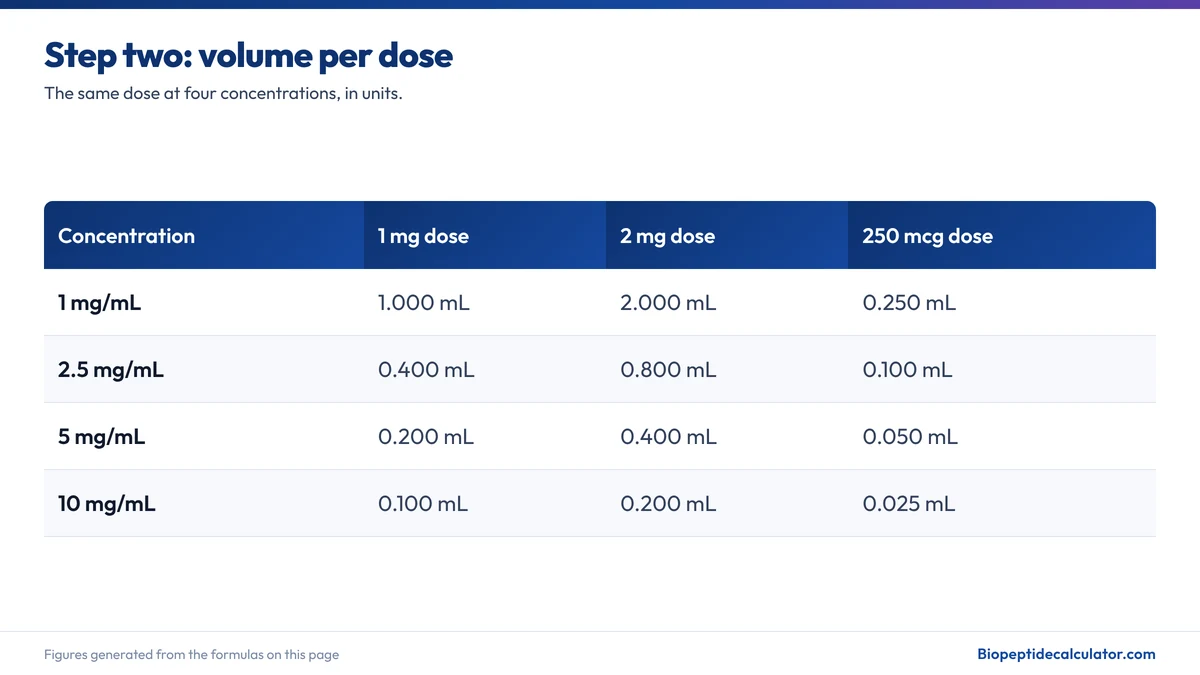
Concentration table for common vials
Common vial sizes against common water volumes. Find your row, read across.
Choosing a water volume that works
There is no single correct volume. There is a range that makes your dose easy to measure, and you want to land inside it.
- Aim for a dose between about 10 and 50 units. Below 10 a small reading error is a large dosing error. Above 50 you may not fit it in a smaller barrel.
- Prefer round numbers. Twenty units beats 17.5 units for the same reason round prices are easier to add up.
- Check it fits your syringe. A 0.3 mL barrel tops out at 30 units.
- Think about how long the vial lasts. More water is fine, but a vial you will be using for three months has a stability question attached to it.
What the calculator cannot know
Worth stating plainly, because arithmetic can look like authority.
The calculator knows mass and volume. That is all it knows.
Frequently asked questions
What formula does a peptide reconstitution calculator use?
Three steps. Concentration equals vial mg divided by water mL. Volume equals dose mg divided by concentration. Units equals that volume times 100, because a U-100 syringe has 100 units per milliliter.
How do I calculate peptide concentration after reconstitution?
Divide the milligrams in the vial by the milliliters of bacteriostatic water you added. A 10 mg vial with 2 mL of water is 5 mg/mL. The answer is always in mg per mL.
How do I convert mL to units on an insulin syringe?
Multiply by 100. A U-100 syringe holds 100 units per milliliter, so 0.4 mL is 40 units and 0.08 mL is 8 units.
Is the reconstitution calculation different for different peptides?
No. The arithmetic is identical for every peptide, because it is only about mass and volume. What differs between peptides is the dose, not the math that turns that dose into units.
What happens if I add the wrong amount of water?
Nothing is ruined, but every unit figure you calculated is now wrong. Recalculate using the volume you actually added rather than the one you intended, and the doses will be correct again.
Does temperature or peptide type change the concentration math?
No. Concentration is mass divided by volume. Storage and handling affect how much active peptide survives over time, which is a separate question from what the solution is at the moment you mix it.
Run your own vial and dose through the peptide dosage calculator.
Sources & Scientific References
The science on this page traces to the peer-reviewed and reference sources below. We link only to research and reference material.
Reference & Regulatory
- PubChem: Copper tripeptide-1. – the chemical database entry for the GHK-Cu complex
More at Bio Peptide Calculator
- Peptide reconstitution calculator – the tool that runs this math for you
- BAC water calculator – work backwards from the units you want
- Peptide dosage charts – ready-made charts by peptide