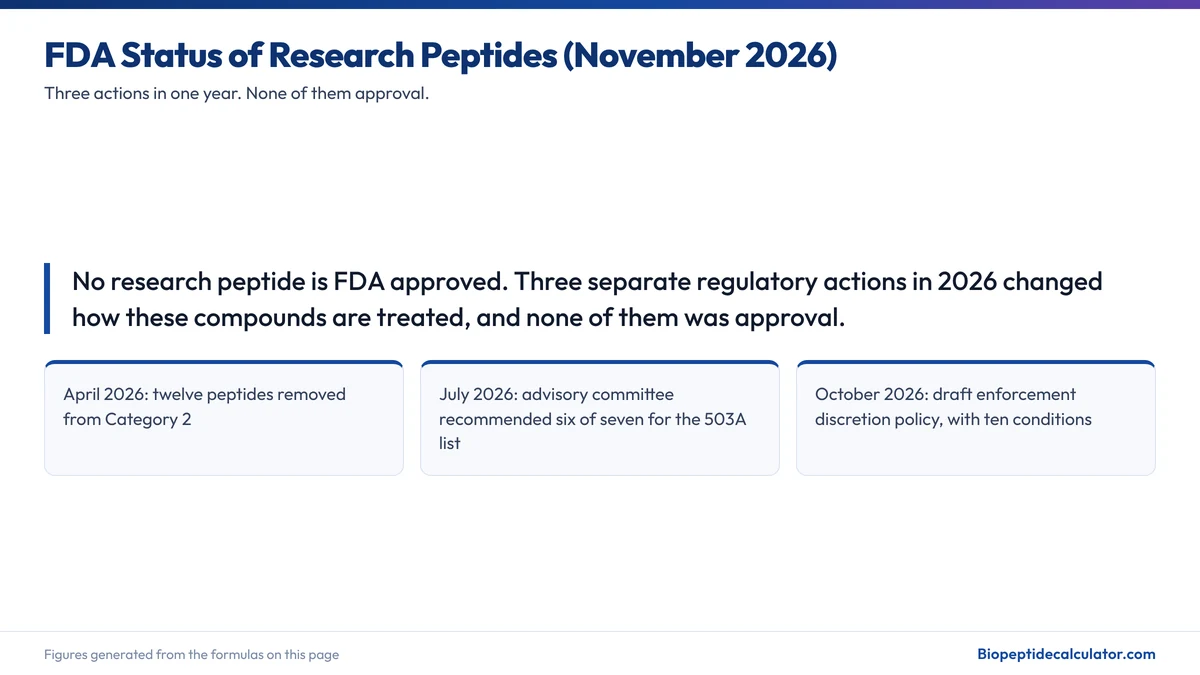
- April 2026: twelve peptides removed from Category 2
- July 2026: advisory committee recommended six of seven for the 503A list
- October 2026: draft enforcement discretion policy, with ten conditions
This area moved three times in 2026, and most of what is written about it online describes a position that is now out of date, in both directions. Some pages still say these compounds are banned. Others now say they are approved. Neither is right.
- The short version
- Four statuses that get confused
- What happened in 2026, in order
- April 2026: removal from Category 2
- July 2026: the advisory committee vote
- October 2026: draft enforcement discretion
- Where that leaves each peptide
- What research use only means on a label
- What would actually count as approval
The short version
None of these 2026 actions approved any peptide. Enforcement discretion is a statement about what a regulator intends to prioritize, not a finding that a substance is safe or effective.
Not approved.
Not on the 503A bulks list either, as of November 2026. What exists is a draft policy about enforcement priorities, with ten conditions attached, which the Federal Register notice itself describes as having no formal effect of law.
Four statuses that get confused
Four things get used interchangeably and mean entirely different things.
What happened in 2026, in order
April 2026: removal from Category 2
On April 15, 2026 the FDA announced its intent to remove twelve peptide bulk drug substances from Category 2 of the 503A bulks list review, among them BPC 157, TB 500, Epitalon, KPV, MOTS-c, Semax and Melanotan II.
Removal from Category 2 did not make those substances eligible for compounding and did not place them in Category 1. It removed them from a list of substances identified as presenting significant safety risks, nothing more.
Category 2 is a list of substances identified as presenting significant safety risks. Coming off it is a statement that the agency is no longer making that specific finding. It is not a statement that the substance is permitted.
July 2026: the advisory committee vote
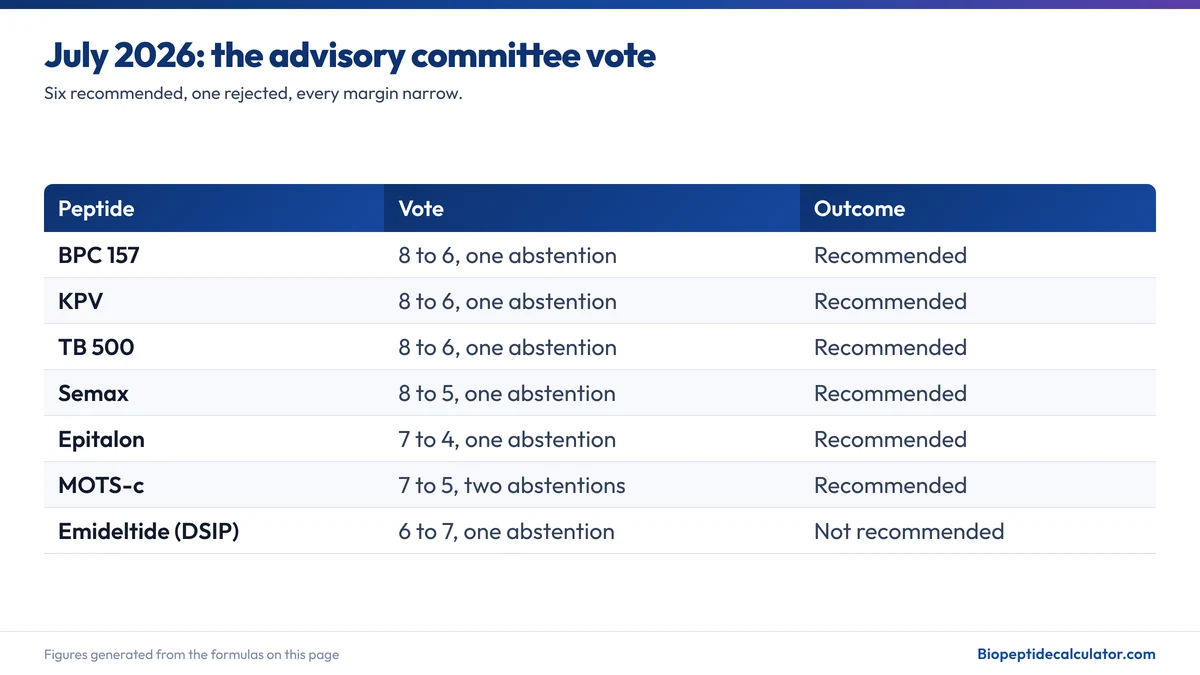
At the Pharmacy Compounding Advisory Committee meeting held on July 23 and 24, 2026, the committee voted to recommend six of seven peptides for the 503A bulks list. BPC 157, KPV and TB 500 each passed 8 to 6 with one abstention, Epitalon 7 to 4, Semax 8 to 5 and MOTS-c 7 to 5. Emideltide, also called DSIP, was the only one voted against, 6 to 7.
The advisory committee’s recommendation is not binding. Adding a substance to the 503A bulks list requires formal notice and comment rulemaking, which had not concluded as of November 2026.
Those are narrow margins. A recommendation carried 8 to 6 is not a scientific consensus, and the committee is advisory in any case.
October 2026: draft enforcement discretion
On October 30, 2026 the Department of Health and Human Services published a notice of availability for a draft enforcement discretion policy covering 503A compounding with six peptide bulk drug substances: BPC 157, Epitalon, KPV, MOTS-c, Semax and TB 500. The comment period, under docket HHS-OASH-2026-0496, closed on November 13, 2026.
The draft policy applies only where all ten of its conditions are met, including a certificate of analysis from an FDA registered source, a single active ingredient, Not for resale labeling, and adverse event reporting to MedWatch.
The notice is explicit about what it is not. It states that compounded drugs are not FDA-approved, which means FDA does not review their safety, effectiveness, or quality before they are marketed.
Where that leaves each peptide
What research use only means on a label
Peptides sold online as research chemicals are labeled for laboratory research use only and are not sold as medicines, which means they are not manufactured, tested or labeled to the standard required of a drug intended for human use.
That phrase is not a disclaimer bolted on for legal cover. It is a description of what the product is and what standards it was made to.
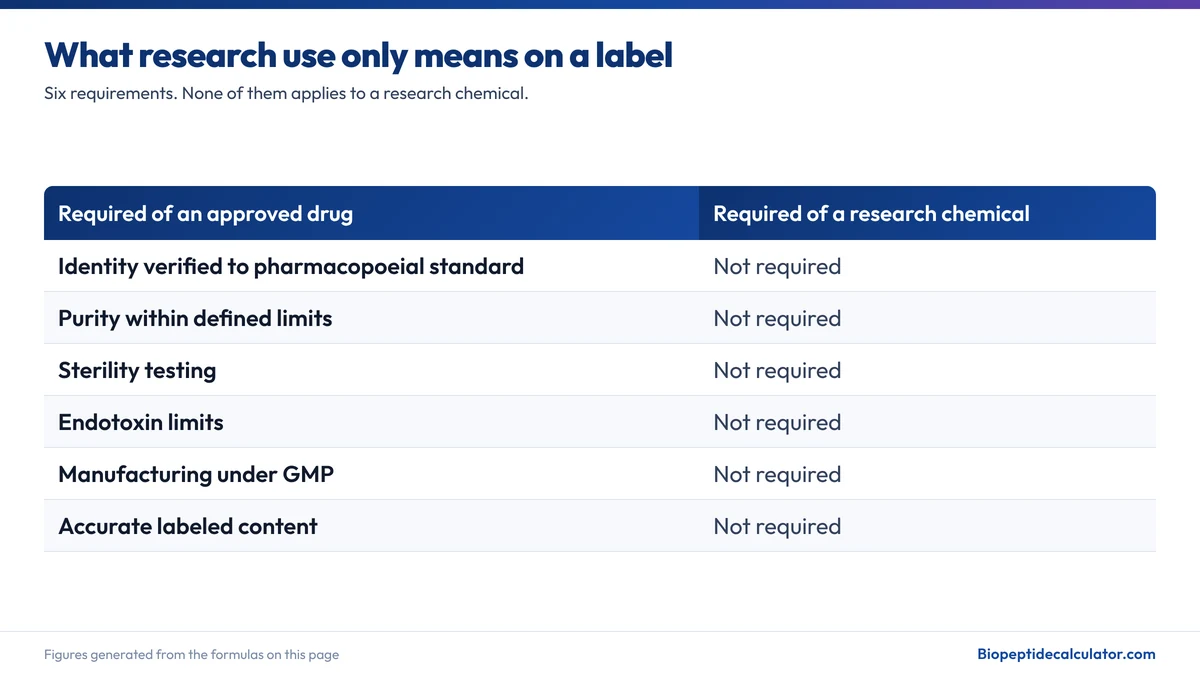
A seller may do some or all of these voluntarily, and the better ones publish certificates of analysis. Voluntary is the operative word.
What would actually count as approval
For completeness, because the bar is worth knowing.
Approval means a sponsor ran adequate and well-controlled human trials, submitted the full dataset, and the agency reviewed it and concluded the compound is safe and effective for a specific stated use in a specific population. The label that results lists indications, contraindications, interactions and adverse reaction rates.
None of the compounds in the tables above has been through that, with the exception of the approved drugs named as approved.
Frequently asked questions
Are research peptides FDA approved?
No. No research peptide is FDA approved. Approved peptide drugs exist, such as semaglutide and tirzepatide, but compounds sold as research peptides are not approved, and the 2026 regulatory changes did not approve any of them.
Did the FDA legalize BPC-157 in 2026?
No. BPC 157 was removed from Category 2 in April 2026, recommended for the 503A bulks list by an advisory committee in July 2026, and included in a draft HHS enforcement discretion policy in October 2026. None of those is approval, and it is still not on the bulks list.
What is the 503A bulks list?
It is the list of bulk drug substances that compounding pharmacies may legally use under section 503A of the Federal Food, Drug, and Cosmetic Act. Being on it permits compounding. It is not drug approval, and as of November 2026 none of the six peptides in the draft policy had been added to it.
What is enforcement discretion?
A statement by a regulator about how it intends to prioritize enforcement. It is not a law, not an approval, and not a safety finding. The October 2026 HHS policy says it has no formal effect of law.
What does research use only mean?
It means the product is sold for laboratory research and is not intended, manufactured, tested or labeled for human use. There is no requirement that it contains what the label says at the purity claimed.
Is it illegal to buy research peptides?
The legal position differs between selling, possessing and administering, and it varies by jurisdiction and over time. What is clear is that these compounds are not approved medicines and are not sold as medicines, and this page is not legal advice.
Run your own vial and dose through the peptide dosage calculator.
Sources & Scientific References
The science on this page traces to the peer-reviewed and reference sources below. We link only to research and reference material.
Peer-Reviewed Research
- Jozwiak M, et al. Multifunctionality and Possible Medical Application of the BPC 157 Peptide: Literature and Patent Review. Pharmaceuticals, 2025;18:185 (PMC). – the current review of what BPC 157 research does and does not show
Reference & Regulatory
- Federal Register: Enforcement Discretion Policy Regarding 503A Compounding Using Certain Peptide Bulk Drug Substances. HHS, 91 FR, October 30, 2026. Docket HHS-OASH-2026-0496. – the official notice of the draft enforcement discretion policy, which states that compounded drugs are not FDA-approved
- Frier Levitt: FDA to remove 12 peptides from the Category 2 do not compound list, April 2026. – the April 15, 2026 action and what removal from Category 2 does and does not mean
- McDermott Will & Schulte: PCAC backs majority of peptides in two-day public meeting, July 2026. – the recorded vote counts from the July 23 to 24, 2026 advisory committee meeting
- Holland & Knight: HHS issues interim enforcement discretion policy for compounding of 6 peptides, November 2026. – a breakdown of the ten conditions attached to the policy
More at Bio Peptide Calculator
- Are peptides safe – risk, separated by category
- What is peptide therapy – how the three categories differ in practice
- Peptide library – status notes compound by compound