
The GHKcu peptide is the most-studied copper peptide in skin and regenerative research. It is a naturally occurring tripeptide bound to copper that stimulates collagen and supports wound healing. The peptide influences thousands of human genes. This guide covers what the GHKcu peptide is, how it works, its benefits and side effects, topical versus injectable use, before-and-after expectations, what people report (interesting), and where the science actually stands.
Quick summary: GHK-Cu (copper tripeptide-1) is a natural copper-binding peptide first isolated from human plasma in 1973. It boosts collagen and elastin, aids wound healing, and is used both in topical skincare and as an injectable research compound. Its levels in the body decline with age, which is part of why it is studied for anti-aging. It is a cosmetic ingredient, not an FDA-approved drug.
Watch: GHK-Cu peptide overview
A short visual overview of the GHK-Cu copper peptide — what it is and why it is used for skin and repair.
What Is GHK-Cu Peptide?
GHK-Cu is a copper-binding tripeptide, three amino acids (glycine, histidine, and lysine) bound to a single copper ion. Its cosmetic-industry name (INCI) is copper tripeptide-1, and you will also see it written as the ghk-cu peptide, GHKCu, or simply GHK-Cu. It was first isolated from human blood plasma in 1973 by biochemist Loren Pickart, who found it is a natural fragment the body produces, likely released when collagen and other proteins break down during tissue injury.
The key detail behind all the interest in the GHKcu peptide is that the body’s own levels of it fall with age — from roughly 200 ng/mL around age 20 down substantially by age 60. That decline tracks closely with the visible signs of aging: reduced collagen, slower wound healing, thinner skin, and less elasticity. Restoring GHK, through topical or injectable copper peptide GHK-Cu, is the central idea researchers have pursued for decades. Structurally the molecule is small (the free peptide is about 340 g/mol; the copper complex near 404 g/mol), which is part of what makes it useful in skincare — large enough to signal to cells, small enough to formulate.
GHK is not an exotic laboratory invention — it is a fragment your own body produces, likely released during the breakdown of collagen and other proteins during tissue injury, where it appears to act as a natural “repair signal” that tells surrounding cells to begin rebuilding. This is why researchers describe it less as a drug and more as a restoration of something the body already uses and gradually loses. That framing — replacing a declining natural signal rather than introducing a foreign one — is central to why the ghk cu peptide has drawn decades of scientific attention across dermatology, wound care, and regenerative medicine.
How the GHK-Cu Peptide Works
The GHKcu peptide works through two overlapping roles: it is both a copper carrier and a signaling molecule. As a copper carrier, it delivers copper, which is an essential cofactor for the enzymes that cross-link and strengthen collagen. As a signaling molecule, it tells skin cells (fibroblasts) to ramp up production of collagen, elastin, and the moisture-binding molecules that keep skin plump.
The most striking research finding is its scale of gene influence. A widely cited 2010 analysis found GHK modulates the expression of around 4,000 human genes — roughly a third to 6% of the genome depending on how it is counted — generally shifting aging-related expression patterns back toward a younger baseline. Beyond that broad reset, specific documented mechanisms include:
- Stimulating fibroblasts to produce type I collagen, elastin, proteoglycans, and glycosaminoglycans — in lab studies, collagen synthesis has increased significantly at very low concentrations.
- Promoting new blood-vessel formation (angiogenesis) by upregulating VEGF and bFGF, which feeds healing tissue.
- Acting as an antioxidant and anti-inflammatory, boosting glutathione and superoxide-dismutase pathways while dialing down inflammatory signals.
- Remodeling the skin’s support matrix by balancing MMP enzymes and their inhibitors (TIMPs), which helps rebuild rather than just break down.
Deep dive: the science of GHK-Cu
A longer, more detailed look at the mechanisms and research behind the GHK-Cu peptide.
GHK-Cu Benefits
The researched benefits of the copper peptide GHK-Cu span skin, wound healing, and hair, with the strongest evidence in wound repair and reasonable clinical support for anti-aging skincare.
- Collagen and elastin support — the headline benefit. In a 2024 randomized controlled trial, 60 women aged 40–65 using a 0.1% GHK-Cu cream twice daily for 12 weeks saw about 31% wrinkle reduction and 28% improved elasticity versus placebo.
- Wound healing — the most robust area of evidence. GHK-Cu accelerates the phases of tissue repair and improves the strength of healed tissue in animal and human studies.
- Skin firmness, thickness, and hydration — controlled trials of copper-peptide creams have improved skin density and reduced fine lines, in one eye-cream study outperforming both placebo and a vitamin-K cream.
- Hair support — copper peptides are studied for supporting follicle size and growth, and appear in some hair tonics and after-transplant protocols.
- Antioxidant and anti-inflammatory effects — helping protect skin from oxidative and inflammatory damage that drives aging.
Note: GHK-Cu is regulated as a cosmetic ingredient, not an approved drug. Topical use in skincare is well established; injectable use is off-label or investigational, and results vary. This is educational information, not medical advice.
What Is GHK-Cu Peptide Used For?
People ask what the ghk cu peptide is used for, and the answer spans three main areas. In skincare and anti-aging, it is used topically (as copper tripeptide-1 in serums and creams) to firm skin, reduce fine lines, and improve texture and hydration. In wound healing and skin repair, it is researched for accelerating recovery, improving scar quality, and supporting skin after procedures or radiation. In hair care, it appears in tonics and post-transplant protocols for follicle support. It is also a core ingredient in blended research peptides like the GLOW and KLOW stacks, where it provides the skin-and-collagen component.
GHK-Cu Peptide Injection and Dosage
A ghk-cu peptide injection delivers the copper peptide subcutaneously rather than applying it to the skin surface, which some researchers use for a systemic rather than purely local effect. Injectable GHK-Cu comes as a lyophilized powder that is reconstituted with bacteriostatic water, and the solution takes on a characteristic blue tint from the copper — this is normal and expected.
There is no FDA-approved injectable dose, so figures come from community research protocols, not medical guidance. Commonly cited research ranges land around 1–2 mg per day for the injectable form, often run in a cycle of about 4 weeks on followed by a break, because GHK-Cu is over 70% copper by design and continuous high-dose use raises a theoretical copper-accumulation concern. Because these are microgram-to-milligram doses drawn from a reconstituted vial, accurate measuring matters — our GHK-Cu dosage calculator and GHK-Cu dosage chart convert any vial size and water volume into exact syringe units.
Disclaimer: Injectable GHK-Cu is not FDA-approved and injectable dosing is not clinically established. The figures above are community-reported research protocols, not medical advice. Topical cosmetic use has a far better-established safety profile than injection.
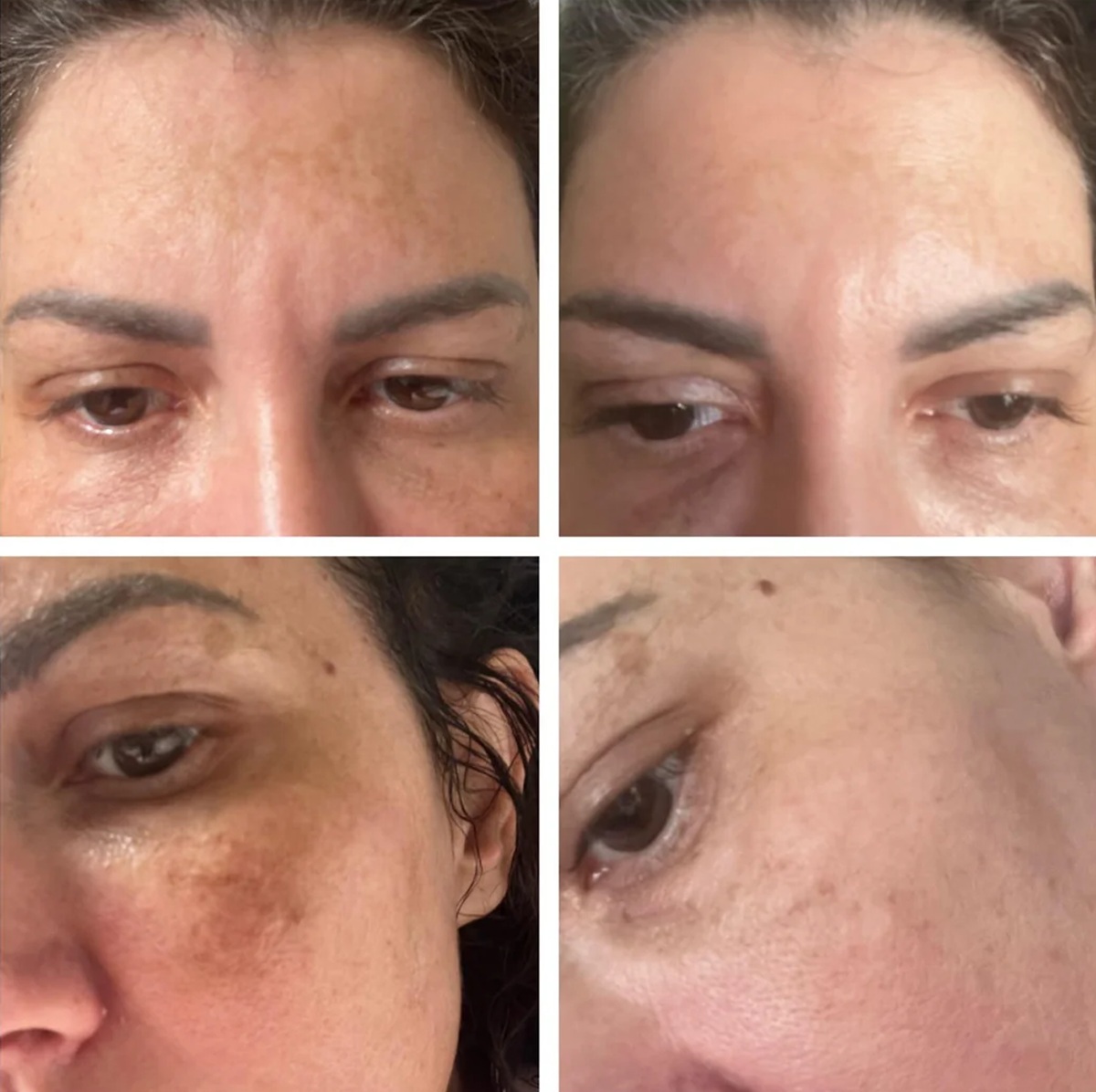
GHK-Cu Peptide Injection Before and After
When people search for ghk-cu peptide injection before and after results, they want a realistic timeline. Based on the clinical and community evidence, here is what tends to happen — noting that individual results vary and that most controlled data is for topical use.
| Timeframe | Commonly Reported Changes |
|---|---|
| Weeks 1–2 | Subtle changes; smoother texture and better hydration begin for some. |
| Weeks 2–4 | Visible skin changes typically start — improved tone, early firmness. |
| Weeks 8–12 | Peak collagen-density and firmness improvements; fine-line reduction most evident. |
| 3–6 months | Hair changes (where applicable) are slower and appear over this longer window. |
In the 2024 controlled trial, twelve weeks of consistent use produced roughly 31% wrinkle reduction and 28% better elasticity — a good benchmark for what “after” can look like with steady topical use. Injectable before-and-after reports are anecdotal and more variable. Realistic expectations matter: GHK-Cu produces gradual, cumulative improvement, not an overnight transformation.
GHK-Cu Side Effects
The ghk cu peptide is generally well tolerated, especially in topical form, but it is not risk-free. Most reported effects are mild and local.
Topical side effects: occasional redness, itching, stinging, dryness, or contact irritation, most often when starting or at higher concentrations. Combining strong actives (like high-strength vitamin C or retinoids) in the same routine can increase irritation for some people.
Injectable side effects: injection-site redness or a small bump, a temporary blue-green tint at the site from the copper, and mild first-week fatigue in some reports. The most-discussed longer-term concern is copper accumulation with prolonged, high-dose injectable use, which is why cycling is emphasized.
Who should avoid it: anyone with Wilson’s disease or another copper-metabolism disorder should not use GHK-Cu, since they cannot clear copper normally. People who are pregnant or breastfeeding, and anyone with a known copper allergy, should also avoid it. As with any injectable research compound, those with active cancer are generally advised to be cautious given GHK-Cu’s growth-supporting, angiogenic activity.
Disclaimer: This is not a complete list of risks. Injectable GHK-Cu lacks long-term human safety data. Consult a qualified professional, and stop use if you experience a significant reaction.
Topical vs Injectable GHK-Cu: Which Is Better?
This is one of the most common questions, and the honest answer is that they serve different purposes with very different evidence bases. Topical GHK-Cu (in serums and creams) has the stronger safety record and the bulk of the controlled clinical data — it acts locally on the skin it is applied to and is the mainstream, well-established use. A ghk-cu peptide injection acts systemically and is favored by some researchers for that broader reach, but it carries the added risks of any injection, has far less controlled human data, and raises the copper-accumulation concern with repeated use.
| Topical (serum/cream) | Injectable | |
|---|---|---|
| Evidence | Strong (controlled trials) | Limited / anecdotal |
| Effect | Local (applied area) | Systemic |
| Safety record | Well established | Less established; copper concern |
| Status | Cosmetic ingredient | Research use, not approved |
For most people whose goal is skin quality, topical GHK-Cu is the sensible, evidence-backed choice. The injectable route is a research decision that should only be considered with full awareness of its weaker evidence and added risks.
GHK-Cu vs Other Anti-Aging Ingredients
A useful way to understand the ghk cu peptide is to see how it compares with the other ingredients people weigh it against. Each works differently, and many people use them together rather than choosing one.
- GHK-Cu vs retinoids (retinol/tretinoin): retinoids are the gold standard for anti-aging but can be harsh, causing dryness and peeling. GHK-Cu is gentler and works through collagen signaling and copper delivery rather than accelerating cell turnover. Many people pair them — retinoid for turnover, GHK-Cu for collagen and repair — on alternating schedules.
- GHK-Cu vs Matrixyl (palmitoyl peptides): both are collagen-supporting peptides. Matrixyl is a signal peptide that mimics collagen breakdown fragments to prompt repair, while GHK-Cu adds the copper-delivery and broad gene-modulating angle. Some formulations combine them for complementary collagen support.
- GHK-Cu vs vitamin C: vitamin C is an antioxidant and collagen cofactor, but it can destabilize the copper complex if layered directly with GHK-Cu, which is why they are usually separated by time of day. Used apart, they can be complementary parts of a routine.
- GHK-Cu vs BPC-157 / TB-500: these are recovery peptides focused on tissue and injury repair rather than skin collagen. GHK-Cu is the skin-and-collagen specialist, which is exactly why blends like GLOW and KLOW combine all three — GHK-Cu for skin, BPC-157 and TB-500 for broader tissue repair.
The takeaway: the ghk cu peptide is not a replacement for retinoids or vitamin C but a complementary, gentler collagen-and-repair tool that plays well alongside them when used thoughtfully.
What Do People Say About GHK-Cu?
Read this as community sentiment, not clinical evidence. The themes below summarize what recurs across skincare communities (like r/SkincareAddiction), peptide forums (r/Peptides), and beauty and biohacking discussion. These are unverified personal reports that often contradict each other. They are included to show the real-world conversation, not as medical claims.
Skin texture and “glow” are the most-praised effects. The single most consistent positive report is improved skin texture — smoother, more even, more “bouncy” skin, and a subtle radiance people often call a glow. Many topical users say texture and tone are the first things they notice, frequently within the first two to four weeks, and that it stacks well as a gentle base layer in a routine.
Fine lines and firmness improve gradually. Longer-term users commonly report softened fine lines and firmer-feeling skin over two to three months of consistent use, which lines up with the clinical timeline. The recurring caveat is patience: people who quit after a week or two almost always report “nothing happened,” while those who stick with it for the full collagen-building window are the ones describing real change.
Wound and scar healing gets strong anecdotal support. A frequent theme is faster healing of blemishes, minor cuts, and post-procedure skin, and improved appearance of newer scars. This is the use with the best research backing, and community reports tend to echo it — though people note it works far better on fresh healing than on old, set scars.
The vitamin C conflict is the top practical debate. One of the most-discussed points is whether GHK-Cu and vitamin C (ascorbic acid) can be used together. The community consensus that has emerged is to separate them — use them at different times of day — because strong vitamin C can destabilize the copper complex and some people get irritation when layering them. This “don’t mix them in the same step” tip comes up constantly.
The blue tint sparks endless questions. New users of both the serum and the injectable are routinely surprised by the blue-green color and ask if their product has gone bad. Experienced users reassure them that the blue is simply the copper and is completely normal — in fact its absence can be a sign the product lacks real copper peptide.
Injectable users report skin plus recovery, but with more caution. Those using the injectable form describe systemic skin improvements and better general recovery, but the more experienced voices consistently raise the copper-accumulation concern and push newcomers toward cycling and toward topical use unless they have a specific reason to inject. “Start topical” is common advice.
Hair reports are mixed and slower. Some users add copper peptide to their hair routine and report thicker-looking hair or better scalp condition over several months, while others see little. The consensus is that hair effects, if they come, are subtle and take far longer than skin effects — nobody describes it as a dedicated hair-loss treatment.
Product-quality skepticism is constant. As with any peptide, a major recurring theme is doubt about whether a given serum or vial actually contains real, correctly-concentrated GHK-Cu. Community members stress buying from sources with third-party testing (a Certificate of Analysis for injectables, a credible formulation for topicals) and warn that a large share of “it did nothing” reports trace back to weak or fake product.
Sensitive-skin users appreciate the gentleness. Compared with retinoids, many people with sensitive or reactive skin describe GHK-Cu as a gentler way to pursue anti-aging, tolerable when retinol is too harsh. A common routine tip is to use GHK-Cu on “off” nights from retinoids, or to lead with it while building retinoid tolerance.
For the live conversation, active hubs include Reddit’s r/SkincareAddiction for the topical/cosmetic angle and r/Peptides for the injectable/research angle. Recent threads there give a more current, unfiltered picture than any single summary, including this one.
Disclaimer: Community reports are anecdotal, unverifiable, and vary widely between individuals and products. They are not a substitute for clinical evidence or professional guidance.
Where to Get GHK-Cu Peptide
People search for where to buy or get the ghk cu peptide, and the answer depends on which form you want. For topical use, GHK-Cu (listed as copper tripeptide-1) is a legal, widely available cosmetic ingredient sold in serums and creams from mainstream skincare brands and retailers — this is the easiest and best-evidenced route. For the injectable research form, GHK-Cu is sold by research-peptide suppliers as a lyophilized powder labeled “for research use only,” which is a legal gray area and unregulated for human use.
We do not sell peptides or endorse specific vendors. If you are evaluating an injectable source, the key checks are the same as for any research peptide: a batch-specific third-party Certificate of Analysis (showing HPLC purity and mass-spec identity), lyophilized powder rather than pre-mixed solution, a verifiable business, realistic pricing, and “research use only” labeling. For topical products, look for a credible formulation with copper tripeptide-1 listed meaningfully in the ingredients rather than as a trace afterthought. Whichever form, the characteristic blue color is a basic sign that real copper peptide is present.
Disclaimer: Topical GHK-Cu is a legal cosmetic ingredient; injectable GHK-Cu is sold for research use only and is not approved for human use. This page does not endorse any vendor. Follow the laws in your area and consult a professional before injecting anything.
GHK-Cu Peptide FAQ
What is GHK-Cu peptide?
GHK-Cu is a copper-binding tripeptide made of glycine, histidine, and lysine bound to a copper ion, known cosmetically as copper tripeptide-1. It occurs naturally in the body, was first isolated from human plasma in 1973, and stimulates collagen, supports wound healing, and influences thousands of genes. It is used topically in skincare and as an injectable research compound.
What is GHK-Cu peptide used for?
It is used mainly for three things: anti-aging skincare (firming skin, reducing fine lines, improving texture), wound and skin repair (accelerating healing and improving scar quality), and hair support. Its strongest evidence is in wound healing, with solid clinical support for topical anti-aging. It is also the skin-and-collagen component in blended peptides like GLOW and KLOW.
What are the benefits of the GHK-Cu peptide?
Key benefits include boosting collagen and elastin, reducing fine lines and wrinkles (about 31% wrinkle reduction in a 2024 controlled trial), improving skin firmness, thickness, and hydration, accelerating wound healing, supporting hair follicles, and providing antioxidant and anti-inflammatory effects. These come from its dual role as a copper carrier and a signaling molecule that influences roughly 4,000 human genes.
What are the side effects of GHK-Cu?
Topical side effects are usually mild — occasional redness, itching, stinging, or dryness. Injectable side effects include injection-site reactions, a temporary blue tint, and, with prolonged high-dose use, a copper-accumulation concern. People with Wilson’s disease or other copper-metabolism disorders, a copper allergy, or who are pregnant or breastfeeding should avoid it.
Where can I buy or get a GHK-Cu peptide injection?
Topical GHK-Cu (copper tripeptide-1) is a legal cosmetic ingredient sold widely in serums and creams. The injectable research form is sold by research-peptide suppliers as a lyophilized powder labeled “for research use only,” which is unregulated for human use. We do not endorse vendors; if buying injectable, insist on a batch-specific third-party Certificate of Analysis, and follow the laws in your area.
How long does GHK-Cu take to work?
Subtle changes in texture and hydration can appear within the first two weeks, with visible skin improvements typically starting around weeks two to four. Peak collagen-density and firmness gains usually show at eight to twelve weeks. Hair effects, where they occur, are slower — three to six months. Consistency over the full window is the biggest factor in results.
Can GHK-Cu cause hair thinning?
No — GHK-Cu is more often studied for the opposite, supporting hair follicle size and growth, and copper peptides appear in some hair tonics and post-transplant protocols. Hair thinning is not a recognized effect. Responses vary and controlled hair data is limited, but the peptide is associated with hair support rather than loss.
How much GHK-Cu should I use, and is 1 mg enough?
For topical products, follow the formulation’s directions (concentrations around 0.1% appear in clinical studies). For the injectable research form, community protocols often cite roughly 1–2 mg per day, so 1 mg sits at the lower, gentler end of that range. There is no FDA-established dose, and lower amounts carry less copper load. This is not medical dosing advice.
Can you use GHK-Cu with vitamin C or retinol?
With vitamin C, the common guidance is to separate them — use them at different times of day — because strong ascorbic acid can destabilize the copper complex and layering them causes irritation for some people. With retinol, many use GHK-Cu on alternate nights or lead with it while building retinoid tolerance, since GHK-Cu is comparatively gentle. Patch-test any new combination.
Why does GHK-Cu turn blue, and is that bad?
The blue-green color comes from the copper in the peptide and is completely normal — both reconstituted injectable solutions and many topical products carry this tint. It is not a sign of spoilage; in fact, the absence of any blue can indicate a product lacks real copper peptide. Discard a product only if it becomes cloudy or shows particles.
Is GHK-Cu FDA-approved?
GHK-Cu is regulated as a cosmetic ingredient (copper tripeptide-1) and is legal in topical skincare, but it is not an FDA-approved drug for any medical indication. Injectable GHK-Cu use is off-label or investigational. Its cosmetic topical use is well established; injectable use is not clinically approved.
Sources & Scientific References
The science on this page traces to the peer-reviewed and reference sources below. We link only to research and reference material.
Peer-Reviewed Research
- Pickart L, Margolina A. The Effect of the Human Peptide GHK on Gene Expression Relevant to Skin. BioMed Research International, 2015 (PMC). — GHK’s role in collagen, skin remodeling, and gene expression.
- Pickart L, Margolina A. Regenerative and Protective Actions of the GHK-Cu Peptide. Int J Mol Sci, 2018 (PMC). — the review documenting GHK-Cu’s effects across thousands of human genes.
- Pickart L, et al. GHK and DNA: Resetting the Human Genome to Health. BioMed Research International, 2014 (PubMed). — the analysis of GHK’s broad gene-modulating activity.
- Pickart L. The Human Tri-Peptide GHK and Tissue Remodeling. J Biomater Sci (PMC). — GHK-Cu in wound healing and tissue repair.
Reference & Regulatory
- Wikipedia: Copper peptide GHK-Cu. — background on the molecule, discovery, structure, and uses.
- PubChem: Copper tripeptide-1. — the chemical database entry for the GHK-Cu complex.
- Cleveland Clinic: Wilson Disease. — the copper-metabolism disorder for which GHK-Cu should be avoided.
More at Bio Peptide Calculator
- GHK-Cu dosage chart and GHK-Cu dosage calculator — convert any vial to exact units.
- Glow dosage chart and Klow dosage chart — the blends built around GHK-Cu.
- Peptide library — what every peptide is and does.
Full disclaimer: This article is educational only and is not medical advice. GHK-Cu is a cosmetic ingredient, not an FDA-approved drug; injectable use is off-label or investigational and sold for research use only. Dosing and injection information reflects community-reported research protocols, not validated regimens. Individual results vary. People with copper-metabolism disorders such as Wilson’s disease should avoid GHK-Cu. Always consult a licensed healthcare professional before using any peptide, especially by injection.