
This Glow dosage chart shows the titration schedule and per-injection component breakdown for the glow peptide blend (GHK-Cu, BPC-157, and TB-500). The Glow peptide dosage chart shows exact syringe units at the standard 70 mg reconstitution. The glow stack is a research-only blend, not FDA-approved; the figures below reflect community protocols, not medical guidance.
Educational information only. The glow peptide blend is sold as a research chemical and is not FDA-approved for human use. No published clinical trial has evaluated the three-peptide combination together. Nothing here is medical advice or a dosing recommendation; doses are community-reported research protocols.
Glow Dosage Chart (Titration & Component Breakdown)
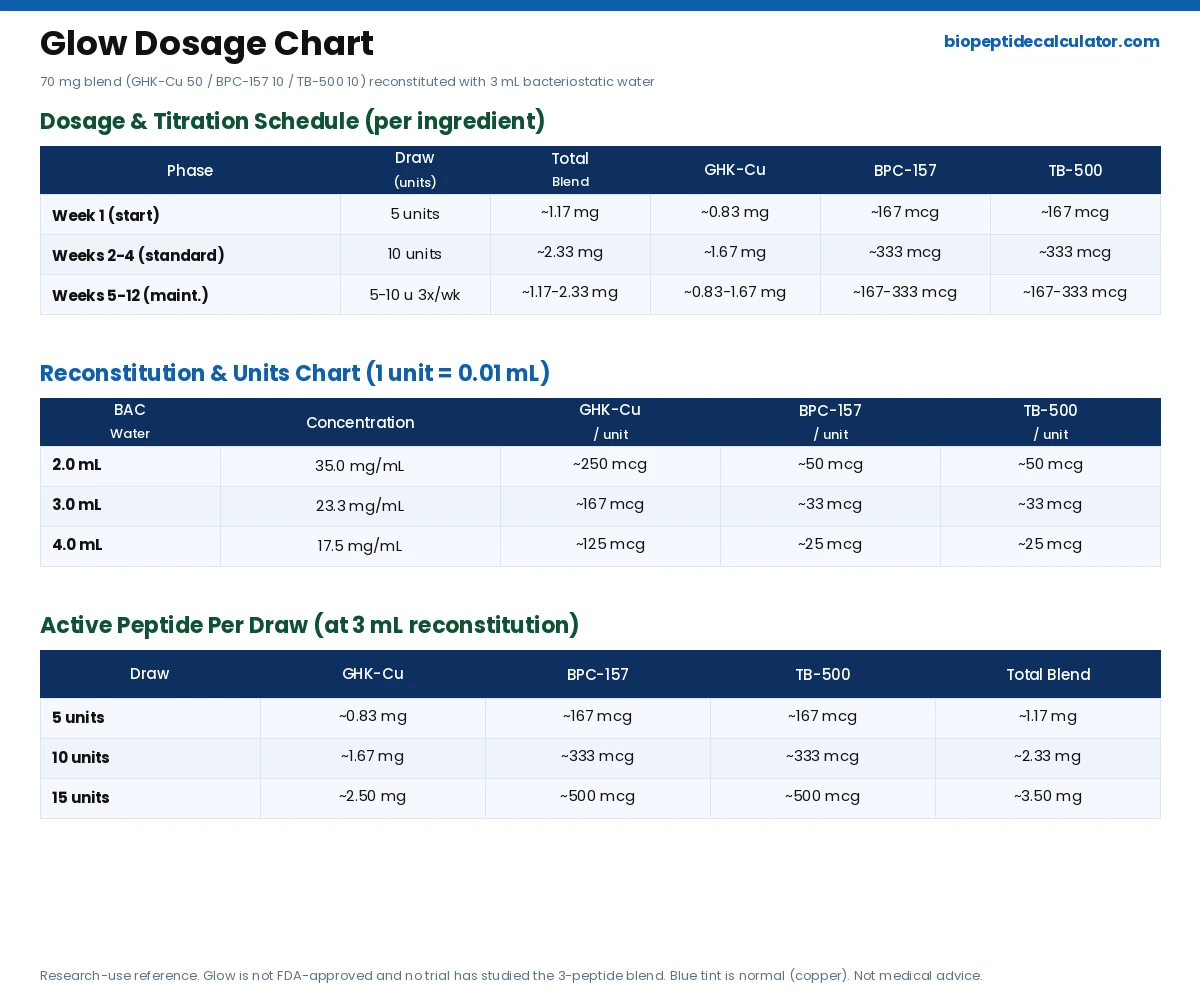
This Glow dosage chart shows the most common community titration for the standard 70 mg vial reconstituted with 3 mL of bacteriostatic water (23.3 mg/mL). Because GHK-Cu makes up over 70% of the blend, every draw delivers more GHK-Cu alongside smaller matched amounts of BPC-157 and TB-500. Injection is once daily, subcutaneous.
| Phase | Draw (units) | Total Blend | GHK-Cu | BPC-157 / TB-500 (each) |
|---|---|---|---|---|
| Week 1 (start) | 5 units | ~1.17 mg | ~0.83 mg | ~167 mcg |
| Weeks 2–4 (standard) | 10 units | ~2.33 mg | ~1.67 mg | ~333 mcg |
| Weeks 5–12 (maintenance) | 5–10 units, 3x/week | ~1.17–2.33 mg | ~0.83–1.67 mg | ~167–333 mcg |
| Off-cycle | 0 units | — | — | 2–4 week break |
Units are on a U-100 insulin syringe (100 units = 1 mL) at the 3 mL reconstitution, where 1 unit ≈ 233 mcg of total blend. A 30- or 50-unit syringe is easiest for these small draws. Everyone starts low; these are community-derived research volumes, not clinically validated doses.
Glow Peptide Reconstitution & Units Chart
The glow peptide dosage you draw depends on how much bacteriostatic water you add to the 70 mg vial. This chart shows the resulting concentration and how much of each peptide lands in a single unit (0.01 mL) at the three most common water volumes.
| BAC Water | Total Concentration | GHK-Cu / unit | BPC-157 / TB-500 / unit |
|---|---|---|---|
| 2.0 mL | 35.0 mg/mL | ~250 mcg | ~50 mcg each |
| 3.0 mL (most common) | 23.3 mg/mL | ~167 mcg | ~33 mcg each |
| 4.0 mL | 17.5 mg/mL | ~125 mcg | ~25 mcg each |
More water gives larger, easier-to-read draws but a bigger injection volume. The solution takes on a blue tint from the copper in GHK-Cu, which is normal and expected. For custom vial sizes, use the peptide reconstitution calculator to confirm your units before drawing.
Glow Dosage Chart – All-in-One Chart that Shows Active Ingredients per Draw.
What Is the Glow Peptide?
The glow peptide is a three-peptide research blend that combines GHK-Cu, BPC-157, and TB-500 in a single lyophilized vial. A typical commercial vial is 70 mg total, split in a 5:1:1 ratio as 50 mg GHK-Cu, 10 mg BPC-157, and 10 mg TB-500. Because everything is pre-mixed, you reconstitute once and every daily draw delivers all three glow peptides in that fixed ratio. Products are often sold under names like the “Pure Bio Labs glow blend peptide vial,” but the underlying formula is the same three-compound combination.
The idea behind the glow blend peptide is that skin and tissue repair happen through several parallel pathways. GHK-Cu drives collagen, elastin, and skin remodeling; BPC-157 supports blood-vessel growth (angiogenesis) and gut, tendon, and ligament repair; and TB-500 helps repair cells migrate to where they are needed. Combining them is meant to hit all three at once in a single injection. It is important to understand that glow is not FDA-approved and no trial has tested the three peptides together; the rationale is mechanism-based reasoning, not proven combination science.
Glow Peptide Benefits
The researched glow peptide benefits come from what each of its three components is individually studied for. There is no direct trial on the blend, so these reflect component research and community reports, not validated outcomes of glow itself.
- Skin quality and anti-aging — GHK-Cu is the most-studied copper peptide for collagen and elastin synthesis, skin firmness, and reduced fine lines. This is the headline glow peptide benefit and the reason the blend is associated with a “glow.”
- Tissue and injury repair — BPC-157 and TB-500 are researched for tendon, ligament, muscle, and soft-tissue healing, and for improving the blood supply that feeds repair.
- Recovery and skin-repair synergy — taken together, the three peptides are used in research contexts that span skin appearance and physical recovery in one protocol, which is the practical appeal of the blend.
- Convenience of a single injection — getting three studied peptides in one pre-mixed vial means one daily shot instead of three, with no separate reconstitution math for each.
Disclaimer: These benefits are extrapolated from individual-component research and community reports. The glow blend itself has not been clinically tested, and none of these are proven outcomes or medical claims.
Glow Blend Peptide: The Three Components
Understanding the glow blend peptide means understanding what each of its three peptides does. The table breaks down the standard 70 mg vial.
| Peptide | Amount | What It Is | Researched For |
|---|---|---|---|
| GHK-Cu | 50 mg | Copper-binding tripeptide | Collagen, elastin, skin repair, gene expression |
| BPC-157 | 10 mg | Gastric-protein-derived peptide | Soft-tissue and gut repair, angiogenesis |
| TB-500 | 10 mg | Thymosin beta-4 fragment | Cell migration, wound healing, flexibility |
Ratios vary by supplier; 50:10:10 (5:1:1) is the most common reference, and some vendors use a 70 mg or 90 mg total. GHK-Cu dominates the vial, which is why copper handling drives the cycle length.
GHK-Cu: The Copper Peptide in Glow
GHK-Cu is the star of the glow blend and the reason it works on skin. The ghk copper peptide is a naturally occurring tripeptide (glycyl-L-histidyl-L-lysine) bound to a copper ion. Levels of it in the body decline with age, which is part of the rationale for supplementing. In research, the ghk-cu peptide benefits most often cited are stimulation of collagen and elastin, activation of skin-remodeling genes, antioxidant and anti-inflammatory activity, and support for wound healing.
A common question is how a ghk-cu peptide injection in glow compares to using GHK-Cu on its own. Injected GHK-Cu (as in glow) acts systemically, while topical GHK-Cu in skincare acts locally on the skin it is applied to. In the standard glow blend, GHK-Cu makes up 50 of the 70 mg, so a typical 10-unit daily draw delivers roughly 1.67 mg of GHK-Cu — the majority of the injection. Whether injected copper peptide outperforms topical for skin is not settled by controlled trials; both are used in different contexts.
Glow vs Klow: What’s the Difference?
Glow and Klow are closely related blends, and the difference is one ingredient. Glow is the three-peptide blend of GHK-Cu, BPC-157, and TB-500. Klow is that same trio plus KPV, an anti-inflammatory peptide. So klow is essentially “glow plus KPV,” and it usually carries more of each peptide per vial.
| Glow | Klow | |
|---|---|---|
| Components | GHK-Cu + BPC-157 + TB-500 | GHK-Cu + BPC-157 + TB-500 + KPV |
| Typical vial | 70 mg (50/10/10) | 80 mg (50/10/10/10) |
| Extra ingredient | — | KPV (anti-inflammatory) |
| Research focus | Skin + tissue repair | Skin + tissue + anti-inflammatory / gut |
| Best when | Skin quality and general recovery focus | Inflammation or gut is also a factor |
Choose glow if the goal is skin quality and recovery; choose klow if you also want anti-inflammatory or gut support and are comfortable with the added KPV. For the full breakdown, see the Klow dosage chart.
Glow Peptide Side Effects
There are no published safety studies on the three-peptide glow combination, so the side-effect picture is drawn from individual-component research and community reports. Most reported effects are mild and local.
Most commonly reported: injection-site redness, mild swelling, itching, or sensitivity. A faint blue-green tint at the injection site is sometimes reported and comes from the copper in GHK-Cu — it is cosmetic only. Mild first-week fatigue and brief digestive shifts are also described.
Less commonly reported: headache, light-headedness, vivid dreams (often attributed to BPC-157), and temporary appetite changes. None have been formally measured in a controlled study of the blend.
The main stack-specific concerns are two. First, copper accumulation: GHK-Cu is over 70% of the vial, so prolonged continuous use without an off-period raises a theoretical risk of copper buildup — the reason cycles are time-limited. Second, angiogenesis: BPC-157 and TB-500 both promote new blood-vessel formation, which supports repair but is a meaningful reason for anyone with active or recent cancer to avoid the blend.
Who should avoid glow: anyone with active or recent cancer, people with Wilson’s disease or other copper-metabolism disorders, anyone pregnant or breastfeeding, and athletes subject to WADA testing (BPC-157 and TB-500 are listed under WADA’s S0 unapproved-substances category). Anyone on blood thinners should be especially cautious given the angiogenesis-active components.
Disclaimer: This is not a complete list of risks. The glow blend has no controlled human safety data. Stop and seek qualified medical care if pronounced symptoms appear (significant swelling, ongoing dizziness, rapid heart rate, shortness of breath). Only a clinician can assess your individual risk.
Glow Stack: Cycling and How It Compares
“Glow blend” and “glow stack” usually refer to the same thing — the three peptides in one vial — but “stack” tends to be used when discussing how it is run as a protocol and how it sits alongside related blends. The most common cycle for the glow stack peptide is 4 weeks on daily, followed by a 2–4 week break, with some running a longer 12-week structure that tapers to a maintenance frequency of a few injections per week. The off-period is there mainly to allow copper from the GHK-Cu component to clear.
The glow stack sits in a family of regenerative blends. The simplest is the Wolverine stack (BPC-157 + TB-500). Glow adds GHK-Cu to that base for skin and collagen. Klow adds KPV on top of glow for anti-inflammatory coverage. Some researchers instead run separate vials of each peptide, which allows independent dose adjustment (useful when TB-500 needs to run higher) at the cost of more injections and more reconstitution math. Note that separate-vial peptides should not be combined into one syringe, because they can have different stability and pH requirements — the pre-blended glow vial avoids that issue by being formulated together. Whichever route, the blend is cycled and rested as a unit.
The Advanced Glow Stack (5-Compound Protocol)
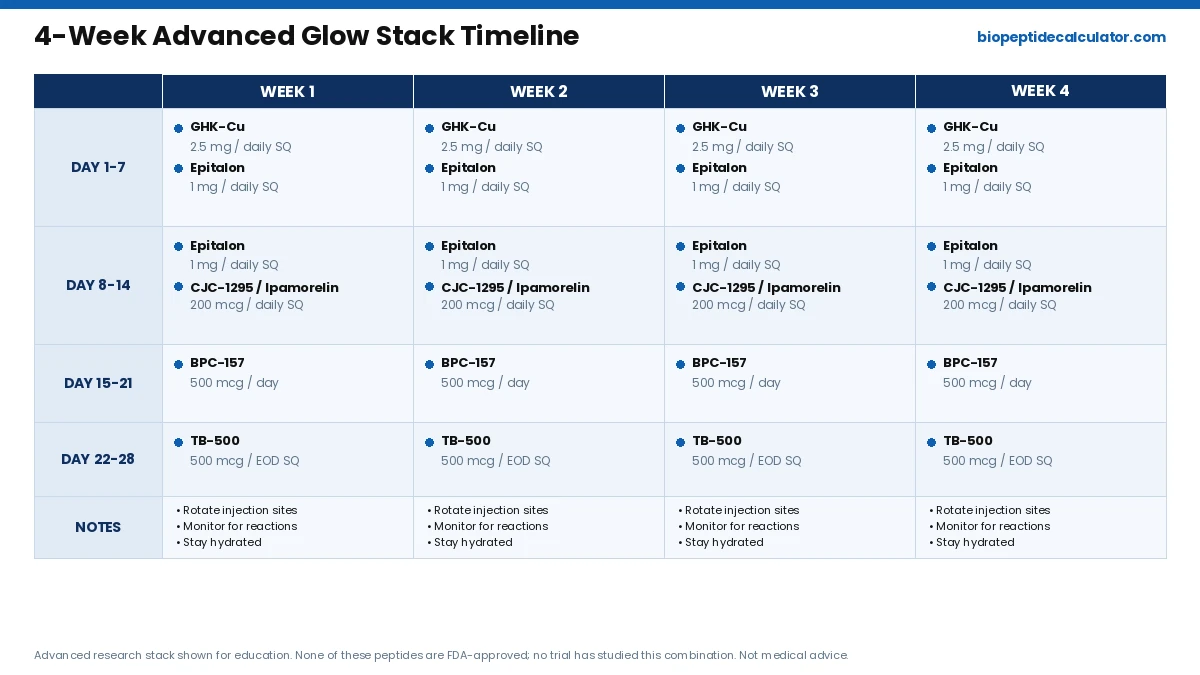
Beyond the standard three-peptide blend, experienced researchers sometimes run an “advanced” glow stack that layers extra compounds onto the Glow base across a structured 4-week timeline. Rather than everything in one vial, this version rotates several peptides by day-block, combining skin and tissue repair with growth-hormone support and a longevity peptide. It is meaningfully more complex than basic Glow, involves more injections, and multiplies the unknowns — it is not a beginner protocol.

A typical advanced protocol adds two things the basic Glow blend does not contain: a growth-hormone-releasing pair (CJC-1295 with Ipamorelin) and a longevity peptide (Epitalon). The result is a five-compound schedule where GHK-Cu and Epitalon run early in the cycle, the GH pair and BPC-157 come mid-cycle, and TB-500 anchors the final week. The idea is to cover skin, recovery, growth-hormone support, and cellular-aging pathways in one coordinated month. Because no trial has tested this combination, the structure below is a community-style framework, not validated medicine.
What the extra compounds add
- CJC-1295 / Ipamorelin — a growth-hormone-releasing pair. CJC-1295 (a GHRH analog) and Ipamorelin (a selective ghrelin-receptor peptide) work on two different receptors to produce a larger, cleaner natural GH pulse together than either alone. Added to Glow, they bring recovery and body-composition support that the base blend does not target. See the ipamorelin dosage chart for the pairing details.
- Epitalon (Epithalon) — a synthetic tetrapeptide (Ala-Glu-Asp-Gly) developed from pineal-gland research by Vladimir Khavinson. It is the most prominent longevity peptide, studied for activating telomerase (the enzyme that maintains the protective caps on chromosomes) and for supporting melatonin and sleep. Long-term, independently replicated human data are limited, and it is not FDA-approved — it is included here for the cellular-aging angle, not as a proven anti-aging treatment.
Is the advanced stack worth it?
For most people, no — the basic three-peptide glow stack already covers skin and tissue repair, which is what draws people to Glow in the first place. The advanced version adds cost, more injections, and more compounds whose combined behavior has never been studied, in exchange for growth-hormone and longevity effects that are separate goals. It makes sense only for experienced researchers who specifically want those additional pathways and understand the added risk. If your interest is skin quality and recovery, the standard Glow blend charted above is the simpler, better-understood choice.
Disclaimer: This advanced stack combines five unapproved research compounds with no combined safety data. The timeline shown is an educational illustration of how such protocols are structured, not a recommendation to run it. Stacking multiple peptides multiplies unknown risks. Consult a licensed healthcare professional.
Advanced Glow Peptide Stack.
What Do People Report About the Glow Peptide?
Read this as community sentiment, not evidence. The themes below summarize what recurs across peptide communities such as Reddit’s r/Peptides and dedicated blend threads. These are unverified personal reports from anonymous users, not clinical findings, and they often contradict each other. They are included so you understand the real-world conversation, not as anything to act on.
Skin changes are the most-reported effect. The most consistent positive reports are about skin — smoother texture, a healthier “glow,” faster-healing blemishes, and improved elasticity. Many users say skin quality is the first thing they notice, sometimes within the first two to three weeks, and they credit the GHK-Cu component specifically.
Recovery and joint reports are common but more variable. Users often mention faster recovery from training and improvement in minor nagging injuries, attributed to the BPC-157 and TB-500 in the blend. These reports are more mixed than the skin reports, and some people say they cannot clearly separate the effect from normal recovery.
The blue tint and injection sting come up constantly. New users frequently ask about the blue color of the solution and a mild sting on injection; experienced posters reassure them both are normal and due to the copper in GHK-Cu, not a bad batch. This is one of the most repeated exchanges in glow threads.
Copper and cycle length are the top cautions. More knowledgeable community members repeatedly raise the copper-accumulation point — because GHK-Cu is most of the vial — and push back on running glow continuously without an off-period. The 4-weeks-on, then a break structure is treated as the sensible default, and some warn against stacking glow with additional standalone GHK-Cu for that reason.
Debate over blend vs separate vials. A recurring discussion is whether the pre-mixed glow blend is worth it versus buying GHK-Cu, BPC-157, and TB-500 separately. The pro-blend camp values one injection and simplicity; the pro-separate camp wants dose control (especially higher TB-500). Both views appear regularly, and neither is treated as clearly correct.
Product quality is a constant worry. Because glow is a research-market blend, a major theme is doubt over whether a vial actually contains all three peptides at the stated ratio and purity. Community members stress third-party Certificates of Analysis and argue that many “it did nothing” reports trace back to under-dosed or mislabeled product rather than the blend itself.
For the live conversation, the most active hub is Reddit’s r/Peptides community, where users regularly post glow protocols, COAs, and skin results, with additional discussion in the broader r/PeptideProtocols community. Reading recent threads there gives a more current, unfiltered picture than any single summary — including this one.
Disclaimer: Community reports are anecdotal, unverifiable, and often influenced by other compounds users take at the same time. They are not a substitute for medical evidence or professional guidance.
Need exact units for a different vial size or water volume? The peptide reconstitution calculator converts any blend into precise syringe units. Browse all tools in the calculator library, see every dosage chart, or explore the full peptide library.
Glow Peptide FAQ
What exactly is the glow peptide?
Glow is a three-peptide research blend combining GHK-Cu, BPC-157, and TB-500 in a single vial, typically 70 mg total (50 mg GHK-Cu plus 10 mg each of the others). It is used in research contexts for skin quality, collagen, and tissue repair, and it is not FDA-approved. Everything is pre-mixed, so one daily injection delivers all three peptides.
What’s in the glow peptide mix?
The glow mix contains three peptides: GHK-Cu (a copper-binding tripeptide for collagen and skin), BPC-157 (a gastric-protein-derived peptide for tissue and gut repair), and TB-500 (a thymosin beta-4 fragment for cell migration and healing). The standard ratio is 5:1:1 — 50 mg GHK-Cu, 10 mg BPC-157, 10 mg TB-500.
Does glow peptide make you look younger?
Users commonly report improved skin texture, firmness, and a healthier appearance, which is attributed mainly to the GHK-Cu component’s role in collagen and elastin. These are subjective, anecdotal reports rather than results from controlled anti-aging trials. Any effect is gradual, builds over weeks, and there is no clinical evidence establishing the glow blend as an anti-aging treatment.
Does glow peptide work?
Each component has a research basis — GHK-Cu for skin and collagen, BPC-157 and TB-500 for tissue repair — and many users report noticeable skin and recovery benefits. However, the three-peptide blend itself has never been tested in a clinical trial, so “does it work” is answered by component research and anecdote, not direct evidence for glow. Results vary and depend heavily on product quality.
What are the risks of glow peptides?
The most common risks are mild: injection-site redness, swelling, or itching. More significant concerns include copper accumulation from the high GHK-Cu content with prolonged use, and the angiogenesis-promoting activity of BPC-157 and TB-500, which is a reason for anyone with active or recent cancer to avoid it. The blend is not FDA-approved, has no long-term human safety data, and research-market product quality varies.
Is there a downside to using peptides?
Yes. Research peptides like those in glow are not FDA-approved for these uses, lack long-term human safety data, and are unregulated on the research market, so purity and dosing accuracy vary. Injections carry infection and irritation risk, some peptides interact with medical conditions (copper disorders, cancer history), and many are banned in sport. The convenience and reported benefits come with real, under-studied risks — which is why medical supervision matters.
How often should I inject glow peptide?
The most common protocol is once daily, subcutaneously, during a 4-week cycle, then tapering to a few injections per week in a maintenance phase or taking a 2–4 week break. Because the blend is pre-mixed, one injection covers all three peptides. These frequencies are community-derived research protocols, not medical dosing.
How long to take glow peptide?
Common cycles run 4 weeks on daily, then a 2–4 week off-period, with some using a longer 12-week structure that includes a maintenance phase. The off-period exists mainly to let copper from GHK-Cu clear. Continuous use beyond about 12 weeks without a break is not supported by any safety data.
Where to inject glow peptide?
Glow is injected subcutaneously — into the fat layer, most commonly the lower abdomen, though the thigh also works. Rotate the injection site each day to avoid irritation and lumps, and use sterile technique (clean hands, alcohol-swabbed vial and skin, fresh needle). A 30- or 50-unit U-100 insulin syringe suits the small draw volumes.
What shouldn’t you mix with peptides?
Do not combine separate-vial peptides into one syringe unless they are formulated to be mixed, because different peptides can have different stability and pH requirements — a pre-blended vial like glow is designed for this, but ad-hoc mixing is not. Be cautious combining peptides with blood thinners (given the angiogenesis-active components), and discuss any combination with prescription medications with a clinician. Avoid reconstituting with anything other than bacteriostatic (or sterile) water.
How to make your own glow peptide?
Some researchers build glow from separate vials of GHK-Cu, BPC-157, and TB-500 rather than buying a pre-blend, which allows independent dose control. The trade-off is more injections and more reconstitution math, and each peptide should be drawn and injected separately rather than combined in one syringe. Getting the ratios and units right requires careful calculation — the reconstitution calculator handles the per-peptide math.
What are the differences between GHK-Cu and glow peptide?
GHK-Cu is a single copper-binding peptide focused on skin, collagen, and repair. Glow is a three-peptide blend that contains GHK-Cu plus BPC-157 and TB-500, adding tissue-repair and cell-migration pathways. So GHK-Cu is one ingredient; glow is a combination built around it. If your only goal is skin, GHK-Cu alone may suffice; glow adds broader recovery coverage in one injection.
How much GHK-Cu is in glow?
In the standard 70 mg glow vial, GHK-Cu is 50 mg — over 70% of the blend. At the common 3 mL reconstitution (23.3 mg/mL), a typical 10-unit daily draw delivers roughly 1.67 mg of GHK-Cu, alongside about 0.33 mg each of BPC-157 and TB-500.
Is 1 mg of GHK-Cu enough?
Community protocols for injected GHK-Cu often land in the 1–2 mg per day range, so 1 mg is within the commonly used range, on the lower end. In the glow blend, a standard daily draw delivers around 1.67 mg of GHK-Cu. There is no FDA-established dose, so “enough” depends on the research goal; lower doses are gentler and higher ones increase the copper load. This is not medical dosing advice.
Can GHK-Cu cause hair thinning?
GHK-Cu is more often researched for the opposite — it is studied for supporting hair follicle size and growth, and copper peptides appear in some hair products. Hair thinning is not a commonly reported effect. That said, responses vary and no controlled trial has evaluated the glow blend’s effect on hair, so individual experiences differ.
What are the negative side effects of GHK-Cu?
Reported GHK-Cu side effects are generally mild: injection-site reactions, a temporary blue tint at the site (from the copper), and occasional headache or light-headedness. The main longer-term concern is copper accumulation with prolonged high-dose use, which is why cycling matters. People with copper-metabolism disorders such as Wilson’s disease should avoid it entirely.
Where can I buy a glow peptide stack?
Glow is sold by research-peptide suppliers (often as a “glow blend” or under brand names like the Pure Bio Labs glow blend peptide vial), strictly for research use and not as an approved medicine. We do not sell peptides or endorse specific vendors. If you are evaluating a supplier, the key checks are batch-specific third-party Certificates of Analysis (HPLC purity and mass-spec identity), a verifiable business, and realistic pricing. Laws on buying research peptides vary by location.
How to Reconstitute for the Glow Dosage Chart
Glow arrives as a single lyophilized (freeze-dried) powder containing all three peptides. You reconstitute once, and every daily draw comes from that one solution. Getting this step right is what makes the Glow dosage chart above usable, because the water volume sets your concentration and therefore your units. The standard setup the chart is built on is the 70 mg vial mixed with 3 mL of bacteriostatic water.
- Let the vial reach room temperature and inspect it. Swab the rubber stoppers of the glow vial and the bacteriostatic water with separate alcohol pads.
- Draw 3 mL of bacteriostatic water into a sterile syringe.
- Insert the needle and let the water run slowly down the inside glass wall of the glow vial — do not spray it directly onto the powder, which can cause foaming.
- Swirl or roll gently for a minute or two until fully dissolved. Never shake. The solution will take on a blue tint from the GHK-Cu, which is expected and confirms proper dissolution.
- Label with the date and store refrigerated. Use the reconstitution and units chart above, or the calculator, to convert your target dose to units.
Once mixed, the peptide reconstitution calculator confirms your exact draw for any vial size or water volume.
Storing the Glow Peptide Blend
Before reconstitution, the lyophilized powder is best kept frozen at about −20°C for long-term storage — up to around two years — kept dry, dark, and in its original packaging. After reconstitution, store the liquid refrigerated at 2–8°C (36–46°F) and use it within about 28 days. Do not freeze the reconstituted solution, and avoid repeated freeze-thaw cycles, since each one damages the peptides; aliquoting into single-use portions helps if you need longer storage. Keep the vial protected from light. A clear blue-tinted solution is normal; discard anything cloudy or showing particles.
Sources & Research References
Because no trial has studied the glow combination, the references below cover the individual components. We link only to peer-reviewed research and reference sources — never to vendors.
GHK-Cu Research
- Pickart L, Margolina A. Regenerative and Protective Actions of the GHK-Cu Peptide. Int J Mol Sci. 2018. — the review documenting GHK-Cu’s effect on thousands of human genes.
- Pickart L, et al. GHK Peptide as a Natural Modulator of Cellular Pathways in Skin Regeneration. BioMed Res Int. 2015. — GHK-Cu’s role in collagen and skin repair.
- Wikipedia: GHK-Cu (copper peptide). — background on the tripeptide that dominates the glow blend.
BPC-157 & TB-500 Research
- Vasireddi N, et al. Emerging Use of BPC-157 in Orthopaedic Sports Medicine: A Systematic Review. HSS J. 2025. — a review of the (mostly preclinical) BPC-157 evidence base.
- Malinda KM, et al. Thymosin beta-4 accelerates wound healing. J Invest Dermatol. 1999. — foundational research on the parent molecule of TB-500.
- Wikipedia: Thymosin beta-4 (TB-500). — reference on the peptide TB-500 is derived from.
Regulatory
- WADA Prohibited List. — confirms BPC-157 and TB-500 are banned in sport under category S0.
More at Bio Peptide Calculator
- Peptide reconstitution calculator — convert any glow vial to exact units.
- Klow dosage chart — the four-peptide version with KPV added.
- All peptide dosage charts — every compound’s chart in one place.
- Peptide library — guides and information on GHK-Cu, BPC-157, TB-500, and more.
Full disclaimer: This Glow dosage chart and guide is educational only and is not medical advice. The glow peptide blend is not FDA-approved, and no clinical trial has evaluated the three-peptide combination; all dosing and cycle information reflects community-reported research protocols, not validated regimens. Several components are banned in competitive sport. Buying, possessing, or using research peptides may be restricted where you live. Always consult a licensed healthcare professional before considering any peptide.