
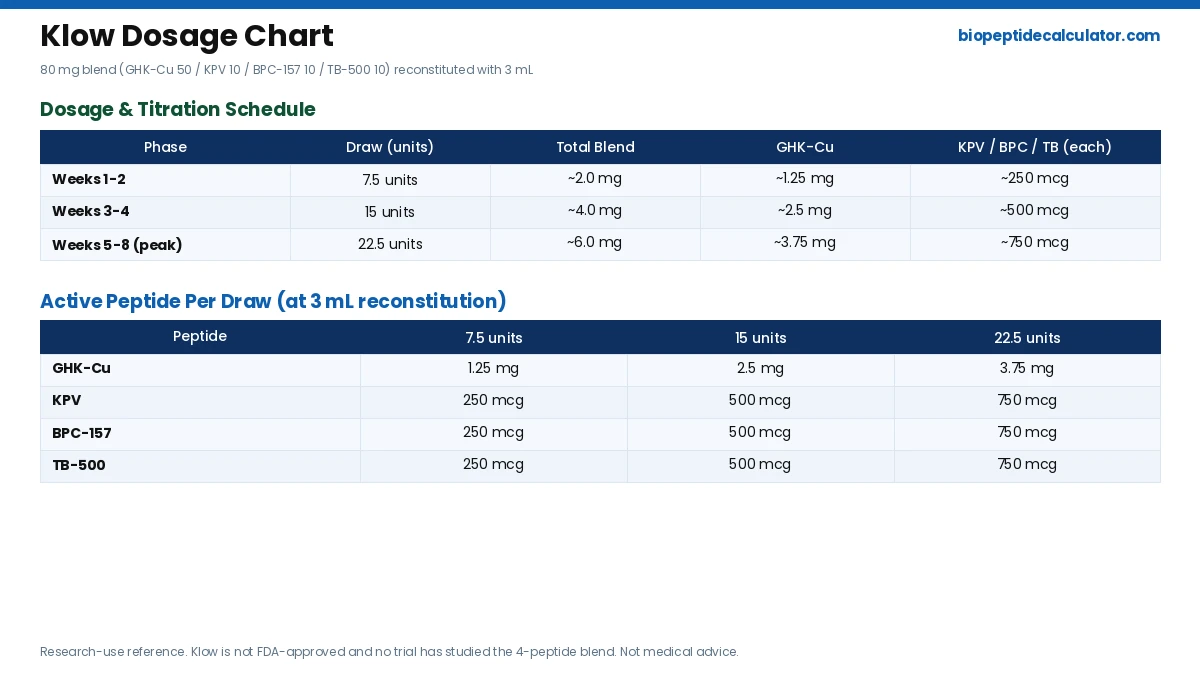
This Klow Dosage Chart shows the titration schedule and per-injection component breakdown for the klow peptide blend (GHK-Cu, KPV, BPC-157, and TB-500), with exact syringe units at the standard 80 mg reconstitution. Klow is a research-only blend, not FDA-approved; the figures below reflect community protocols, not medical guidance.
Educational information only. The klow peptide blend is sold as a research chemical and is not FDA-approved for human use. No published clinical trial has evaluated the four-peptide combination together. Nothing here is medical advice or a dosing recommendation; doses are community-reported research protocols.
Klow Dosage Chart (Titration & Component Breakdown)
This Klow Dosage Chart shows the most common community titration for the standard 80 mg vial reconstituted with 3 mL of bacteriostatic water. Because GHK-Cu makes up 62.5% of the blend, every draw delivers more GHK-Cu alongside smaller matched amounts of KPV, BPC-157, and TB-500. Injection is once daily, subcutaneous.
| Phase | Draw (units) | Total Blend | GHK-Cu | KPV / BPC / TB (each) |
|---|---|---|---|---|
| Weeks 1–2 | 7.5 units | ~2.0 mg | ~1.25 mg | ~250 mcg |
| Weeks 3–4 | 15 units | ~4.0 mg | ~2.5 mg | ~500 mcg |
| Weeks 5–8 (peak) | 22.5 units | ~6.0 mg | ~3.75 mg | ~750 mcg |
| Weeks 9–12 (taper) | 15 units | ~4.0 mg | ~2.5 mg | ~500 mcg |
Units are on a U-100 insulin syringe (100 units = 1 mL) at the 3 mL reconstitution. A 30- or 50-unit syringe is easiest for these small draws. These are community-derived research volumes, not clinically validated doses. Everyone starts low and titrates up while watching for a response.
Klow Peptide Reconstitution & Units Chart
The klow peptide dosage you draw depends on how much bacteriostatic water you add to the 80 mg vial. This chart shows the resulting concentration and how much of each peptide lands in a single unit (0.01 mL) at the three most common water volumes.
| BAC Water | Total Concentration | GHK-Cu / unit | KPV / BPC / TB / unit |
|---|---|---|---|
| 2.0 mL | 40.0 mg/mL | ~250 mcg | ~50 mcg each |
| 3.0 mL (most common) | 26.7 mg/mL | ~167 mcg | ~33 mcg each |
| 4.0 mL | 20.0 mg/mL | ~125 mcg | ~25 mcg each |
More water gives larger, easier-to-read draws but a bigger injection volume. The solution may show a faint blue tint from the copper in GHK-Cu, which is normal. For custom vial sizes, use the peptide reconstitution calculator to confirm your units before drawing.
Klow Peptide Dosage Chart
What Is the Klow Peptide?
The klow peptide is a four-peptide research blend that combines GHK-Cu, KPV, BPC-157, and TB-500 in a single lyophilized vial. The name comes from its components: the “K” is KPV, added to the three peptides found in the popular GLOW blend. A typical commercial vial is 80 mg total, split as 50 mg GHK-Cu, 10 mg KPV, 10 mg BPC-157, and 10 mg TB-500. Because everything is pre-mixed, you reconstitute once and every daily draw delivers all four peptides in that fixed ratio.
The logic behind the klow blend peptide is that repair and inflammation are two different problems. Three of the four peptides work on rebuilding tissue — collagen and elastin in skin, connective tissue in joints and tendons, and the blood supply that feeds both — while the fourth, KPV, works on calming the inflammatory signaling that can slow that repair. Stacking them is meant to address both layers in one injection. It is important to understand that klow is not FDA-approved and no trial has tested the four peptides together; the rationale is mechanism-based reasoning, not proven combination science.
Klow Peptide Benefits
The researched klow peptide benefits come from what each of its four components is individually studied for. There is no direct trial on the blend, so these reflect the component research and community reports, not validated outcomes of klow itself.
- Skin and collagen support — GHK-Cu is the most-studied copper peptide for collagen and elastin synthesis, skin firmness, and reduced fine lines. This is the headline klow peptide benefit for cosmetic research.
- Tissue and injury repair — BPC-157 and TB-500 are researched for tendon, ligament, muscle, and soft-tissue healing, and for improving the blood supply that feeds repair.
- Anti-inflammatory and gut support — KPV, the peptide that distinguishes klow, is studied for calming NF-κB-driven inflammation, particularly in gut models. This is why klow is often chosen over glow when inflammation is part of the picture.
- Recovery and skin-gut axis — taken together, the four peptides are used in research contexts spanning recovery, skin quality, and inflammatory or gut-related questions in a single protocol.
Disclaimer: These benefits are extrapolated from individual-component research and community reports. The klow blend itself has not been clinically tested, and none of these are proven outcomes or medical claims.
Klow Blend Peptide: The Four Components
Understanding the klow blend peptide means understanding what each of its four peptides does. The table breaks down the standard 80 mg vial.
| Peptide | Amount | What It Is | Researched For |
|---|---|---|---|
| GHK-Cu | 50 mg | Copper-binding tripeptide | Collagen, elastin, skin repair, gene expression |
| KPV | 10 mg | Alpha-MSH tripeptide fragment | Anti-inflammatory / NF-κB signaling, gut models |
| BPC-157 | 10 mg | Gastric-protein-derived peptide | Soft-tissue and gut repair, angiogenesis |
| TB-500 | 10 mg | Thymosin beta-4 fragment | Cell migration, wound healing, flexibility |
Ratios vary by supplier; 50:10:10:10 is the most common reference. GHK-Cu dominates the vial, which is why copper accumulation drives the cycle length.
Klow vs Glow Peptide
The klow vs glow peptide question is the most common one people ask, and the answer is simpler than most write-ups make it. Glow is a three-peptide blend of GHK-Cu, BPC-157, and TB-500. Klow is that same trio plus KPV — and klow also carries substantially more of each peptide per vial. So klow is best thought of as “glow plus KPV, at a higher concentration.”
| Glow | Klow | |
|---|---|---|
| Components | GHK-Cu + BPC-157 + TB-500 | GHK-Cu + BPC-157 + TB-500 + KPV |
| Typical vial | ~30–70 mg | 80 mg |
| Extra ingredient | — | KPV (anti-inflammatory) |
| Research focus | Skin + tissue repair | Skin + tissue + anti-inflammatory / gut |
| Best when | Cosmetic skin and recovery focus | Inflammation or gut is also a factor |
Choose glow if the goal is skin quality and general recovery; choose klow if you also want anti-inflammatory or gut support and are comfortable with the added KPV. Note that “K glow peptide” is simply a common misspelling of klow versus glow — there is no separate “K-glow” product.
Klow Peptide Side Effects
There are no published safety studies on the four-peptide klow combination, so the side-effect picture is drawn from individual-component research and community reports. Most reported effects are mild and local.
Most commonly reported: injection-site redness, mild swelling, itching, or sensitivity. A faint blue-green tint at the injection site is sometimes reported and comes from the copper in GHK-Cu — it is cosmetic only. Mild first-week fatigue and brief digestive shifts are also described.
Less commonly reported: headache, light-headedness, vivid dreams (often attributed to BPC-157), and brief appetite changes. None have been formally measured in a controlled study of the blend.
The main stack-specific concerns are two. First, copper accumulation: GHK-Cu is 62.5% of the vial, so prolonged continuous use without an off-period raises a theoretical risk of copper buildup — the reason cycles are time-limited. Second, angiogenesis: BPC-157 and TB-500 both promote new blood-vessel formation, which supports repair but is a meaningful reason for anyone with active or recent cancer to avoid the blend.
Who should avoid klow: anyone with active or recent cancer, people with Wilson’s disease or other copper-metabolism disorders, anyone pregnant or breastfeeding, and athletes subject to WADA testing (BPC-157 and TB-500 are listed under WADA’s S0 unapproved-substances category). Anyone on blood thinners should be especially cautious given the angiogenesis-active components.
Disclaimer: This is not a complete list of risks. The klow blend has no controlled human safety data. Stop and seek qualified medical care if pronounced symptoms appear (significant swelling, ongoing dizziness, rapid heart rate, shortness of breath). Only a clinician can assess your individual risk.
Klow Stack: Cycling and How It Compares
“Klow blend” and “klow stack” usually refer to the same thing — the four peptides in one vial — but “stack” tends to be used when discussing how klow is run as a protocol and how it sits alongside related blends. The most common cycle is 4–6 weeks on, followed by 2–4 weeks off, with the off-period there mainly to allow copper clearance from the GHK-Cu component. Some protocols extend to 8–12 weeks with longer breaks, though longer continuous use raises the copper-accumulation concern and has no safety data behind it.
Klow sits in a family of regenerative blends. The simplest is the Wolverine stack (BPC-157 + TB-500). Glow adds GHK-Cu to that base for skin and collagen. Klow adds KPV on top of glow for anti-inflammatory coverage. Moving up the family adds ingredients and research scope, but also more compounds whose combined behavior has never been formally studied. Whichever you consider, the whole blend is cycled and rested together rather than adjusting individual peptides, which is the trade-off of a fixed-ratio pre-mix.
What Do People Report About the Klow Peptide?
Read this as community sentiment, not evidence. The themes below summarize what recurs across peptide communities such as Reddit’s r/Peptides and dedicated blend threads. These are unverified personal reports from anonymous users, not clinical findings, and they often contradict each other. They are included so you understand the real-world conversation, not as anything to act on.
Skin and healing are the most-praised effects. The most consistent positive reports are about skin quality — smoother texture, faster-healing blemishes, and improved elasticity — and about recovery from nagging injuries. Users often credit the GHK-Cu and BPC-157/TB-500 combination, and many say skin changes are the first thing they notice, sometimes within a couple of weeks.
The KPV addition is why people choose klow over glow. A recurring theme is that people dealing with gut issues or general inflammation specifically pick klow (not glow) for the KPV component, and some report calmer digestion during a cycle. Others say they cannot tell the KPV apart from the rest of the blend, which is a common honest caveat.
Injection-site stinging and the blue tint come up often. Many users mention a mild sting on injection (attributed to GHK-Cu) and the faint blue-green color of the solution or a temporary tint at the site. Experienced posters reassure newcomers that the color is just the copper and is normal, not a sign of a bad batch.
Copper and cycle length are the top cautions. More knowledgeable community members repeatedly raise the copper-accumulation point — because GHK-Cu is most of the vial — and push back on anyone running klow continuously without an off-period. The 4–6 weeks on, then a break structure is treated as the sensible default.
Expectations get managed toward “recovery, not transformation.” Veterans consistently frame klow as a repair and skin tool rather than a dramatic body-changer, and they warn against expecting fat loss or muscle gain from it. Anyone asking whether klow will help them lose weight is usually redirected, correctly, toward the GLP-1 drugs instead.
Product quality is a constant worry. Because klow is a research-market blend, a major theme is doubt over whether a vial actually contains all four peptides at the stated ratio. Community members stress third-party Certificates of Analysis and argue that a lot of “it did nothing” reports come down to under-dosed or mislabeled product rather than the blend itself.
For the live conversation, the most active hub is Reddit’s r/Peptides community, and there is a detailed community write-up in the r/ParamountPeptide KLOW blend guide thread. Reading recent posts there gives a more current, unfiltered picture than any single summary — including this one.
Disclaimer: Community reports are anecdotal, unverifiable, and often influenced by other compounds users take at the same time. They are not a substitute for medical evidence or professional guidance.
Need exact units for a different vial size or water volume? The peptide reconstitution calculator converts any blend into precise syringe units. Browse all tools in the calculator library, see every dosage chart, or explore the full peptide library.
Klow Peptide FAQ
What is the Klow peptide?
Klow is a four-peptide research blend combining GHK-Cu, KPV, BPC-157, and TB-500 in a single vial, typically 80 mg total (50 mg GHK-Cu plus 10 mg each of the others). The “K” stands for KPV, the peptide added to the three-peptide GLOW blend. It is used in research contexts for skin, tissue repair, recovery, and anti-inflammatory support, and it is not FDA-approved.
What are the benefits of KLOW peptides?
The researched benefits come from its four components: GHK-Cu for collagen, skin firmness, and repair; BPC-157 and TB-500 for soft-tissue, tendon, and injury recovery; and KPV for calming inflammation, especially in gut models. Together they are used for skin quality, recovery, and inflammatory or gut-related research. These reflect component research, not a validated trial of the blend itself.
How much klow peptide should I take?
Community protocols for the 80 mg vial reconstituted with 3 mL of bacteriostatic water typically start around 7.5 units (about 2 mg total blend) daily, titrating up to roughly 22.5 units (about 6 mg total blend) at peak, then tapering. These are research-context volumes, not medical dosing. Because klow is not approved, there is no established therapeutic dose — always confirm any amount with a qualified clinician.
How long do you stay on klow peptide?
The most common cycle is 4–6 weeks on, followed by 2–4 weeks off. Some protocols extend to 8–12 weeks with longer breaks. The off-period exists mainly to let copper from the GHK-Cu component clear, since GHK-Cu is most of the vial. Continuous use beyond about 12 weeks is not supported by any safety data.
Where to inject klow?
Klow is injected subcutaneously — into the fat layer, most commonly the lower abdomen, though the thigh or upper arm also work. Rotate the injection site each day to avoid irritation and lumps, and use sterile technique (clean hands, alcohol-swabbed vial and skin, fresh needle). A 30- or 50-unit U-100 insulin syringe suits the small draw volumes.
What is the difference between klow and glow peptide?
Glow is a three-peptide blend (GHK-Cu, BPC-157, TB-500) focused on skin and tissue repair. Klow is that same trio plus KPV, an anti-inflammatory tripeptide, and it also carries more of each peptide per vial. So klow is essentially “glow plus KPV” with a higher concentration, chosen when inflammation or gut support is also part of the goal. Everything else about the two is very similar.
What is K glow peptide?
“K glow” is not a separate product — it is almost always a misspelling or mishearing of “klow” versus “glow.” People searching “K glow peptide” are usually looking for the klow blend (GHK-Cu, KPV, BPC-157, TB-500) or comparing it to glow. There is no distinct “K-glow” peptide.
Is klow peptide worth it?
That depends on the goal. For skin, recovery, and anti-inflammatory research, the convenience of getting four studied peptides in one injection is the main appeal, and many users report skin and healing benefits. However, the blend has no clinical trial behind it, locks you into a fixed ratio, and is not FDA-approved. Buying the peptides separately gives more dose control. Whether it is “worth it” is an individual decision best made with a clinician, not a settled fact.
How long does it take for klow peptide to get out of your system?
The individual peptides clear at different rates — the small peptides like KPV and BPC-157 have short half-lives (hours), while GHK-Cu and TB-500 clear over a longer window, and copper from GHK-Cu can linger longer in tissue. As a practical rule, the peptides themselves are largely cleared within a few days of the last dose, which is part of why an off-period is used to allow copper to normalize. There is no formal clearance study on the blend.
What is the most powerful peptide for fat loss?
Klow is not a fat-loss blend — it is for repair, skin, and inflammation. For fat loss, the most powerful peptides are the GLP-1 and multi-receptor agonists: retatrutide produced the largest weight loss in trials (up to ~24–28%), followed by tirzepatide (~20%) and semaglutide (~15%). See our retatrutide, tirzepatide, and semaglutide charts. Klow will not drive meaningful fat loss.
What kills visceral fat fast?
No peptide “kills” visceral fat instantly, and klow does not target fat at all. The most evidence-backed pharmaceutical option for visceral fat is tesamorelin (FDA-approved for HIV-associated visceral fat), and the GLP-1/dual/triple agonists (semaglutide, tirzepatide, retatrutide) reduce visceral fat as part of overall weight loss. The durable basics — a calorie deficit, resistance training, sleep, and reduced alcohol — remain the foundation. This is general information, not medical advice.
What are the top 3 peptides to take?
There is no universal top three — it depends entirely on the goal. For recovery and injury, BPC-157 and TB-500 are the most-researched pair. For skin and anti-aging, GHK-Cu leads. For fat loss, the GLP-1 class (semaglutide, tirzepatide) dominates. Klow is popular precisely because it bundles several recovery and skin peptides together. The “best” peptide is the one matched to a specific, well-defined goal, chosen with medical guidance.
Are peptides safer than steroids?
It depends on which peptide and which steroid, and the honest answer is that it is not a simple yes. Some peptides have milder side-effect profiles than anabolic steroids, but many research peptides (including those in klow) have little or no long-term human safety data, are unregulated on the research market, and are not FDA-approved. “Safer” is not the same as “safe.” Both categories carry real risks and should only be considered with medical supervision.
Is klow FDA-approved?
No. None of the four peptides in klow are FDA-approved for the uses discussed in the research community, and the combination has never been tested in a clinical trial. BPC-157 and TB-500 are also listed by WADA under category S0 (unapproved substances) and are banned in tested sport. Klow is sold strictly as a research chemical.
Does the klow solution turn blue, and is that bad?
A faint blue or blue-green tint is normal and expected — it comes from the copper in GHK-Cu. A light tint is not a sign of contamination. However, cloudiness, floating particles, or a marked change in color beyond a faint blue hint can indicate a problem, and such a vial should not be used.
How to Reconstitute for the Klow Dosage Chart
Klow arrives as a single lyophilized (freeze-dried) powder containing all four peptides. You reconstitute once, and every daily draw comes from that one solution. Getting this step right is what makes the Klow Dosage Chart above usable, because the water volume sets your concentration and therefore your units. The standard setup that the chart is built on is the 80 mg vial mixed with 3 mL of bacteriostatic water.
- Let the vial reach room temperature and inspect it — loose, even powder is normal; a discolored or damp vial should not be used. Swab the rubber stoppers of the klow vial and the bacteriostatic water with separate alcohol pads.
- Draw 3 mL of bacteriostatic water (the most common volume for the 80 mg vial) into a sterile syringe.
- Insert the needle and let the water run slowly down the inside glass wall of the klow vial — do not spray it directly onto the powder, which can cause foaming.
- Swirl or roll gently until fully dissolved. Never shake. The solution should be clear, possibly with a faint blue tint from the GHK-Cu, which is normal.
- Label with the date and store refrigerated. Use the reconstitution and units chart above, or the calculator, to convert your target dose to units.
Once mixed, the peptide reconstitution calculator confirms your exact draw for any vial size or water volume.
Storing the Klow Peptide Blend
Before reconstitution, the lyophilized powder is best kept frozen at about −20°C for long-term storage, though refrigeration is acceptable short-term; keep it dry, dark, and in its original packaging. After reconstitution, store the liquid refrigerated at 2–8°C (36–46°F) and use it within about 14 to 28 days. Do not freeze the reconstituted solution, and avoid repeated freeze-thaw cycles, since each one damages the peptides. Keep the vial protected from light. A clear solution with at most a faint blue tint is normal; discard anything cloudy or discolored. Because the blend contains four peptides mixed together, proper cold storage matters more than for a single-peptide vial, since any degradation affects the whole protocol at once.
Sources & Research References
Because no trial has studied the klow combination, the references below cover the individual components. We link only to peer-reviewed research and reference sources — never to vendors.
GHK-Cu Research
- Pickart L, Margolina A. Regenerative and Protective Actions of the GHK-Cu Peptide. Int J Mol Sci. 2018. — the review documenting GHK-Cu’s effect on thousands of human genes.
- Pickart L. GHK Peptide as a Natural Modulator of Cellular Pathways in Skin Regeneration. BioMed Res Int. 2015. — GHK-Cu’s role in collagen and skin repair.
KPV Research
- Dalmasso G, et al. PepT1-Mediated Tripeptide KPV Uptake Reduces Intestinal Inflammation. Gastroenterology. 2008. — the key study on KPV’s anti-inflammatory, NF-κB-related mechanism.
- Brzoska T, et al. Alpha-MSH related peptides: anti-inflammatory and immunomodulating drugs. Br J Pharmacol. — background on the alpha-MSH family KPV derives from.
BPC-157 & TB-500 Research
- Vasireddi N, et al. Emerging Use of BPC-157 in Orthopaedic Sports Medicine: A Systematic Review. HSS J. 2025. — a review of the (mostly preclinical) BPC-157 evidence base.
- Malinda KM, et al. Thymosin beta-4 accelerates wound healing. J Invest Dermatol. 1999. — foundational research on the parent molecule of TB-500.
- Goldstein AL, et al. Thymosin beta-4: a multi-functional regenerative peptide. Expert Opin Biol Ther. 2012. — a review of thymosin beta-4’s regenerative roles.
Reference & Regulatory
- Wikipedia: GHK-Cu. — background on the copper tripeptide, the dominant klow component.
- Wikipedia: Thymosin beta-4 (TB-500). — reference on the peptide TB-500 is derived from.
- WADA Prohibited List. — confirms BPC-157 and TB-500 are banned in sport under S0.
More at Bio Peptide Calculator
- Peptide reconstitution calculator — convert any klow vial to exact units.
- All peptide dosage charts — every compound’s chart in one place.
- Peptide library — guides and information on every peptide, including GHK-Cu, BPC-157, and TB-500.
- Calculator library — every dosing tool on the site.
Full disclaimer: This Klow Dosage Chart and guide is educational only and is not medical advice. The klow peptide blend is not FDA-approved, and no clinical trial has evaluated the four-peptide combination; all dosing and cycle information reflects community-reported research protocols, not validated regimens. Several components are banned in competitive sport. Buying, possessing, or using research peptides may be restricted where you live. Always consult a licensed healthcare professional before considering any peptide.