This semaglutide dosage chart shows the full FDA titration schedules for Wegovy and Ozempic, plus a semaglutide dosage chart units reference for compounded vials. Find your weekly dose, then read the milligrams, the schedule week, or the exact syringe units to draw.
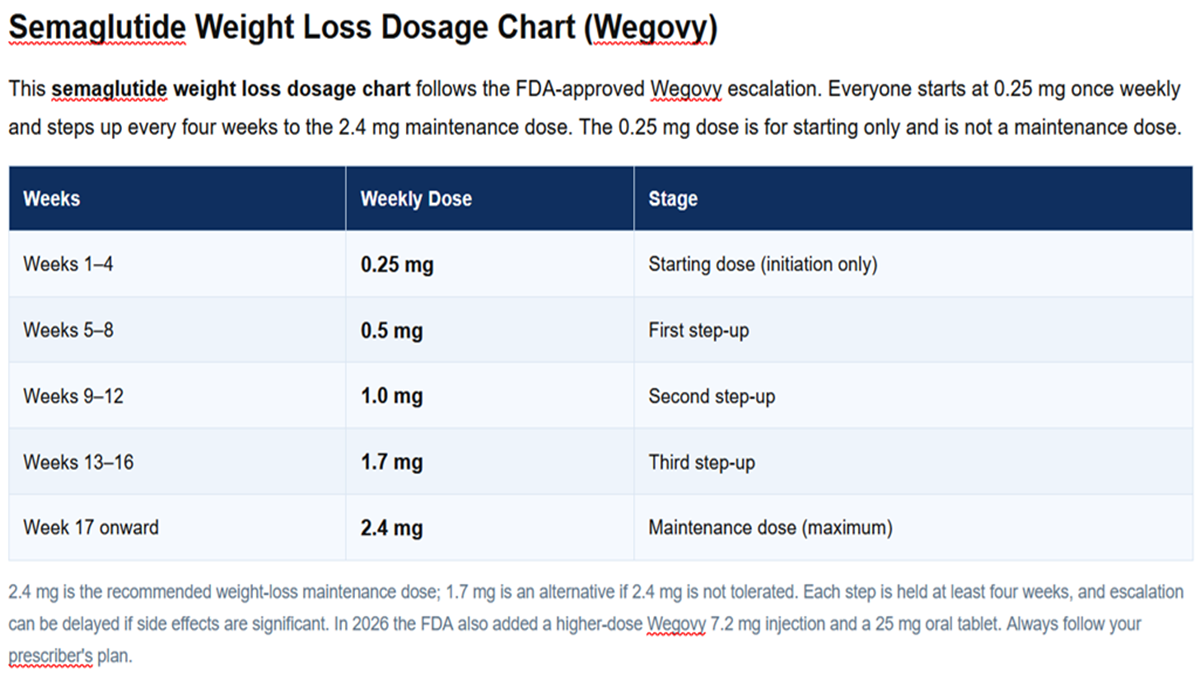
Semaglutide Weight Loss Dosage Chart (Wegovy)
This semaglutide weight loss dosage chart follows the FDA-approved Wegovy escalation. Everyone starts at 0.25 mg once weekly and steps up every four weeks to the 2.4 mg maintenance dose. The 0.25 mg dose is for starting only and is not a maintenance dose.
| Weeks | Weekly Dose | Stage |
|---|---|---|
| Weeks 1–4 | 0.25 mg | Starting dose (initiation only) |
| Weeks 5–8 | 0.5 mg | First step-up |
| Weeks 9–12 | 1.0 mg | Second step-up |
| Weeks 13–16 | 1.7 mg | Third step-up |
| Week 17 onward | 2.4 mg | Maintenance dose (maximum) |
2.4 mg is the recommended weight-loss maintenance dose; 1.7 mg is an alternative if 2.4 mg is not tolerated. Each step is held at least four weeks, and escalation can be delayed if side effects are significant. In 2026 the FDA also added a higher-dose Wegovy 7.2 mg injection and a 25 mg oral tablet. Always follow your prescriber’s plan.
Semaglutide Dosage Chart Units (Compounded Vials)
If you use a compounded vial instead of a brand pen, you draw your dose in units on a U-100 insulin syringe. This semaglutide dosage chart units reference shows the units for each dose at common compounded concentrations. Because semaglutide doses are small, accurate measuring matters.
| Dose | 1 mg/mL | 2.5 mg/mL | 5 mg/mL |
|---|---|---|---|
| 0.25 mg | 25 units | 10 units | 5 units |
| 0.5 mg | 50 units | 20 units | 10 units |
| 1.0 mg | 100 units | 40 units | 20 units |
| 1.7 mg | over 100* | 68 units | 34 units |
| 2.4 mg | over 100* | 96 units | 48 units |
*Over 100 units exceeds a 1 mL U-100 syringe — use a more concentrated vial. Units = (dose ÷ concentration) × 100. For any concentration not shown, use the peptide dosage calculator for exact units.
Brand pens do not use units. Wegovy and Ozempic pens deliver a fixed dose automatically — there is nothing to measure. The units chart applies only to compounded semaglutide drawn from a vial.
Ozempic (Diabetes) Semaglutide Dosage Chart
Ozempic contains the same semaglutide molecule as Wegovy but is FDA-approved for type 2 diabetes, with a slightly different top dose. This semaglutide dosage chart for Ozempic tops out at 2 mg rather than 2.4 mg. It is also widely prescribed off-label for weight loss.
| Weeks | Weekly Dose | Stage |
|---|---|---|
| Weeks 1–4 | 0.25 mg | Starting dose (initiation only) |
| Weeks 5–8 | 0.5 mg | First maintenance dose |
| Weeks 9–12 | 1.0 mg | Step-up if needed |
| Weeks 13+ | 2.0 mg | Maximum dose |
For diabetes, common maintenance doses are 0.5, 1, or 2 mg depending on blood-sugar control. The 0.25 mg starting dose is identical to Wegovy; the difference is the ceiling.
Compounded Semaglutide Dosage Chart
Compounded semaglutide is made by a compounding pharmacy rather than by Novo Nordisk, and it comes in a vial with a concentration on the label instead of a fixed-dose pen. A compounded semaglutide dosage chart matters because you draw the dose yourself in units, and the same milligram dose is a different number of units at every concentration. The dose ladder is the same as the brand schedule (0.25 mg up to 2.4 mg); only the measuring differs.
Compounded semaglutide is sometimes dosed in milligrams and sometimes in units or “clicks” on a pen-style device, which is a frequent source of confusion and dosing errors. The safest approach is to know your vial’s concentration in mg/mL, then use the units chart above (or the calculator) to convert your prescribed milligram dose to units. Never copy a unit count from someone using a different concentration.
Note that compounded semaglutide is not FDA-approved, and its availability has narrowed since the brand shortage officially resolved. Its quality and concentration vary between pharmacies, so confirm any compounded product and dose with a licensed provider.
Semaglutide 2.5 mg/mL Dosage Chart
A 2.5 mg/mL concentration is one of the most common for compounded semaglutide, so it deserves its own reference. This semaglutide 2.5 mg/mL dosage chart shows the exact units to draw on a U-100 syringe for each dose in the titration.
| Dose (mg) | Units (U-100) | Volume (mL) |
|---|---|---|
| 0.25 mg | 10 units | 0.10 mL |
| 0.5 mg | 20 units | 0.20 mL |
| 1.0 mg | 40 units | 0.40 mL |
| 1.7 mg | 68 units | 0.68 mL |
| 2.4 mg | 96 units | 0.96 mL |
At 2.5 mg/mL, the full titration fits comfortably on a single U-100 syringe, which is part of why this concentration is popular. For any other concentration, the calculator gives exact figures.
Semaglutide Weight Loss by Dose and Timeline
In the STEP-1 trial, adults on the 2.4 mg maintenance dose lost an average of about 15% of body weight over 68 weeks. Weight loss builds gradually as the dose escalates; the biggest changes come during the maintenance phase, not the low starting doses.
| Timeframe | Typical Average Weight Loss |
|---|---|
| Month 1 (0.25 mg) | Minimal — titration phase, ~1–2% |
| Month 3 | ~5–6% as the dose climbs |
| Month 6 | ~10% on average |
| 68 weeks (2.4 mg) | ~15% average (STEP-1) |
These are trial averages with diet and exercise support; individual results vary widely. Weight loss is fastest once you reach the higher maintenance doses, which is why finishing the titration matters.
Semaglutide Side Effects
Semaglutide’s side effects are mostly gastrointestinal and dose-related, which is the reason for gradual titration. They are most common when starting and just after each dose increase, and usually ease as the body adapts.
Most common: nausea, diarrhea, vomiting, constipation, stomach pain, indigestion, and reduced appetite. Most are mild to moderate. Eating smaller, lower-fat meals and stopping when full helps.
Less common but serious: pancreatitis (severe, persistent abdominal pain), gallbladder problems, low blood sugar (especially with insulin or sulfonylureas), kidney problems from dehydration, diabetic retinopathy changes, and allergic reactions. Like other drugs in its class, semaglutide carries a boxed warning for thyroid C-cell tumor risk seen in rodents; it is not recommended for people with a personal or family history of medullary thyroid carcinoma or MEN 2.
Because side effects scale with dose, many people do best staying at the lowest dose that controls appetite well. Report severe or persistent symptoms to your provider promptly.
What Is Semaglutide?
Semaglutide is a once-weekly injectable medication that mimics a natural gut hormone called GLP-1 (glucagon-like peptide-1). It is the active ingredient in three brand-name products: Ozempic (for type 2 diabetes), Wegovy (for weight management), and Rybelsus (an oral tablet for diabetes). By activating GLP-1 receptors, semaglutide reduces appetite, slows how quickly the stomach empties, increases feelings of fullness, and improves the body’s insulin response. This combination lowers blood sugar and leads to significant, sustained weight loss, which is why the same molecule is approved for both diabetes and obesity under different brand names and doses.
How Semaglutide Works for Weight Loss
Semaglutide drives weight loss mainly by reducing appetite and calorie intake. It acts on appetite centers in the brain to lower hunger and cravings, so you feel satisfied with less food. It slows gastric emptying, so meals keep you full longer. And it improves how your body handles blood sugar and insulin. Together these effects mean most people naturally eat less without constant hunger, producing gradual weight loss over months. Unlike stimulant appetite suppressants, semaglutide works with your body’s own hormone signaling, which is why the effect feels less like forcing willpower and more like simply wanting less food.
What If You Miss a Semaglutide Dose?
According to the manufacturer’s guidance, if you miss a dose and your next scheduled dose is more than two days (48 hours) away, take the missed dose as soon as possible. If your next dose is less than two days away, skip the missed dose and take your next dose on the regular day. Do not take two doses close together or double up to make up for a missed dose. If you miss doses for more than about two weeks, contact your provider, as you may need to restart at a lower dose and re-titrate.
Ozempic vs Wegovy: Same Drug, Different Dose
Ozempic and Wegovy both contain semaglutide — they are the same molecule made by the same manufacturer. The differences are the FDA-approved use and the maximum dose. Ozempic is approved for type 2 diabetes with a maximum of 2 mg weekly; Wegovy is approved for weight management with a higher maximum of 2.4 mg weekly. Ozempic is frequently prescribed off-label for weight loss, which works because it is the same active drug, just capped at a slightly lower dose. Rybelsus is the oral tablet form of semaglutide, used for diabetes. The titration principle — start at 0.25 mg, climb every four weeks — is the same across the injectable versions.
Need units for a concentration not shown above? The peptide dosage calculator converts any semaglutide dose to exact units for your vial, with a true-to-scale syringe visual. See also the tirzepatide dosage chart and retatrutide dosage chart for the other weight-loss compounds.
Semaglutide Dosage & Weight Loss FAQ
Is semaglutide the same as Ozempic?
Semaglutide is the active ingredient in Ozempic, so in that sense they are the same drug. Ozempic is one brand of semaglutide, approved for type 2 diabetes. Wegovy is another brand of the same molecule, approved for weight loss at a slightly higher maximum dose, and Rybelsus is the oral tablet version. So all Ozempic is semaglutide, but not all semaglutide is Ozempic.
What is the negative side of semaglutide?
The main downsides are gastrointestinal side effects (nausea, diarrhea, vomiting, constipation), the need for weekly injections, high cost without insurance, and a strong tendency to regain weight after stopping. Less commonly it can cause pancreatitis, gallbladder issues, or low blood sugar, and it carries a boxed warning for thyroid tumor risk. Muscle loss alongside fat loss is another concern, making protein and resistance training important.
How much weight can I lose on semaglutide in a month?
In the first month you are on the 0.25 mg starting dose, which is for titration, so weight loss is usually modest — often around 1 to 2% of body weight, or a few pounds. Faster loss typically comes later, once you reach higher doses. Averaged across a full course, many people lose roughly 1 to 2% of body weight per month, but early months are slower and results vary.
How fast can I lose 20 lbs on semaglutide?
For someone with a higher starting weight, losing 20 pounds often takes somewhere in the range of three to six months, since meaningful weight loss ramps up as the dose escalates past the first two months. The pace depends on your starting weight, dose, diet, activity, and individual response. Because the drug titrates slowly, expecting rapid loss in the first month is unrealistic; steady progress over several months is the norm.
Does semaglutide reduce belly fat?
Yes, as part of overall weight loss. Semaglutide reduces total body fat, including visceral fat (the deep abdominal fat around the organs), and most people see a reduction in waist size at effective doses. It does not specifically target belly fat — no medication can spot-reduce — but abdominal fat tends to respond well to the overall weight loss it produces.
What foods should you avoid while taking semaglutide?
Avoid large, high-fat, fried, and greasy meals, which worsen nausea and can cause discomfort because the stomach empties slowly. Very sugary foods and drinks can trigger nausea and blood-sugar swings. Alcohol is best limited, as it irritates the stomach and affects blood sugar. Many people do better with smaller portions, lower-fat meals, adequate protein, and plenty of water. Eating slowly and stopping when full helps a great deal.
Why do I feel so good on semaglutide?
Many people report feeling calmer around food, with the constant “food noise” and cravings quieting down, which can feel like relief. Steadier blood sugar (fewer spikes and crashes), gradual weight loss, and improved energy also contribute to feeling better overall. GLP-1 receptors are found in brain areas involved in reward and appetite, which is thought to explain the reduced preoccupation with food that many describe as a notable positive.
Can I lose 10 kg in 2 months with Ozempic?
Losing 10 kg (about 22 lbs) in two months is faster than typical, and unlikely for most people, because the first two months are the low-dose titration phase where weight loss is modest. Average results are closer to a few kilograms in the first two months, with the pace increasing later. Very rapid loss is neither the expected outcome nor generally the healthiest; steady loss over many months is the realistic pattern.
Can you stay on 0.25 Ozempic for weight loss?
The 0.25 mg dose is designed as a four-week starting dose for titration, not a maintenance dose, and it generally produces limited weight loss on its own. Some people who are very sensitive to side effects do stay on a low dose longer under medical guidance, accepting slower results for better tolerability. But for meaningful weight loss, most people need to titrate up to a higher maintenance dose.
Why are people stopping Ozempic?
Common reasons people stop include side effects (especially persistent nausea), high cost or loss of insurance coverage, reaching their goal weight, drug shortages, and sometimes the plateau or the realization that weight can return after stopping. Some also stop because of unpleasant “Ozempic face” (facial volume loss from rapid weight loss) or simply because injections and ongoing cost are hard to sustain long-term.
What happens when you stop semaglutide?
When you stop semaglutide, its appetite-suppressing effect fades over a few weeks as the drug clears, and hunger returns. Studies show most people regain a significant portion of the weight they lost, often about two-thirds within a year, unless strong diet and lifestyle habits are maintained. This is why semaglutide is generally viewed as a long-term treatment for a chronic condition rather than a short course, and why stopping is best planned with a provider.
Is semaglutide safe for long-term use?
Semaglutide has been studied for several years and is generally considered safe for long-term use under medical supervision, and it is intended as an ongoing treatment for chronic conditions. Most side effects are gastrointestinal and manageable. Long-term monitoring covers the rarer risks (pancreatitis, gallbladder, thyroid-related concerns). As with any long-term medication, ongoing use should be guided by a healthcare provider weighing benefits against risks for you.
What is the starting dose of semaglutide?
The starting dose of semaglutide is 0.25 mg injected once weekly for the first four weeks, for both Wegovy and Ozempic. This dose is for treatment initiation only, to let the body adjust and reduce side effects, and it is not considered a therapeutic maintenance dose. After four weeks it is typically increased to 0.5 mg.
How many units is 0.25 mg of semaglutide?
It depends on your vial’s concentration. At 1 mg/mL, 0.25 mg is 25 units on a U-100 syringe; at 2.5 mg/mL it is 10 units; at 5 mg/mL it is 5 units. Always match your own vial’s concentration to the correct column of the units chart above, or use the calculator, since drawing the wrong units is a common error with compounded semaglutide.
How long does it take to reach the full semaglutide dose?
Reaching the 2.4 mg Wegovy maintenance dose takes about 16 to 20 weeks, since each of the doses (0.25, 0.5, 1, and 1.7 mg) is held for at least four weeks before the next increase. Some people take longer if they hold a dose to let side effects settle, and some stay at a lower maintenance dose that works well for them.
Which is better for weight loss, semaglutide or tirzepatide?
In clinical trials, tirzepatide (Mounjaro, Zepbound) produced greater average weight loss than semaglutide, likely because it activates two receptors (GIP and GLP-1) rather than one. However, semaglutide is highly effective, well studied, and better for some people based on tolerability, cost, and coverage. The best choice depends on the individual and is made with a prescriber. See our tirzepatide dosage chart to compare.
What is semaglutide microdosing?
Microdosing refers to using smaller-than-standard doses of semaglutide, an approach some people and clinics discuss for gentler side effects, maintenance after reaching a goal, or cost savings. It is not an FDA-approved strategy, and evidence for it is limited. Anyone considering a non-standard dose should do so only under medical supervision, since the approved titration schedule exists specifically to balance results against side effects.
Do you inject semaglutide in the same place every week?
No — rotate your injection site. Semaglutide is injected subcutaneously into the abdomen, thigh, or upper arm, and rotating sites (and spots within each site) helps prevent irritation and skin changes. You can inject at any time of day, with or without food, on your chosen weekly day, and you can change the day if needed as long as doses are at least 48 hours apart.
Should I go up to the next dose if I’m doing well?
Not necessarily. A common misconception is that you must climb to the maximum dose, but the goal is the lowest dose that gives you good appetite control and steady weight loss with tolerable side effects. If you are losing weight and feeling well at a lower dose, many providers keep you there rather than pushing higher, since higher doses bring more side effects. Dose changes should always be a shared decision with your prescriber.
Does semaglutide cause muscle loss?
Some of the weight lost on semaglutide comes from muscle as well as fat, which is true of most rapid weight loss. You can limit muscle loss by keeping protein intake high (a common target is around 0.7 to 1 gram per pound of goal body weight), doing regular resistance training, and not losing weight faster than necessary. Preserving muscle is one reason not to rush the titration or chase the fastest possible loss.
What is “Ozempic face”?
“Ozempic face” is an informal term for the facial changes — hollowing, sagging, or a more aged look — that can come with rapid or significant weight loss. It is not a direct drug effect but a consequence of losing facial fat quickly, and it can happen with any fast weight loss. Losing weight more gradually, staying hydrated, and maintaining muscle and protein intake can help reduce it.
How long does nausea last on semaglutide?
Nausea is most common in the first few days after starting and after each dose increase, and for most people it eases within a few days to a couple of weeks as the body adapts. Eating smaller, lower-fat meals, avoiding greasy or very sweet foods, and not overeating help considerably. Persistent or severe nausea should be discussed with your provider, who may slow the titration.
How to Read This Semaglutide Dosage Chart
Using this semaglutide dosage chart is straightforward once you know which product and format you have. If you use a brand pen (Wegovy or Ozempic), you only need the schedule chart: it tells you which milligram dose you should be on for each four-week block, and the pen delivers that dose automatically. If you use a compounded vial, you need two pieces of information: your prescribed milligram dose (from the schedule) and your vial’s concentration in mg/mL (from the label). Cross those in the units chart to find how many units to draw.
The single most important concept is that units are not the same as milligrams. Units measure volume on the syringe; milligrams measure the actual drug. How many units equal your milligram dose depends entirely on concentration. This is why the same 1 mg dose can be 100 units, 40 units, or 20 units depending on whether your vial is 1, 2.5, or 5 mg/mL. Getting this wrong is the most common and most dangerous compounded-dosing error, so always confirm your concentration and use the matching chart column or the calculator.
Tips for Managing the Semaglutide Titration
The titration schedule is designed to minimize side effects, and a few practical habits make it easier. Do not rush dose increases; there is no benefit to climbing faster, and staying longer at a dose is fine if side effects are still settling. Eat smaller, lower-fat meals, especially in the day or two after each injection when nausea peaks. Stay hydrated, particularly if you have any vomiting or diarrhea, to protect your kidneys. Keep protein intake up and include resistance exercise to limit muscle loss during weight loss. And keep the same weekly injection day for consistency. If a dose increase brings side effects you cannot tolerate, the standard approach is to hold at the current dose — or step back down — rather than push forward, always in consultation with your prescriber.
Sources & Clinical References
Every dose and figure on this page is drawn from the FDA prescribing information and peer-reviewed research below. We link only to primary sources, the manufacturer, and regulators — never to competing vendors.
FDA & Regulatory
- FDA Wegovy (semaglutide) Prescribing Information. — the official weight-loss label with the full 0.25–2.4 mg escalation and boxed warning.
- FDA Ozempic (semaglutide) Prescribing Information. — the diabetes label confirming the 0.25–2 mg schedule.
- FDA Clinical Pharmacology Review (semaglutide). — regulatory detail on the 2.4 mg and 1.7 mg maintenance doses.
Peer-Reviewed Studies
- Wilding JPH, et al. Once-Weekly Semaglutide in Adults with Overweight or Obesity (STEP-1). N Engl J Med. 2021. — the pivotal weight-loss trial reporting ~15% average weight reduction at 2.4 mg.
- Once-Weekly Semaglutide for Weight Management (PMC/NIH review). — peer-reviewed overview of semaglutide dosing and efficacy for weight loss.
- STEP-1 trial on PubMed. — abstract and citation record for the landmark obesity trial.
Manufacturer & Reference
- Wegovy (Novo Nordisk) official site. — manufacturer dosing and administration information.
- Ozempic (Novo Nordisk) official site. — manufacturer information for the diabetes indication.
- Drugs.com: Semaglutide. — consumer drug reference on dosing, interactions, and side effects.
- Wikipedia: Semaglutide. — background on the molecule, brands, and approval history.
More at Bio Peptide Calculator
- Peptide dosage calculator — convert any semaglutide dose to exact units.
- Tirzepatide dosage chart — compare with the dual agonist.
- Retatrutide dosage chart — the investigational triple agonist.
- Peptide library — every compound and tool in one place.
Disclaimer: This semaglutide dosage chart is educational only and is not medical advice. Semaglutide is a prescription medication; compounded semaglutide is not FDA-approved. Dosing must be set and supervised by a licensed healthcare provider based on your individual health. Always confirm your dose and concentration before injecting, and never adjust your dose without medical guidance.