This retatrutide dosage chart shows the once-weekly titration schedule used in clinical trials and the exact mg-to-units conversions for drawing each dose.
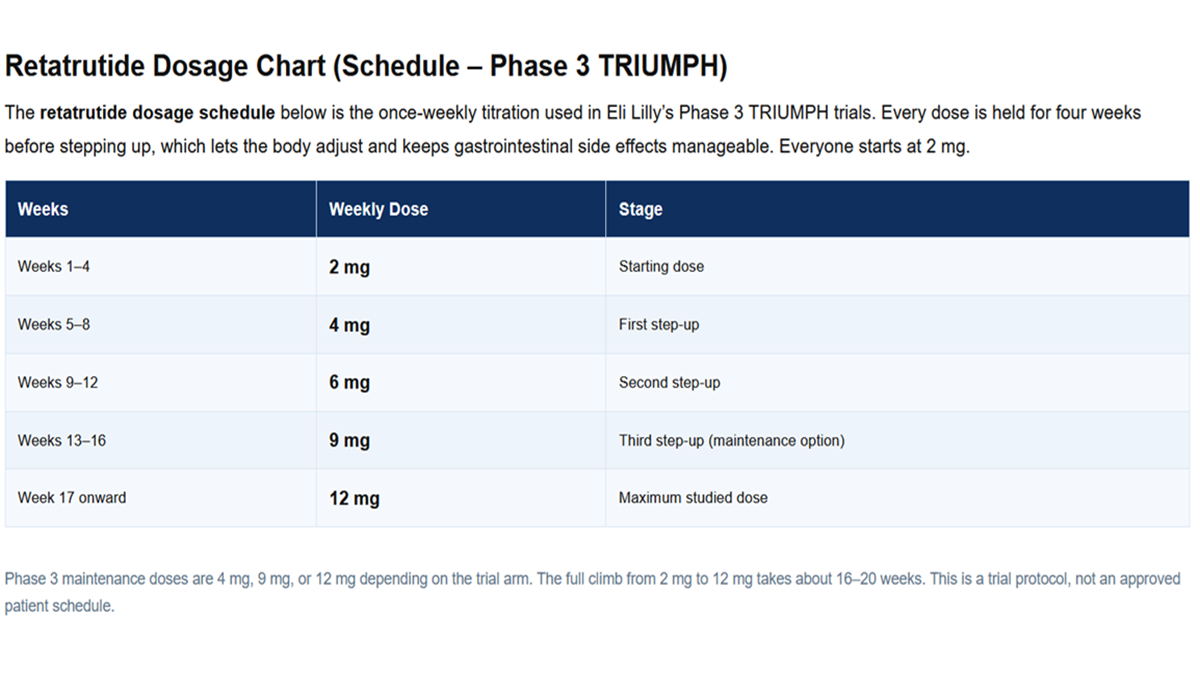
Retatrutide Dosage Chart (Schedule – Phase 3 TRIUMPH)
The retatrutide dosage schedule below is the once-weekly titration used in Eli Lilly’s Phase 3 TRIUMPH trials. Every dose is held for four weeks before stepping up, which lets the body adjust and keeps gastrointestinal side effects manageable. Everyone starts at 2 mg.
| Weeks | Weekly Dose | Stage |
|---|---|---|
| Weeks 1–4 | 2 mg | Starting dose |
| Weeks 5–8 | 4 mg | First step-up |
| Weeks 9–12 | 6 mg | Second step-up |
| Weeks 13–16 | 9 mg | Third step-up (maintenance option) |
| Week 17 onward | 12 mg | Maximum studied dose |
Phase 3 maintenance doses are 4 mg, 9 mg, or 12 mg depending on the trial arm. The full climb from 2 mg to 12 mg takes about 16–20 weeks. This is a trial protocol, not an approved patient schedule.
Retatrutide Dosage Chart: mg to Units
This retatrutide dosage chart converts each dose into units on a U-100 insulin syringe, for the most common reconstitution setups. Find your dose down the left, your vial-and-water combination across the top, and read off the units to draw. For any other combination, use the retatrutide dosage calculator.
| Dose | 10 mg vial + 1 mL (10 mg/mL) |
10 mg vial + 2 mL (5 mg/mL) |
15 mg vial + 1 mL (15 mg/mL) |
20 mg vial + 2 mL (10 mg/mL) |
|---|---|---|---|---|
| 2 mg | 20 units | 40 units | 13 units | 20 units |
| 4 mg | 40 units | 80 units | 27 units | 40 units |
| 6 mg | 60 units | over 100* | 40 units | 60 units |
| 9 mg | 90 units | over 100* | 60 units | 90 units |
| 12 mg | over 100* | over 100* | 80 units | over 100* |
*Over 100 units exceeds a 1 mL U-100 syringe — use a more concentrated mix (less water or a larger vial). Units are rounded; the formula is units = (dose ÷ concentration) × 100. Confirm every figure in the calculator before drawing.
What Is the Starting Dose of Retatrutide?
The retatrutide starting dose is 2 mg once weekly in the Phase 3 TRIUMPH trials, held for the first four weeks. This is deliberately low: retatrutide activates three hormone receptors at once (GIP, GLP-1, and glucagon), so a gradual start lets the body adjust and sharply reduces early nausea. Phase 2 data confirmed that starting at 2 mg rather than 4 mg significantly reduced gastrointestinal side effects without compromising long-term weight loss. Some slower protocols begin at 1 mg, but 2 mg is the standard trial starting dose.
Note on inaccurate charts: some pages list a 0.5 mg retatrutide starting dose. No published retatrutide trial uses 0.5 mg — the documented starting dose is 2 mg (with 1 mg in some slower schedules). Always cross-check dosing against primary trial sources, several of which are linked at the bottom of this page.
Retatrutide Weight Loss by Dose
Higher maintenance doses produced greater average weight loss in trials. The figures below are mean results from Eli Lilly’s published Phase 2 and Phase 3 data.
| Dose | Mean Weight Loss | Trial / Duration |
|---|---|---|
| 4 mg | ~ up to 17% (Phase 2 range) | Phase 2, 48 weeks |
| 8 mg | ~22.8% | Phase 2, 48 weeks |
| 9 mg | ~26.4% | Phase 3 TRIUMPH-4, 68 weeks |
| 12 mg | 24.2% (Phase 2) – 28.7% (Phase 3) | 48–68 weeks |
The 12 mg dose reached 24.2% at 48 weeks in Phase 2 and up to 28.7% at 68 weeks in Phase 3 TRIUMPH-4 — the largest weight loss reported for any obesity drug in trials to date. Individual results vary.
Retatrutide Reconstitution Chart
Research-grade retatrutide comes as a lyophilized powder that must be mixed with bacteriostatic water before use. The amount of water you add sets the concentration, which determines your units. This chart shows the resulting concentration for common vial-and-water combinations.
| Vial Size | + 1 mL water | + 2 mL water | + 3 mL water |
|---|---|---|---|
| 5 mg | 5 mg/mL | 2.5 mg/mL | 1.7 mg/mL |
| 10 mg | 10 mg/mL | 5 mg/mL | 3.3 mg/mL |
| 15 mg | 15 mg/mL | 7.5 mg/mL | 5 mg/mL |
| 20 mg | 20 mg/mL | 10 mg/mL | 6.7 mg/mL |
| 30 mg | 30 mg/mL | 15 mg/mL | 10 mg/mL |
Once you know your concentration, the retatrutide dosage calculator converts any dose to exact units. Store reconstituted retatrutide at 2–8°C and use within about four weeks.
Retatrutide Side Effects by Dose
Side effects are dose-related and are the main reason the schedule escalates gradually. The most common are gastrointestinal, and they are most likely during dose increases.
| Dose Level | Commonly Reported Effects |
|---|---|
| 2–4 mg (low) | Mild nausea, reduced appetite, occasional constipation; usually settles within days. |
| 6–9 mg (mid) | More noticeable nausea, diarrhea or constipation, fatigue; most common right after a step-up. |
| 12 mg (high) | Strongest GI effects; a dose-dependent increase in heart rate was also observed in trials, peaking around 24 weeks. |
In the Phase 2 trial, GI side-effect rates nearly doubled when participants jumped straight to 8 mg instead of climbing gradually — which is why slow titration is the standard.
Phase 2 vs Phase 3 Dosing
The retatrutide dosing schedule was refined between trial phases. Knowing the difference explains why you will see two slightly different dose ladders online.
| Phase 2 (NEJM 2023) | Phase 3 TRIUMPH | |
|---|---|---|
| Dose ladder | 2 → 4 → 8 → 12 mg | 2 → 4 → 6 → 9 → 12 mg |
| Maintenance arms | 1, 4, 8, 12 mg | 4, 9, 12 mg |
| Step interval | Every 4 weeks | Every 4 weeks |
| Peak weight loss | 24.2% (48 wks) | 28.7% (68 wks) |
The key change in Phase 3 was adding the intermediate 6 mg and 9 mg steps (replacing the Phase 2 jump to 8 mg), giving a smoother climb and a new 9 mg maintenance option.
What Is Retatrutide?
Retatrutide (development code LY3437943) is an investigational once-weekly injectable developed by Eli Lilly for weight loss and metabolic disease. It belongs to a new class often called “triple agonists” because it activates three hormone receptors at once: GIP, GLP-1, and glucagon. GLP-1 and GIP reduce appetite and improve blood-sugar handling, while the added glucagon activity increases energy expenditure — the combination is thought to explain why retatrutide produced the largest average weight loss of any obesity drug studied to date. Understanding this triple mechanism is important for the dosage schedule, because hitting three pathways at once is exactly why the dose has to be raised gradually rather than started high.
Retatrutide is administered as a subcutaneous injection once every seven days. Because it is still in Phase 3 trials and not approved, there is no official prescribing label yet; the dosage schedule and chart on this page come from the protocols published in peer-reviewed trials and Eli Lilly’s trial records, not from an FDA-approved package insert.
How Retatrutide Dosing Works: Why It Escalates
Unlike medications where you begin at the target dose, retatrutide uses a stepwise titration protocol: you start low and increase in defined steps over several weeks until reaching a maintenance dose. This is not optional fine-tuning — it is the core of how the drug is dosed safely. Because retatrutide acts on gut motility, appetite, and blood-sugar regulation simultaneously, starting at a high dose overwhelms the digestive system and causes severe nausea, vomiting, and dehydration. Escalating slowly lets the gut adapt at each level before the next increase.
The evidence for gradual titration is concrete. In the Phase 2 trial, gastrointestinal side-effect rates nearly doubled when participants jumped straight to 8 mg compared with climbing gradually from 2 mg. Slower titration was the single biggest factor in whether people could tolerate the drug and stay on it. This is also why the Phase 3 schedule added intermediate 6 mg and 9 mg steps: smoothing the climb improves tolerability without sacrificing results. Every dose in the schedule is held for a full four weeks before the next step, and there is no benefit to moving faster.
Retatrutide Dose Steps: What to Expect at Each Level
Here is what the schedule looks like in practice, week by week, based on how the trial protocols structure each stage.
Weeks 1–4 — 2 mg (starting dose). The goal of this stage is tolerance, not weight loss. Appetite changes may be subtle. Mild nausea can appear, usually strongest in the first day or two after each injection and easing as the week goes on. Most people notice reduced cravings and earlier fullness by the end of the month.
Weeks 5–8 — 4 mg (first step-up). The first increase is where gastrointestinal side effects most commonly begin or intensify, since the dose has doubled. Appetite suppression usually becomes clearly noticeable at this stage, and early weight changes often start to appear.
Weeks 9–12 — 6 mg (second step-up). This intermediate step, added in Phase 3, gives a gentler climb than the old Phase 2 jump to 8 mg. Appetite control is typically strong here, and many people see steady weekly weight loss.
Weeks 13–16 — 9 mg (third step-up).9 mg is both a step toward 12 mg and a maintenance dose in its own right in Phase 3 trials. In TRIUMPH-4, the 9 mg arm produced about 26.4% weight loss. Some people stay here rather than climbing further.
Week 17 onward — 12 mg (maximum studied dose). The highest dose studied in the major obesity trials, associated with the greatest weight loss (up to 28.7% at 68 weeks). Not everyone needs to reach 12 mg; the right maintenance dose depends on results and tolerability.
Retatrutide Maintenance Dose
Once you reach a dose that delivers good appetite control and weight loss with manageable side effects, that becomes your maintenance dose — the dose you stay on long-term. In the Phase 3 TRIUMPH program, the maintenance arms are 4 mg, 9 mg, and 12 mg. This means not everyone titrates all the way to 12 mg; some people maintain excellent results at 4 mg or 9 mg and never need the top dose. The principle is to use the lowest dose that achieves your goal, since higher doses carry more side effects. There is no requirement to keep climbing simply because a higher step exists.
Retatrutide Half-Life and Once-Weekly Dosing
Retatrutide has a half-life of approximately six days, which is what makes once-weekly dosing possible. A long half-life means blood levels stay relatively stable between injections rather than spiking and crashing, contributing to steady appetite control across the week. It also means the drug clears slowly if you stop — levels taper over a couple of weeks rather than disappearing immediately. Because of this slow, steady profile, the exact day or time of your weekly injection matters less than consistency: picking one day a week and staying close to it is the standard approach.
What Happens If You Miss a Dose?
Because retatrutide’s roughly six-day half-life keeps levels fairly stable, a single missed weekly dose does not cause an immediate loss of effect. Trial protocols and the general approach for long-acting GLP-1-class injectables is that if a dose is missed, it is typically taken as soon as reasonably possible if the next scheduled dose is still several days away, or skipped if it is nearly time for the next one — without doubling up. Doubling a dose to “catch up” is avoided because it reintroduces the high-dose side effects that gradual titration is designed to prevent. After missing several weeks, a dose reduction and re-titration may be needed, since tolerance to gastrointestinal effects fades during a gap. Any real-world missed-dose decision should be guided by a clinician.
Dose Holds and Slower Titration
The schedule is a framework, not a rigid rule. If side effects are significant at a given dose, the standard response is to hold — stay at the current dose for extra weeks until symptoms settle — rather than push to the next step on time. Some people also need a slower titration overall, for example holding each dose longer or using smaller increases. A more gradual approach is commonly used for those who have had nausea with other GLP-1 medications, who are sensitive to appetite suppressants, or who have a history of digestive issues. Holding or slowing the climb does not reduce the eventual benefit; it simply improves tolerability and the odds of staying on treatment.
How Retatrutide Is Supplied: Vial Sizes and Reconstitution
In the clinical trials, retatrutide is provided as a ready-to-use pre-filled form — participants do not reconstitute anything. Research-grade retatrutide, however, is supplied as a lyophilized (freeze-dried) powder in vials of varying strength, commonly 5, 10, 15, 20, or 30 mg. This powder must be reconstituted with bacteriostatic water before it can be measured or drawn, which is why the reconstitution chart above matters: the vial strength and the amount of water you add together determine your concentration, and the concentration determines how many units each dose becomes. This is the single most common source of dosing errors, because the same milligram dose is a completely different number of units depending on how the vial was mixed.
Choosing a water volume is a balance. More water makes a dilute solution that is easier to measure precisely at low doses but pushes higher doses past a single syringe. Less water concentrates the solution so large doses fit, but makes small early doses harder to read accurately. A practical target keeps your dose in the 10–100 unit range on a U-100 syringe. The retatrutide dosage calculator can suggest a water volume for you.
Retatrutide Dosing vs Tirzepatide and Semaglutide
Retatrutide follows the same general titration logic as the approved GLP-1 drugs — start low, climb every four weeks — but the specifics differ. Semaglutide (Ozempic, Wegovy) titrates from 0.25 mg to a typical maximum of 2.4 mg weekly. Tirzepatide (Mounjaro, Zepbound) climbs from 2.5 mg to a maximum of 15 mg. Retatrutide’s studied range runs from 2 mg to 12 mg. The milligram numbers are not directly comparable across drugs because each molecule has different potency at its receptors — a milligram of one is not equivalent to a milligram of another. What they share is the four-week step interval and the principle that the starting dose exists for tolerance, not results.
| Retatrutide | Tirzepatide | Semaglutide | |
|---|---|---|---|
| Starting dose | 2 mg/week | 2.5 mg/week | 0.25 mg/week |
| Max studied/approved | 12 mg/week | 15 mg/week | 2.4 mg/week |
| Step interval | 4 weeks | 4 weeks | 4 weeks |
| Receptors | GIP + GLP-1 + glucagon | GIP + GLP-1 | GLP-1 |
| FDA status | Investigational | Approved | Approved |
Who Should Not Use Retatrutide
Because retatrutide is investigational, the full picture of who should avoid it is still emerging, but the trial exclusion criteria and the known effects of the GLP-1 drug class point to several groups for whom it is considered inappropriate. These generally include people who are pregnant or breastfeeding, anyone with a personal or family history of medullary thyroid carcinoma or the MEN 2 syndrome (a class warning for GLP-1 receptor agonists), people with a history of pancreatitis, those with severe gastrointestinal disease such as gastroparesis, and anyone with a known hypersensitivity to the drug. Because retatrutide can affect blood sugar, people with diabetes on insulin or sulfonylureas need careful monitoring to avoid hypoglycemia. This is not a complete list, and only a qualified clinician can determine whether it is appropriate for a given individual.
Need units for a vial or water volume not shown here? The retatrutide dosage calculator gives the exact draw for any dose, vial size, and bacteriostatic water amount, with a true-to-scale syringe visual.
Retatrutide Dosage FAQ
What is the retatrutide dosage schedule?
In Phase 3 TRIUMPH trials, retatrutide is escalated every four weeks: 2 mg (weeks 1–4), 4 mg (weeks 5–8), 6 mg (weeks 9–12), 9 mg (weeks 13–16), and 12 mg from week 17. Everyone starts at 2 mg, and the full climb takes about 16–20 weeks. Maintenance doses are 4, 9, or 12 mg depending on the trial arm.
What is the maximum dose of retatrutide?
The maximum dose studied in major obesity trials is 12 mg once weekly, which produced the greatest weight loss (up to 28.7% at 68 weeks). Doses above 12 mg have not been established in the main trials.
How many units is a 2 mg dose of retatrutide?
It depends on your concentration. From a 10 mg vial mixed with 1 mL of bacteriostatic water (10 mg/mL), a 2 mg dose is 20 units. From the same vial with 2 mL (5 mg/mL), it is 40 units. Always match the chart to your exact reconstitution or use the calculator.
How long do you stay on each retatrutide dose?
Each dose is held for four weeks before stepping up, in both Phase 2 and Phase 3 protocols. Some people stay on a lower dose longer if side effects are still settling or if appetite control is already good. There is no benefit to rushing increases.
Is retatrutide FDA-approved?
No. Retatrutide is investigational and in Phase 3 trials. It is not FDA-approved and, according to published drug references, is available only through Eli Lilly’s clinical trials — it cannot be legally purchased, prescribed, or compounded. Any dosing figures here are trial protocols, not approved prescribing guidance.
Why do some charts show different retatrutide doses?
Because the schedule changed between trial phases. Phase 2 used a 2 → 4 → 8 → 12 mg ladder, while Phase 3 refined it to 2 → 4 → 6 → 9 → 12 mg. Charts showing a 0.5 mg start are simply incorrect — no published trial uses that dose.
How often is retatrutide injected?
Retatrutide is injected once weekly as a subcutaneous injection. Its roughly six-day half-life supports the seven-day interval, keeping blood levels relatively steady between doses. Most people pick a consistent day each week and stay close to it.
How long does it take to reach the full retatrutide dose?
Reaching the maximum 12 mg dose takes about 16 to 20 weeks, since each of the intermediate doses (2, 4, 6, and 9 mg) is held for four weeks before the next increase. Some people take longer if they hold a dose for extra weeks to let side effects settle, and some stop at a lower maintenance dose and never reach 12 mg.
What is the retatrutide maintenance dose?
In Phase 3 TRIUMPH trials, the maintenance doses are 4 mg, 9 mg, and 12 mg. The right maintenance dose is the lowest one that gives good appetite control and weight loss with tolerable side effects — not everyone needs to climb to 12 mg. Many people maintain strong results at 9 mg.
What happens if I miss a retatrutide dose?
Because of its long half-life, one missed weekly dose does not cause an immediate loss of effect. The general approach for long-acting GLP-1-class injectables is to take the missed dose if the next one is still several days away, or skip it if it is nearly time for the next dose — without doubling up. After missing several weeks, tolerance fades and a dose reduction with re-titration may be needed. Follow a clinician’s guidance.
Can I stay longer on a lower dose instead of increasing?
Yes. The schedule is a framework, not a rigid rule. If side effects are still settling or your appetite control is already good, holding a dose for extra weeks is common and does not reduce the eventual benefit. There is no advantage to rushing dose increases.
What is the half-life of retatrutide?
Retatrutide has a half-life of about six days. This long half-life is what allows once-weekly dosing and keeps blood levels relatively stable between injections, contributing to steady appetite control across the week.
How much bacteriostatic water do I add to retatrutide?
There is no single correct amount — the water volume sets the concentration, and the best choice keeps your dose in an easy-to-read 10–100 unit range on a U-100 syringe. For a 10 mg vial, 1 mL of water (giving 10 mg/mL) works well across most of the schedule. See the reconstitution chart above or use the calculator, which can suggest a volume.
How does retatrutide dosing compare to tirzepatide?
Both start low and increase every four weeks, but the ranges differ: tirzepatide climbs from 2.5 mg to a maximum of 15 mg, while retatrutide’s studied range is 2 mg to 12 mg. The milligram numbers are not directly comparable because the two molecules have different potency at their receptors. Tirzepatide is FDA-approved; retatrutide is still investigational.
How much weight can you lose on retatrutide?
In trials, the 12 mg dose produced mean weight loss of 24.2% at 48 weeks (Phase 2) and up to 28.7% at 68 weeks (Phase 3 TRIUMPH-4) — the largest of any obesity drug studied to date. The 9 mg dose produced about 26.4%. These are averages with lifestyle support; individual results vary, and retatrutide is not yet approved.
When does retatrutide start working?
Some people notice reduced appetite and cravings within the first one to two weeks on the 2 mg starting dose, though the starting phase is designed for tolerance rather than results. More consistent weight changes usually appear after the first dose increase to 4 mg and beyond.
What are the most common retatrutide side effects?
The most common are gastrointestinal: nausea, diarrhea, vomiting, and constipation. They are dose-related, usually mild to moderate, and most likely right after a dose increase. A dose-dependent increase in heart rate was also observed in trials, peaking around 24 weeks. Gradual titration is the main way side effects are minimized.
Where do you inject retatrutide?
Retatrutide is a subcutaneous injection, typically into the fat layer of the abdomen, thigh, or upper arm. Rotating the injection site each week helps avoid irritation. In clinical trials it is given as a once-weekly subcutaneous shot.
Do you need to reconstitute retatrutide?
The retatrutide used in Eli Lilly’s clinical trials comes ready to use and does not require reconstitution. Research-grade retatrutide, by contrast, is supplied as a lyophilized powder that must be mixed with bacteriostatic water before use. Because retatrutide is investigational, published references note it cannot be legally purchased, prescribed, or compounded outside of clinical trials.
How should retatrutide be stored?
Retatrutide is kept refrigerated at 2–8°C (36–46°F). Once reconstituted, the solution is stored refrigerated and typically used within about four weeks. It should not be frozen, and it should be kept out of direct light. Discard the solution if it becomes cloudy or discolored.
Who should not take retatrutide?
Based on trial exclusions and GLP-1 class warnings, retatrutide is considered inappropriate for people who are pregnant or breastfeeding, those with a personal or family history of medullary thyroid carcinoma or MEN 2, and those with a history of pancreatitis or severe gastrointestinal disease. People with diabetes on insulin or sulfonylureas need close monitoring for low blood sugar. Only a clinician can assess individual suitability.
Sources & Clinical References
Every dose and figure on this page traces to a primary source below. We link only to peer-reviewed research, the manufacturer, and official trial records — never to vendors.
Peer-Reviewed Studies
- Jastreboff AM, et al. Triple–Hormone-Receptor Agonist Retatrutide for Obesity — A Phase 2 Trial. N Engl J Med. 2023 (PubMed). — the Phase 2 trial establishing the 2→4→8→12 mg ladder and 24.2% weight loss at 48 weeks.
- Full text: NEJM (DOI: 10.1056/NEJMoa2301972). — complete Phase 2 dose-escalation protocol and safety data.
- Sanyal AJ, et al. Retatrutide for MASLD: a Phase 2a trial. Nat Med. 2024 (PMC). — liver-fat substudy confirming the ~6-day half-life and once-weekly dosing.
Manufacturer & Trial Records
- Eli Lilly: What to Know About Retatrutide. — the developer’s overview confirming investigational status.
- ClinicalTrials.gov: Phase 2 Retatrutide Obesity Trial (NCT04881760). — official record of the dose-escalation arms.
- ClinicalTrials.gov: TRIUMPH Phase 3 program. — the current Phase 3 trials and their 2→4→6→9→12 mg schedule.
- Drugs.com: Retatrutide. — consumer drug reference on status, dosing, and side effects.
General Reference
- Wikipedia: Retatrutide (LY3437943). — molecule background and the triple-agonist mechanism.
- Wikipedia: Bacteriostatic Water. — the diluent used for reconstitution.
- Wikipedia: Insulin Syringe (U-100 scale). — the 100 units = 1 mL standard these charts use.
Disclaimer: This retatrutide dosage chart is educational only and is not medical advice. Retatrutide is investigational, not FDA-approved, and available only through authorized clinical trials; it cannot be legally purchased, prescribed, or compounded. All dosing reflects published trial protocols, not approved prescribing guidance. Always consult a licensed healthcare professional.