This tirzepatide dosage chart shows the full FDA titration schedule for Mounjaro and Zepbound, plus a tirzepatide dosage chart in units for compounded vials. Find your weekly dose, then read off the milligrams, the schedule week, or the exact syringe units to draw.
Tirzepatide Dosage Chart: Full Titration Schedule
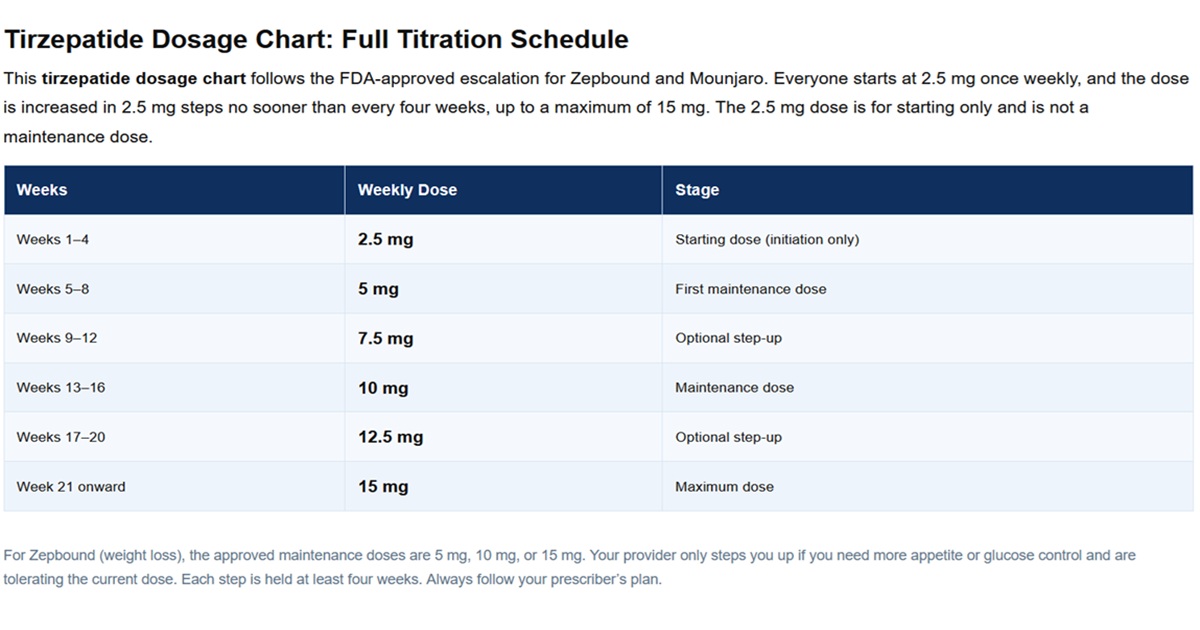
This tirzepatide dosage chart follows the FDA-approved escalation for Zepbound and Mounjaro. Everyone starts at 2.5 mg once weekly, and the dose is increased in 2.5 mg steps no sooner than every four weeks, up to a maximum of 15 mg. The 2.5 mg dose is for starting only and is not a maintenance dose.
| Weeks | Weekly Dose | Stage |
|---|---|---|
| Weeks 1–4 | 2.5 mg | Starting dose (initiation only) |
| Weeks 5–8 | 5 mg | First maintenance dose |
| Weeks 9–12 | 7.5 mg | Optional step-up |
| Weeks 13–16 | 10 mg | Maintenance dose |
| Weeks 17–20 | 12.5 mg | Optional step-up |
| Week 21 onward | 15 mg | Maximum dose |
For Zepbound (weight loss), the approved maintenance doses are 5 mg, 10 mg, or 15 mg. Your provider only steps you up if you need more appetite or glucose control and are tolerating the current dose. Each step is held at least four weeks. Always follow your prescriber’s plan.
Tirzepatide Dosage Chart in Units (Compounded Vials)
If you use a compounded vial rather than a brand pen, you draw your dose in units on a U-100 insulin syringe. This tirzepatide dosage chart in units shows the units for each dose at the common compounded concentrations. Tirzepatide dosing for weight loss in units depends entirely on your vial’s concentration, so match the column to your label.
| Dose | 5 mg/mL | 10 mg/mL | 20 mg/mL | 34 mg/mL |
|---|---|---|---|---|
| 2.5 mg | 50 units | 25 units | 12.5 units | 7 units |
| 5 mg | 100 units | 50 units | 25 units | 15 units |
| 7.5 mg | over 100* | 75 units | 37.5 units | 22 units |
| 10 mg | over 100* | 100 units | 50 units | 29 units |
| 12.5 mg | over 100* | over 100* | 62.5 units | 37 units |
| 15 mg | over 100* | over 100* | 75 units | 44 units |
*Over 100 units exceeds a 1 mL U-100 syringe — use a more concentrated vial. Units are rounded; the formula is units = (dose ÷ concentration) × 100. For any concentration not shown, use the tirzepatide dosage calculator to get exact units.
Brand pens do not use units. Zepbound and Mounjaro single-dose pens deliver a fixed milligram dose automatically — there is nothing to measure. The units chart applies only to compounded tirzepatide drawn from a vial with a syringe.
Tirzepatide Dosage Conversion Chart (mg to Units to mL)
This tirzepatide dosage conversion chart puts the three ways of expressing a dose side by side: milligrams, units on a U-100 syringe, and millilitres. It uses a 10 mg/mL concentration as the reference, one of the most common for compounded tirzepatide. Reading across each row shows how the same dose looks in each unit of measure.
| Dose (mg) | Units (U-100) | Volume (mL) |
|---|---|---|
| 2.5 mg | 25 units | 0.25 mL |
| 5 mg | 50 units | 0.5 mL |
| 7.5 mg | 75 units | 0.75 mL |
| 10 mg | 100 units | 1.0 mL |
| 12.5 mg | over 100* | 1.25 mL |
| 15 mg | over 100* | 1.5 mL |
*At 10 mg/mL, doses above 10 mg exceed a single 1 mL syringe. The relationship is fixed: on a U-100 syringe, 100 units always equals 1 mL, so units and mL track together regardless of concentration — but the milligram value in each unit depends on concentration.
Tirzepatide Dosing for Weight Loss in mL
Some people prefer to measure in millilitres rather than units. Tirzepatide dosing for weight loss in mL is straightforward once you know your concentration: volume (mL) = dose (mg) ÷ concentration (mg/mL). At a 10 mg/mL concentration, a 5 mg dose is 0.5 mL; at 20 mg/mL, that same 5 mg dose is just 0.25 mL. The table below shows the mL volume for each dose at common concentrations.
| Dose | at 5 mg/mL | at 10 mg/mL | at 20 mg/mL |
|---|---|---|---|
| 2.5 mg | 0.50 mL | 0.25 mL | 0.125 mL |
| 5 mg | 1.00 mL | 0.50 mL | 0.25 mL |
| 10 mg | 2.00 mL | 1.00 mL | 0.50 mL |
| 15 mg | 3.00 mL | 1.50 mL | 0.75 mL |
A standard 1 mL insulin syringe holds up to 1 mL (100 units). Doses that come to more than 1 mL at a given concentration need either a more concentrated vial or a larger syringe. The tirzepatide calculator handles any combination.
Compounded Tirzepatide Dosage Chart
Compounded tirzepatide is made by a compounding pharmacy rather than by Eli Lilly, and it is supplied in a vial with a concentration printed on the label — commonly 5, 10, 20, or 34 mg/mL. Unlike the fixed-dose brand pens, a compounded vial requires you to draw the correct number of units yourself, which is why a compounded tirzepatide dosage chart matters so much. The dose ladder itself is the same as the brand schedule (2.5 mg up to 15 mg); only the measuring is different.
The single most important thing to understand about compounded tirzepatide is that the same milligram dose is a different number of units at every concentration. A 5 mg dose is 100 units at 5 mg/mL, 50 units at 10 mg/mL, and only 25 units at 20 mg/mL. This is the leading cause of dosing errors with compounded vials: someone copies a unit count from a person using a different concentration and draws the wrong amount. Always read your own vial’s concentration and match it to the correct column of the units chart above, or confirm with the calculator.
Compounded tirzepatide became widespread during the brand shortage, but its regulatory status has shifted as shortages resolved. It is not FDA-approved, quality varies between pharmacies, and you should confirm any compounded product and dose with a licensed provider before using it.
Tirzepatide Weight Loss by Dose
Higher maintenance doses produced greater average weight loss in the SURMOUNT-1 trial. The figures below are mean total body weight reductions at 72 weeks, from Eli Lilly’s published data.
| Maintenance Dose | Mean Weight Loss (72 weeks) |
|---|---|
| 5 mg | ~15% |
| 10 mg | ~19.5% |
| 15 mg | ~20.9% (up to ~22.5% in some analyses) |
Results are averages from a supervised trial with diet and exercise; individual results vary. Higher doses generally produce more weight loss but also more side effects, which is the trade-off your provider weighs when setting a maintenance dose.
Retatrutide vs Tirzepatide Dosage Chart
A common question is how tirzepatide compares with the newer investigational triple agonist. This retatrutide vs tirzepatide dosage chart lays the two schedules side by side. Both start low and step up every four weeks, but they reach different maximums and hit different numbers of receptors. Note that the milligram values are not interchangeable — each molecule has different potency.
| Tirzepatide | Retatrutide | |
|---|---|---|
| Starting dose | 2.5 mg/week | 2 mg/week |
| Dose ladder | 2.5→5→7.5→10→12.5→15 mg | 2→4→6→9→12 mg |
| Maximum dose | 15 mg/week | 12 mg/week |
| Receptors | GIP + GLP-1 (dual) | GIP + GLP-1 + glucagon (triple) |
| Mean weight loss | ~20.9% (72 wks) | ~24–28.7% (trials) |
| FDA status | Approved | Investigational |
For the full retatrutide schedule, see the retatrutide dosage chart, or convert doses with the retatrutide dosage calculator.
Tirzepatide Side Effects
Tirzepatide’s side effects are mostly gastrointestinal and are strongly dose-related, which is the entire reason for the gradual titration schedule. They are most common when starting and just after each dose increase, and tend to ease as the body adapts.
Most common side effects: nausea, diarrhea, vomiting, constipation, indigestion, reduced appetite, and abdominal pain. These are usually mild to moderate and improve over time. Eating smaller, lower-fat meals and stopping when full helps many people manage them.
Less common but more serious: pancreatitis (severe, persistent abdominal pain), gallbladder problems, low blood sugar (especially when combined with insulin or sulfonylureas), kidney issues from dehydration due to vomiting or diarrhea, and allergic reactions. Tirzepatide also carries a boxed warning for the risk of thyroid C-cell tumors based on rodent studies; it is not recommended for people with a personal or family history of medullary thyroid carcinoma or MEN 2.
Because side effects scale with dose, staying at the lowest dose that controls your appetite and weight — rather than automatically climbing to 15 mg — is often the most comfortable approach. Report severe or persistent symptoms to your provider promptly.
What Is Tirzepatide?
Tirzepatide is a once-weekly injectable medication approved by the FDA for type 2 diabetes (under the brand name Mounjaro) and for chronic weight management (as Zepbound). It is a dual agonist, meaning it activates two gut-hormone receptors at once: GIP and GLP-1. These hormones regulate appetite, blood sugar, and how full you feel after eating. By stimulating both, tirzepatide reduces appetite, slows stomach emptying, and improves the body’s insulin response — the combination that drives both blood-sugar control and substantial weight loss. It is the same molecule whether it is sold as Mounjaro or Zepbound; only the brand and approved indication differ.
To learn more about tirzepatide beyond dosing, see our overview of tirzepatide compound uses and side effects, or explore the full peptide library.
How Tirzepatide Works for Weight Loss
Tirzepatide produces weight loss through several overlapping mechanisms. By activating GLP-1 and GIP receptors, it slows the rate at which the stomach empties, so you feel full longer after meals. It acts on appetite centers in the brain to reduce hunger and cravings, meaning you naturally eat less without the constant battle of willpower. And it improves insulin sensitivity and blood-sugar regulation, which helps the body manage energy more efficiently. The net effect is a significant, sustained reduction in calorie intake that leads to weight loss over months. The dual GIP/GLP-1 action is thought to be why tirzepatide produced greater average weight loss in trials than single-receptor GLP-1 drugs like semaglutide.
What If You Miss a Tirzepatide Dose?
Per the FDA labeling, if you miss a tirzepatide dose, take it as soon as possible if there are at least four days (96 hours) until your next scheduled dose. If fewer than four days remain, skip the missed dose and resume your regular weekly schedule. Never take two doses within three days of each other, and never double up to make up for a missed dose — doing so raises the risk of significant gastrointestinal side effects. You can also change your regular dosing day if needed, as long as there are at least three days (72 hours) between two doses.
Storing Tirzepatide
Brand tirzepatide pens and vials are stored refrigerated at 2–8°C (36–46°F). If needed, an unopened single-dose pen or vial can be kept at room temperature (not above 30°C / 86°F) for up to 21 days, after which it must be used or discarded. Do not freeze tirzepatide, and do not use it if it has been frozen. Compounded tirzepatide storage depends on the pharmacy’s formulation, so follow the specific instructions provided with your vial and keep it refrigerated unless told otherwise.
Need units for a concentration not shown in the charts above? The tirzepatide dosage calculator gives the exact draw for any dose, vial concentration, and syringe size, with a true-to-scale syringe visual.
Tirzepatide Dosage FAQ
Is tirzepatide the same as Ozempic?
No. Tirzepatide (Mounjaro, Zepbound) and Ozempic (semaglutide) are different drugs. Tirzepatide is a dual agonist that activates both GIP and GLP-1 receptors, while Ozempic is a single GLP-1 receptor agonist. In head-to-head research, tirzepatide produced greater average weight loss, though both are effective. They are made by different mechanisms and dosed on different schedules.
What does the drug tirzepatide do?
Tirzepatide lowers blood sugar and reduces body weight by mimicking two natural gut hormones, GIP and GLP-1. It slows stomach emptying, reduces appetite and cravings, and improves the body’s insulin response. This is why it is approved both for type 2 diabetes (as Mounjaro) and for chronic weight management (as Zepbound).
How does tirzepatide work on weight loss?
Tirzepatide works on weight loss by slowing how quickly your stomach empties (so you stay full longer), acting on appetite centers in the brain to reduce hunger, and improving insulin sensitivity. Together these effects substantially lower how much you eat, producing steady weight loss over months. Its dual GIP/GLP-1 action is thought to be why it outperforms single-receptor GLP-1 drugs in trials.
Will tirzepatide get rid of belly fat?
Tirzepatide produces overall body-fat loss, and studies show it reduces visceral fat (the deep abdominal fat around the organs) as part of total weight loss. It does not target belly fat specifically — no medication can spot-reduce — but because abdominal and visceral fat respond well to overall weight loss, most people see a meaningful reduction in waist size at effective doses.
What are the drawbacks of tirzepatide?
The main drawbacks are gastrointestinal side effects (nausea, diarrhea, vomiting, constipation), the need for weekly injections, high cost without insurance coverage, and the tendency to regain weight if the medication is stopped. It also carries a boxed warning for thyroid C-cell tumor risk and is not suitable for everyone. Muscle loss alongside fat loss is another consideration, making protein intake and resistance exercise important.
Who cannot take tirzepatide?
Tirzepatide should not be used by people with a personal or family history of medullary thyroid carcinoma or Multiple Endocrine Neoplasia syndrome type 2 (MEN 2), or anyone with a known hypersensitivity to it. It is used with caution or avoided in people with a history of pancreatitis, severe gastrointestinal disease such as gastroparesis, and during pregnancy or breastfeeding. Those on insulin or sulfonylureas need monitoring for low blood sugar. A clinician determines individual suitability.
What should I avoid while taking tirzepatide?
Avoid large, high-fat, or greasy meals, which worsen nausea, and eat slowly and stop when full. Limit alcohol, which can irritate the stomach and affect blood sugar. Be cautious combining tirzepatide with insulin or sulfonylureas without medical supervision because of hypoglycemia risk. Because it slows digestion, tell your provider about all medications, since absorption of some can change. Stay hydrated to protect your kidneys if you have vomiting or diarrhea.
How long can you take tirzepatide?
Tirzepatide is intended as a long-term treatment for chronic conditions (obesity and type 2 diabetes), so many people take it indefinitely under medical supervision. There is no fixed stopping point built into the drug. However, weight regain is common after stopping, because the appetite-suppressing effect ends — which is why it is generally viewed as an ongoing therapy rather than a short course.
Which one is better, tirzepatide or Ozempic?
For weight loss, clinical evidence favors tirzepatide: in trials it produced greater average weight loss than semaglutide (Ozempic/Wegovy). However, “better” depends on the individual — tolerability, cost, insurance coverage, and personal response all matter, and some people do very well on semaglutide. Both are effective; the right choice is made with a prescriber based on your goals and health profile.
Which is safer, Ozempic or Mounjaro?
Both Ozempic (semaglutide) and Mounjaro (tirzepatide) have broadly similar safety profiles, dominated by gastrointestinal side effects, and both carry the same class boxed warning for thyroid C-cell tumors. Neither is clearly “safer” overall; tirzepatide may cause slightly more GI effects at higher doses because it is more potent for weight loss. Safety for a given person depends on their health history, so the comparison is best made with a doctor.
Is tirzepatide cheaper than Ozempic?
List prices for tirzepatide (Mounjaro, Zepbound) and Ozempic are broadly comparable, and the actual out-of-pocket cost depends heavily on insurance coverage, manufacturer savings programs, and pharmacy. Neither is reliably cheaper across the board. Compounded versions were often less expensive during shortages, but their availability and legality have narrowed as brand supply recovered. Check current prices and coverage for your specific situation.
What is the safest weight loss drug you can take?
There is no single “safest” weight-loss drug for everyone — the safest option is the one that fits your health profile, prescribed and monitored by a doctor. Among modern options, the GLP-1 and GIP/GLP-1 medications (semaglutide and tirzepatide) have extensive trial data and are considered effective and generally well tolerated, but they still carry risks and are not right for everyone. Safety is individual, and self-prescribing any weight-loss drug is where most of the real danger lies.
What is the starting dose of tirzepatide?
The starting dose of tirzepatide is 2.5 mg injected once weekly for the first four weeks. This dose is for treatment initiation only, to let your body adjust, and is not considered a maintenance (therapeutic) dose. After four weeks, the dose is typically increased to 5 mg.
How many units is 5 mg of tirzepatide?
It depends on your vial’s concentration. A 5 mg dose is 100 units at 5 mg/mL, 50 units at 10 mg/mL, and 25 units at 20 mg/mL on a U-100 insulin syringe. Always read your vial’s concentration and use the matching column of the units chart above, or the calculator, to avoid a dosing error.
How long does it take to titrate to the full tirzepatide dose?
Reaching the maximum 15 mg dose takes about 20 weeks, since each dose (2.5, 5, 7.5, 10, and 12.5 mg) is held for at least four weeks before the next increase. Many people stop at a lower maintenance dose (5 or 10 mg for weight loss) if it controls their appetite well, and never reach 15 mg.
Can you stay on 2.5 mg of tirzepatide?
The 2.5 mg dose is intended only for the first four weeks to start treatment; it is not an approved maintenance dose and generally produces limited results long-term. That said, some people who are very sensitive to side effects stay on a low dose longer under medical guidance. The lowest approved maintenance dose for weight loss is 5 mg.
Do you inject tirzepatide in the same spot every week?
No — rotate your injection site each week. Tirzepatide is injected subcutaneously into the abdomen, thigh, or upper arm, and rotating sites (and spots within a site) helps prevent irritation, lumps, and skin changes. You can inject at any time of day, with or without food, on your chosen weekly day.
What is the maximum dose of tirzepatide?
The maximum approved dose of tirzepatide is 15 mg once weekly, for both Mounjaro and Zepbound. There is no approved dose above 15 mg. Most people reach an effective maintenance dose at 5, 10, or 15 mg depending on their response and tolerability.
Why does my compounded tirzepatide dose look different in units?
Because compounded vials come in different concentrations. The same milligram dose becomes a different number of units at each concentration — 5 mg is 100 units at 5 mg/mL but only 25 units at 20 mg/mL. This is why you should never copy someone else’s unit count; always match your own vial’s concentration to the correct column of the units chart, or use the calculator.
Tirzepatide Dosing for Weight Loss: Key Points
Pulling the schedule together for weight management specifically: tirzepatide dosing for weight loss in units and milligrams follows the same climb regardless of brand. You begin at 2.5 mg for four weeks to build tolerance, move to 5 mg (the first real therapeutic dose for weight loss), and then increase only as needed and as tolerated toward the 10 mg or 15 mg maintenance doses. Zepbound’s approved maintenance doses for weight loss are 5, 10, and 15 mg. Higher doses generally deliver more weight loss but also more side effects, so the goal is the lowest dose that gives you good results.
If you are using compounded tirzepatide, the extra step is converting each milligram dose to the correct number of units for your vial’s concentration — the whole purpose of the compounded tirzepatide dosage chart and units chart above. When in doubt, the tirzepatide dosage calculator removes the guesswork, and you can compare options in the full calculator library.
Sources & Clinical References
Every dose and figure on this page is drawn from the FDA prescribing information and peer-reviewed research below. We link only to primary sources, the manufacturer, and regulators — never to competing vendors.
FDA Prescribing Information
- FDA Zepbound (tirzepatide) Prescribing Information. — the official label with the full dose-escalation schedule, 2.5–15 mg strengths, and boxed warning.
- FDA Mounjaro (tirzepatide) Prescribing Information. — the diabetes label, confirming identical dosing and titration.
Peer-Reviewed Studies
- Jastreboff AM, et al. Tirzepatide Once Weekly for the Treatment of Obesity (SURMOUNT-1). N Engl J Med. 2022. — the pivotal weight-loss trial reporting up to ~22.5% weight reduction at 15 mg.
- SURMOUNT-1 on PubMed. — abstract and citation record for the obesity trial.
- SURPASS program (tirzepatide for type 2 diabetes), PubMed. — the diabetes trials underpinning the dosing schedule.
Manufacturer & Reference
- Zepbound (Eli Lilly) official site. — manufacturer information for the weight-loss indication.
- Mounjaro (Eli Lilly) official site. — manufacturer information for the diabetes indication.
- Drugs.com: Tirzepatide. — consumer drug reference on dosing, interactions, and side effects.
- Wikipedia: Tirzepatide. — background on the molecule, mechanism, and approval history.
More on Tirzepatide at Bio Peptide Calculator
- Tirzepatide dosage calculator — convert any dose to exact units.
- Tirzepatide compound uses and side effects — the full compound guide.
- Retatrutide dosage chart — the triple-agonist comparison.
- Peptide library — every compound and tool in one place.
Disclaimer: This tirzepatide dosage chart is educational only and is not medical advice. Tirzepatide is a prescription medication; compounded tirzepatide is not FDA-approved. Dosing must be set and supervised by a licensed healthcare provider based on your individual health. Always confirm your dose and concentration before injecting, and never adjust your dose without medical guidance.